Is the auto industry too depressing? Feedback from the front lines is a bit heart-wrenching
 10/08 2026
 357
357
Introduction
Introduction
The results and lessons can only be left for future generations to write.
Before the Mid-Autumn and National Day holidays, the domestic auto market witnessed a lively surge of new car launches.
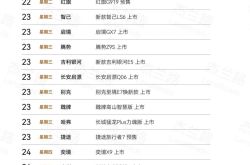
On September 23 alone, nearly ten new car launch events were clustered together, with a total of twenty launch events taking place throughout the week. Sedans, SUVs, MPVs, boxy designs, pure electric, plug-in hybrid, and hybrid models—a diverse array of new products made their debuts in rapid succession. Statistics show that as many as 50 new models were launched in September alone.
On the surface, new products emerged endlessly, export figures continued to climb, and the new energy vehicle penetration rate surged to a peak of 70% in the first half of September, painting a picture of a thriving industry.
Yet, behind this bustling facade lies the very real exhaustion and oppression felt by those within the industry.
Behind the scenes at multiple launch events, countless brands, models, and PR professionals burned the midnight oil, their eyes marked by dark circles and fatigue. Further up the chain, the sales side rushed to push new models onto the market, forcing R&D side (R&D) to continuously compress timelines, with the '007' work schedule (9 a.m. to 9 p.m., 7 days a week) becoming the norm.
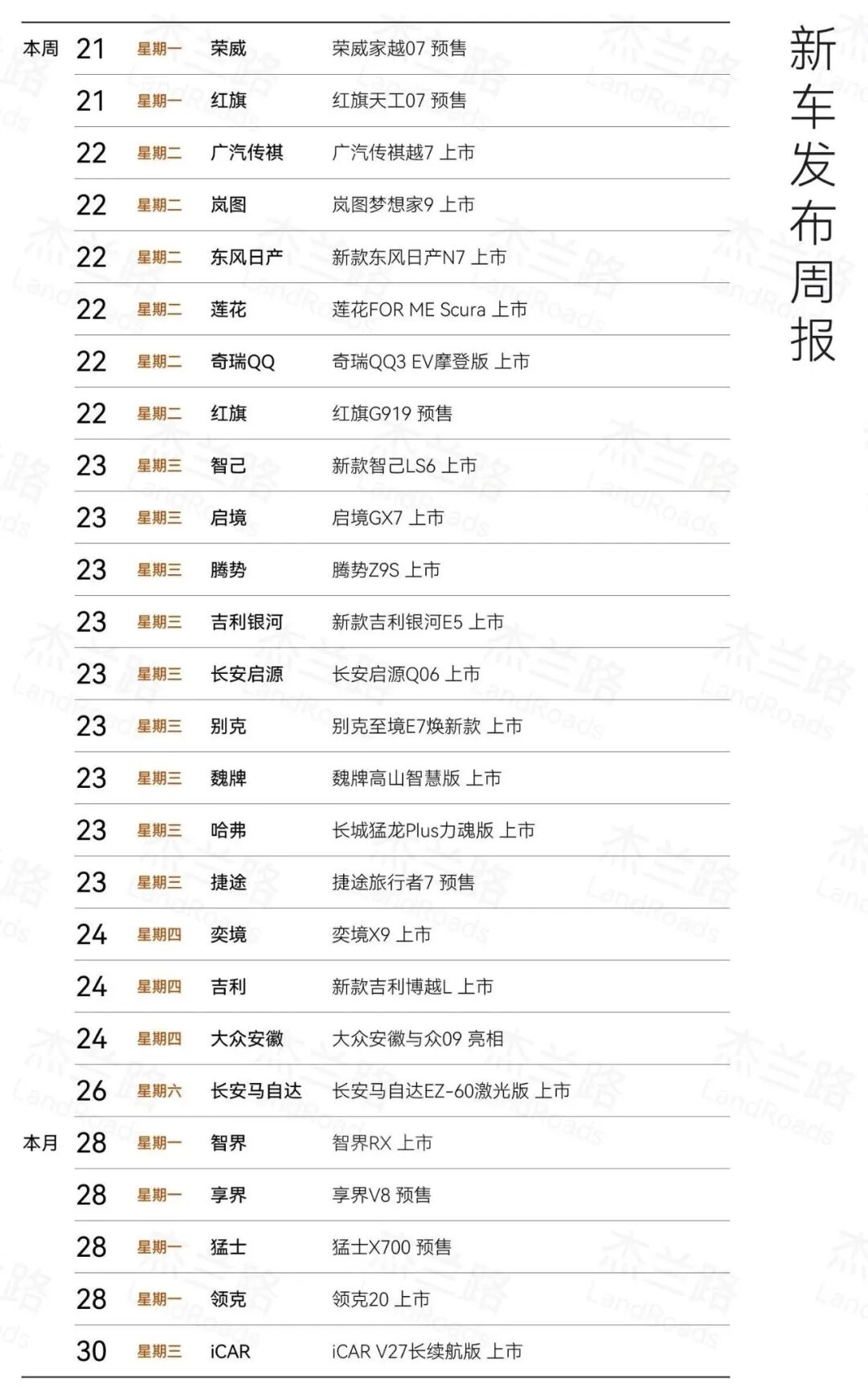
This pressure and suffocation are also spreading toward the supply chain, with survival space continuously shrinking.
Do you think this is merely a temporary state? Far from it. Two recent major industry signals have laid this contradiction bare for all to see.
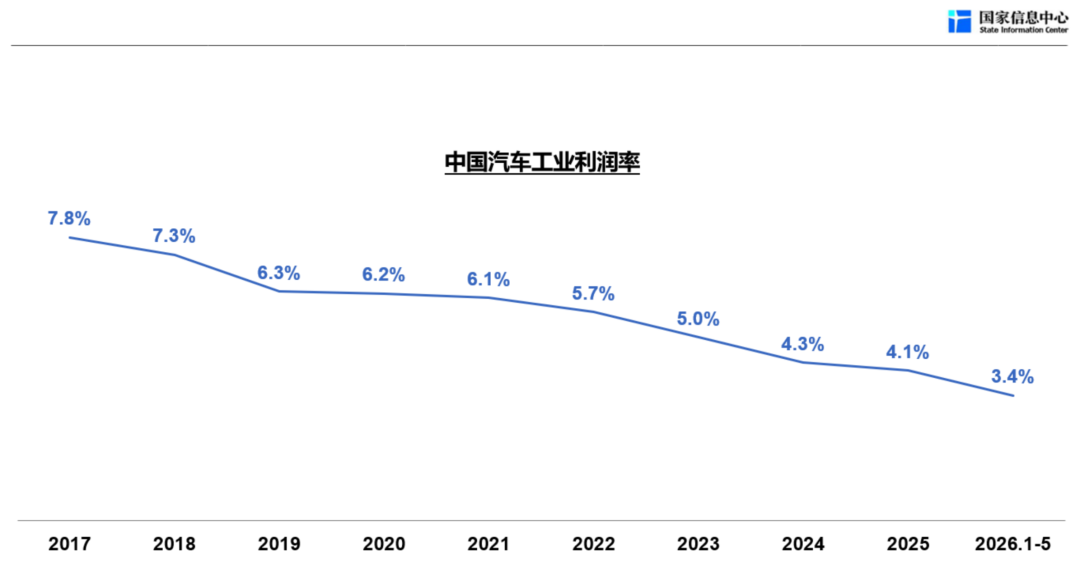
The '15th Five-Year Plan for the Development of the Intelligent Connected New Energy Vehicle Industry' explicitly states that by 2030, the overall labor productivity of the automotive industry should increase by 15% compared to 2025. The policy's intention is to rely on technological upgrades, automation, process optimization, and the development of high-value-added products to achieve high-quality industrial development.
However, when spoken by industry practitioners, this goal raises a layer of practical concern: Will this 15% efficiency gain ultimately translate into more overtime, higher KPIs, and workforce reductions, leaving those who remain to shoulder an even greater workload?
If efficiency improvements rely not on technological and process optimization but simply on squeezing human resources, the level of internal competition within the industry could rise by an additional 15 percentage points in five years.
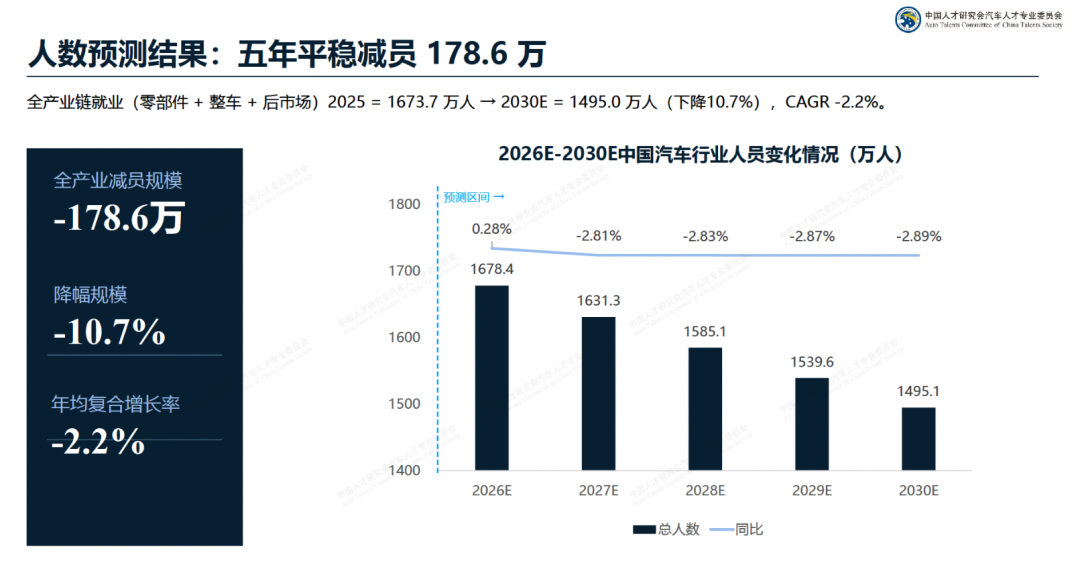
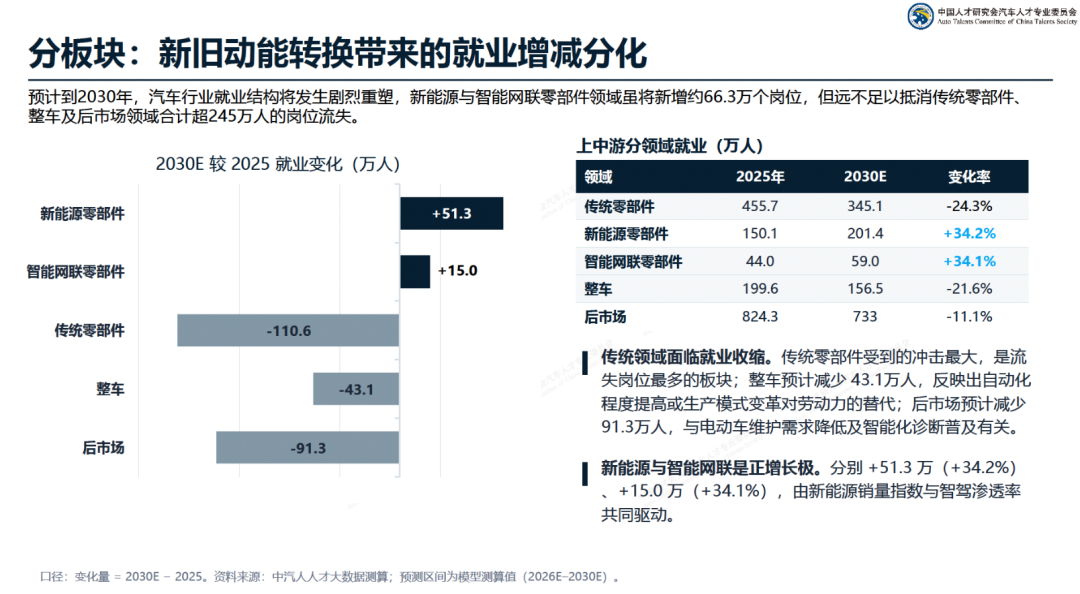
Another set of eye-opening data comes from calculations by the Automobile Talent Professional Committee of the China Human Resources Development Association. By the end of 2025, the domestic auto industry is projected to have approximately 16.74 million employees, a 26.3% decline from 2022. Models predict that by 2030, the industry is expected to see a net reduction of 1.786 million workers, with traditional parts, vehicle manufacturing, and aftermarket sectors losing 1.53 million jobs. The rate of new job creation to replace these lost positions may not even reach 50%.
On one hand, there is an endless stream of new product launches and accelerating technological iteration. On the other, the total number of industry jobs is shrinking, leaving those who remain to bear even greater pressure. Beneath the surface of this thriving industry, oppression has seeped into every link, from vehicle manufacturers to parts companies to R&D engineers.
Recently, Gongshe (a media outlet) has pieced together the highly oppressive underside of the industry's rapid growth through offline exchanges and online collection of feedback from auto industry practitioners.
01 Losing Money on Orders, Losing More by Not Taking Them: Suppliers Caught in a No-Win Situation
'Taking orders is a slow death; not taking them means immediate death.' This is a common refrain among owners of small and medium-sized auto parts companies.
Today, the parts industry is caught in an absurd paradox: Securing orders from automakers means facing losses on every unit produced, yet refusing orders leaves rigid fixed costs—such as factory depreciation, equipment amortization, and employee wages and social security—unabsorbed, making factory operations untenable.
Lao Li, a factory operator with over a decade of experience in auto parts, described the reality: 'We are a fully compliant factory with a standard quality control system, complete reliability testing, and full payment of employee social security. For the same part, after calculating all costs, we quote 100 yuan, but some small workshops dare to accept orders at 50 yuan.'
Price undercutting has become a widespread dilemma for parts companies. 'They skip full validation, use recycled materials, and cut corners on labor norms. Automakers use the low prices from these workshops to pressure us into lowering our prices,' Lao Li said, his voice tinged with frustration but more so with helplessness.
'It's not that we can't compete with our rivals; we dare not. Competing on price with opponents who can delay wage payments and skip testing processes means even if we win the order, we ultimately lose,' Lao Li explained.
Even if a company avoids being undercut by rivals, mandatory annual cost reductions have become the norm in the industry. Many automakers issue rigid cost-cutting targets, typically demanding 5-10% annual price reductions from suppliers, with some projects superposition VAVE (Value Analysis and Value Engineering) cost reductions, leading to even larger comprehensive cost-cutting margins.
While business is supposed to be about win-win cooperation, when it comes to cost reductions in parts, many powerful automakers do not engage in commercial negotiations with suppliers but simply issue notices: Accept the price cut to continue cooperating; refuse, and new suppliers will be brought in immediately.
It is also worth mentioning that as internal competition intensifies and new vehicle lifecycles shorten, a massive gap has emerged between automakers' order commitments to suppliers and actual shipment volumes.
Some suppliers invested millions of yuan in molds and production lines based on automakers' projected monthly sales of 20,000 units. After mass production began, many models saw sales plummet within three months: 13,000 units in the third month, 5,000 in the fourth, and just 1,200 in the fifth. The early investment in molds and tooling had little chance of being recouped.
Lao Li noted that some conscientious automakers at least provide development fees to suppliers as a safety net, but many automakers now use a cost-sharing model. If a model sells poorly, tools, molds, fixtures, and inspection equipment (collectively known as ' Mold clamp inspection '—tooling, molds, fixtures, and inspection equipment, the 'infrastructure' ensuring precision and quality in automotive manufacturing) become stranded assets for suppliers, tying up significant cash flow.
Prototyping is also a bottomless pit of expenditure. Lao Zhang, an interior trim component practitioner, revealed that his company completes over fifty prototype samples for clients annually, consuming large quantities of cutting tools and fixtures, only to secure small-batch, one-time orders for two products with no follow-up mass production demand. The costs incurred from prototyping already exceed the total revenue brought in by the orders.
In Lao Zhang's industry, a phrase captures this harsh reality: Out of a hundred samples, securing stable, large orders for even ten would be considered good fortune.
Additionally, over the past few years, extended payment terms and commercial acceptance bills have further amplified the survival crisis for parts companies.
Prolonged settlement cycles, high-quality guarantees, and large volumes of commercial acceptance bills have created a chain of debt chain (debt triangles) that trickle down the supply chain. Many companies show gross profit on paper but are dragged down by cash flow issues.
'Goods can keep being supplied, prices can be negotiated slowly, and invoices can be delayed, but the actual cash received is minimal,' said A Kuan, a project manager at a parts company, describing the current situation.
He noted that his team no longer dares to blindly expand scale, as doing so would only continue to drain resources indirectly. Not expanding is, in a way, a form of damage control. 'The entire team's focus has shifted away from new projects to project acceptance, invoicing, and chasing payments. The client told us directly to be mentally prepared for every invoice to be overdue,' A Kuan said helplessly.
Fortunately, from last year to now, the state has begun cracking down on extended payment terms, providing some relief for small and medium-sized parts companies. However, a considerable number of parts companies along the supply chain remain in crisis.
02 Infinitely Compressed Timelines, Constantly Drained Engineers
If the oppression in the parts sector stems from survival crises, then for engineers—from automakers to parts R&D—the pressure comes from infinitely compressed timelines, continually lowered standards, and the erosion of personal boundaries.
Automobiles are industrial products with the highest safety requirements, with DV (Design Verification) and PV (Production Verification) serving as two firewalls to ensure product reliability. Yet nowadays, for many automakers, cost reductions and launch deadlines take priority above all else, leading to widespread cutting of development processes.
Lao Qin, a veteran in the seat components industry, finds the current pace hard to understand: 'The old rule was to complete all DV closed loop (closed-loop) processes before moving to PV. Now it's different. DV design verification hasn't even wrapped up, and the automaker's cost-cutting targets are already being imposed. Forget about completing full DV; many of our seat projects skip DV entirely and rush straight into PV production verification.'
To seize market windows, 'rushing models into production before they're ready' has become a common industry phenomenon. 'There are still A bunch of problem points (a host of issues) that haven't been resolved, and defective parts are being installed in vehicles. The priority is to build and sell the cars first; any faults that emerge later are someone else's problem,' said a parts engineer who wished to remain anonymous.
Some industry practitioners also note that even basic process and material change procedures have become meaningless. For ordinary consumer products, changing materials requires a complete ECR (Engineering Change Request) and ECN (Engineering Change Notice) for documentation, but in this industry, it's unclear when this lax attitude emerged. 'A verbal announcement in a meeting is enough to change materials or processes. There might not even be an email notification, let alone proper documentation,' they said.
TR (Technical Review) meetings at some companies have also become increasingly suffocating. Da Bing, a practitioner with years of project management experience at a foreign-owned parts company, cannot understand how things have come to this.
'Before 2022, a TR review required a 50-page PPT: 20 pages introducing the company, 30 pages covering design, simulation, process, manufacturing, and quality inspection. The meeting lasted an hour, with each person speaking for ten minutes. If there were no major flaws, it passed. Subsequent changes required half-hour communications, with at most two or three iterations.'
'After 2025, everything changed. For the same part, the TR PPT ballooned to 270 pages. With design maturity below 80%, we had to outline every process step, production cycle time, equipment selection, and production line layout. The team worked overtime for a month to prepare materials, with core members flying in to present in person for four hours, while others waited online. The same TR went through three or more rounds, with the team enduring three to four months of this. The most ironic part? After all that, the project might not even be awarded to us if our quote wasn't the lowest. All that effort was for nothing,' Da Bing lamented. The industry, he sigh with emotion (mused), is no longer what it used to be.
In such a work environment and atmosphere, frontline engineers suffer the most.
Recently, the topic of a 13-day Mid-Autumn and National Day holiday trended on social media, but before long, those on break began to regret it. In engineering circles within the auto industry, a harsh joke circulates: 'For auto engineers, all holidays are fake. Only by resigning and deleting all work records can you truly take a vacation.'
Even during statutory holidays, meetings, online requests, and work calls never stop. Project deadlines trump everything, personal life continually gives way to work, and anxiety and burnout become the norm.
Chen, an electric control R&D engineer, recounted past projects to Gongshe, noting that nearly half the team was lost by project completion. Some left due to pressure, some were forced out by management, and others were scapegoated and fired after project issues arose.
A Kai, a test engineer at a new energy vehicle startup, is considering changing jobs. He has spent over a year at testing grounds, typically arriving home after 10 p.m. and constantly working overtime. His colleagues in adjacent teams often work until 1 or 2 a.m., leading some to quit due to physical exhaustion.
It's not just their own employees who face high work intensity; automakers directly demand that suppliers' staff work just as hard. Some parts companies have received cooperation requests requiring two shifts per day to match the automaker's development pace.
Xiao Chen, who once oversaw automotive wiring harness prototyping, said the standard timeline for a complete prototype used to be 14 days, but in recent years, this has been continually compressed, especially after the surge in domestic vehicle production, to just one week. Some salespeople even demanded delivery within days.
'It was absolute chaos. Component selection, drawing creation, BOM (Bill of Materials) preparation, prototyping, and shipping—all compressed into two days. We already worked six days a week, but now we had to come in on Sundays too, sometimes working half a month straight without a break. I'm glad I left when I did; staying any longer, I think I would have become depressed,' Xiao Chen said, relieved to have escaped.
03 The Impossible Trinity: Timelines, Costs, and Quality
Cost reduction has become the top priority for procurement teams and automakers, and when it comes to how to achieve it, 'second-track development' is no longer an industry secret. Automakers use high-quality suppliers to complete full R&D validation, then take the drawings, data, and samples to have unqualified small workshops replicate them, seizing mass production orders.
This tactic has become increasingly brazen in today's price and feature competition. Lao Han, who has nearly two decades of experience in parts sales, has witnessed this strategy evolve.
'Initially, they were more discreet: using high-quality suppliers for design and development, only purchasing small quantities of samples, and obtaining full documentation. Then, during a model's mid-cycle refresh, they would replace the original supplier with a small workshop.'
'Later, the pace quickened. Within just three to five months of a new model's launch, once sales stabilized, they would replace the supplier that had done all the hard R&D work. That supplier had spent money on full DV/PV testing, but the second supplier could reuse the drawings and test data, skipping all validation to participate in supply, saving significant time and cost. Now, it's done openly: samples sent by the supplier are passed to small workshops the next day.'
The long-term result is the downgrading of a high-end industry. For example, a role that once required 100 highly paid, highly educated engineers might now be filled by just 20 low-paid workers, with high-paying technical positions disappearing and talent pipelines breaking down.
"After 2020, it has become increasingly difficult to find local suppliers genuinely committed to original R&D. Some high-quality foreign suppliers have exited the domestic market, and many local companies aiming for technological upgrades have been outplayed by these tactics. Now, many of those that remain can only assemble and copy," Lao Han lamented.
Electrical components, at least, have a certain technical threshold, and the technical expertise remains somewhat intact; however, the decline in technical capability in the metal and plastic components sectors is particularly evident, as is the speed of replacement and elimination.
However, once this model becomes widespread, it brings harm to the entire industry.
In the field of automotive engineering, there is a widely acknowledged impossible trinity: it is difficult to simultaneously optimize cycle time, cost, and quality. Yet, the current market and model competition have led to an increasing number of projects, forcing OEMs to break this objective law if they want to stay competitive.
During the era of fuel-powered vehicles, the full development cycle for a new model typically spanned 36 months, with comprehensive testing for cold, hot, high-altitude, and durability conditions all included.
Nowadays, many new energy projects demand mass production and market launch within 12-18 months. As a result, a significant number of verification steps are artificially skipped, which has become an open secret in the industry.
"The timeline is too tight; just modify the date on last year's test report and submit it."
"Testing grounds cost money; just do simple debugging on the main road."
"No need to test extreme conditions; consumers won't encounter them in daily driving."
"Just install it first; whether I'll still be in this position next year is uncertain."
...
These may seem like internet jokes, but they are actually verbal instructions heard by multiple engineers during project advancement.
Many industry veterans lament that the current competition is no longer about who has a lower bottom line (which can be translated as "moral bottom line" or "ethical limit" in this context); many of those bottom lines have already been breached. Now, the competition is about who is more imaginative in breaking these boundaries.
Some, still with a conscience, have jumped ship to companies with ethical standards, while others, unable to change the status quo, have left the industry altogether, leaving behind comments like, "Don't buy the XXX car."
04 Where Did the Problems Originate?
We cannot deny the tremendous progress made in the industry. Under the wave of electrification, Chinese automobiles have achieved a leapfrogging development, thanks to the enormous efforts of countless practitioners. Technological innovation and economies of scale have indeed lowered the prices of expensive automotive configurations and features, effectively reducing the threshold for consumers to purchase cars and allowing people to enjoy a better automotive travel experience.
However, an industry always has multiple facets. The anonymized cases mentioned above, in the author's view, do not represent the entirety of the automotive industry but are merely striking points condensed from the many facets of industrial development.
Yet, behind these points are also living practitioners. The immense pressure of the industry has left some of them struggling to breathe.
We often ponder whether the processes, norms, models, or methods defined by European and American automobiles are superior, or whether, through our systems, capabilities, and innovations, we have made challenging reforms that render the old, outdated models less adaptable and indicative of impending obsolescence—a necessary outcome and objective law of industrial development?
Standing at this juncture, it is indeed difficult to make a historically correct judgment. The results and lessons can only be written by future generations.
However, we should also recognize that the automotive industry cannot solely pursue scale and speed. True industrial progress requires not only producing more cars and selling them worldwide but also protecting companies willing to invest in R&D, respecting engineering objectivity, and upholding quality standards.
Although we have sold many cars, and millions of automotive professionals have propelled several Chinese automotive groups into the global top ten, when taking orders at a loss and not taking orders also at a loss becomes the norm, when engineers never truly rest, when companies genuinely committed to R&D struggle to survive, and when those taking shortcuts thrive, with the bottom line (ethical limit) being lowered time and again, such an ecosystem is unsustainable.
Editor-in-Chief: Shi Jie Editor: Wang Yue

THE END
-
![]()
Micron: Without the Frenzied Surge, Can Long-Term Agreements Really Sustain the Storage Resurgence?
-
![]()
Leapmotor Cuts Ties with Kevin Tsai Amid Controversy: Upholding Unwavering Principles
-
![]()
From Green Leaves to Flowers: How AI Inference Transforms NAND's Destiny?
-
![]()
Paris Auto Show Transforms into a Chinese Auto Extravaganza: AITO Showcases Full Lineup, Geely Occupies 5 Halls
-
![]()
Will Chinese Cars Secure 20% of the European Market This Year?
-
![]()
Is the auto industry too depressing? Feedback from the front lines is a bit heart-wrenching
-
![]()
Qualcomm Pays Huawei, Yet Chip Sales Remain Restricted
-
![]()
The Android Moment of Embodied AI Lies in the Cost of Switching Bodies