Marvell: Aggressive Long-Term Guidance—Is It “Confidence” or “Pie in the Sky”?
 10/08 2026
 427
427
Marvell hosted its Investor Day last night (October 6, 2026, Eastern Time) in New York, featuring presentations by Chairman and CEO Matt Murphy and the executive team. This marked the company's first comprehensive long-term guidance update since postponing its 2025 Investor Day and the first time it provided targets for FY2031.
Previously, Marvell and Google signed a new collaboration agreement for custom ASIC chips, involving “warrant issuance and order competition.” For more details, read “Marvell: ‘Subsidized’ Alliance with Google—Can It ‘Disrupt’ Broadcom’s Position?” However, during last quarter’s earnings call, the company did not raise its ASIC guidance, with management stating that they would announce it at this Investor Day, heightening market anticipation.
Below are the key takeaways from Marvell’s Investor Day:
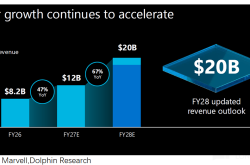
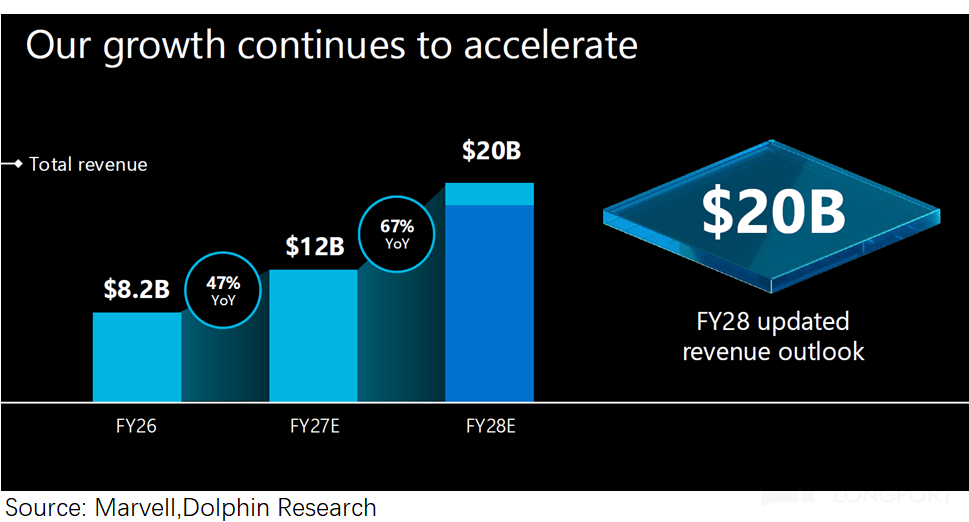
1.Comprehensive Revenue Guidance Upgrades: Total revenue for FY2027 is projected at approximately $12 billion (maintained); the total revenue target for FY2028 has been raised from $18 billion to $20 billion, exceeding market expectations ($18-19 billion), with about $18 billion expected from data centers.
The additional $2 billion is primarily driven by data center connectivity products, including interconnects, scale-up optics, and switching, rather than custom ASICs. This implies that contributions from the Google strategic partnership will not materially reflect until FY2029 at the earliest.
Marvell provided its first revenue outlook for FY2031 during the Investor Day, projecting $70-90 billion in revenue (market expectation: $47-50 billion), a gross margin target of 56-59% (market expectation: 55-56%), and a Non-GAAP EPS target exceeding $30 (market expectation: $20).
Commitment to Shareholder Returns: The company emphasized that capital allocation will prioritize supporting growth over time and committed to returning over 50% of free cash flow to shareholders on average in the long term.
Market expectations had previously suggested a significant slowdown in growth after 2028. However, the company’s guidance, which far exceeds these expectations, reflects its confidence in sustained rapid growth from 2028 to 2030.
2.AI Data Center Outlook
1) ASIC Revenue: The “ suspense ” (suspense) left by Marvell after its last earnings report has finally been resolved. The company reiterated its guidance of “more than doubling” revenue for FY2028 in the previous quarter’s earnings call but did not update its FY2029 guidance.
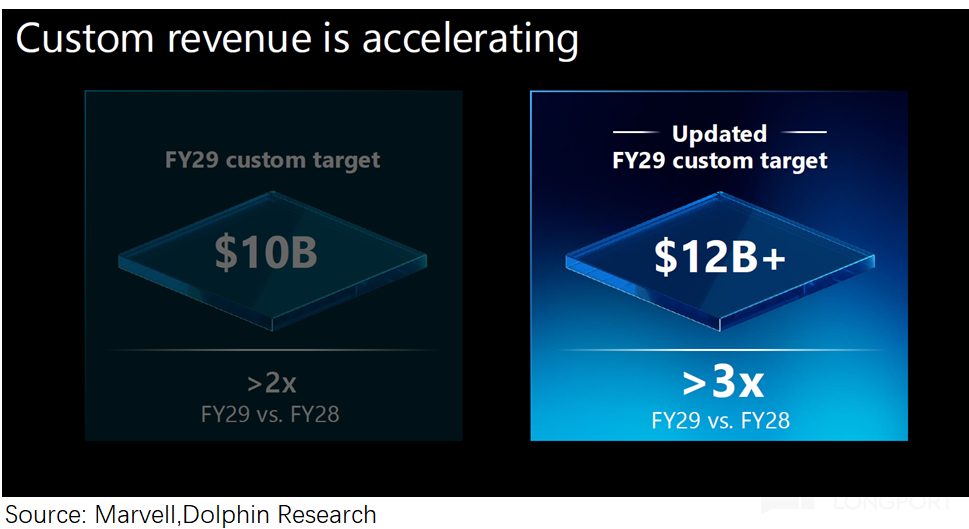
At this Investor Day, the company raised its FY2029 ASIC guidance to over $12 billion, more than triple its FY2028 figure. Previous guidance ranged from $8-10 billion (April 2024) to $10 billion (June 2025).
The guidance upgrade is primarily attributed to opportunities in XPU attach (semi-custom products for AI accelerators, including networking, storage, security, and inference acceleration), including contributions from the strategic agreement with Google in August.
2) Long-Term AI Outlook: The company’s FY2031 outlook, which significantly exceeds expectations, is mainly driven by an upward revision of its long-term projections for the AI data center business.
Based on the midpoint for FY2031, the company expects approximately $37.5 billion in interconnect revenue, $30 billion in custom ASICs, $10 billion in switching and storage, and $2.5 billion in communications and others, with interconnects and custom ASICs being its largest segments.
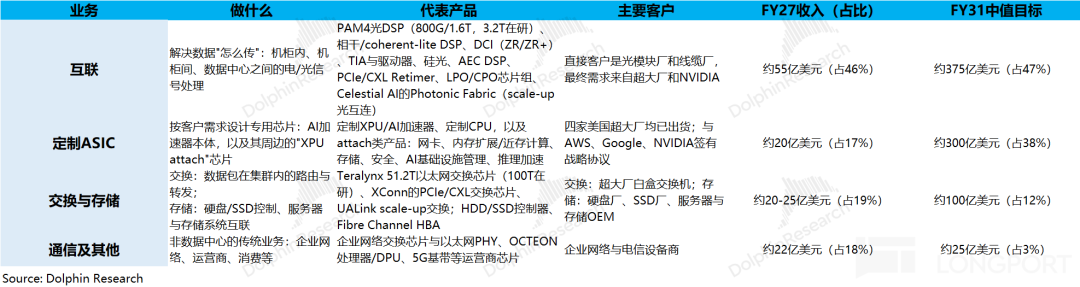
① Among these, the custom ASIC business is expected to grow the fastest, with a projected 5-year CAGR of 75-85% from FY2026 to FY2031, outpacing the company’s total revenue growth and increasing its share of custom ASIC revenue from 17% to 38%.
Since the company has already provided FY2029 custom ASIC revenue guidance of $12 billion (an increase of $2 billion from previous guidance), this implies an additional $18 billion in growth from FY2029 to FY2031 (still a remarkable 2-year CAGR of 55%). The true ramp-up of strategic agreements with Google and others is expected to occur after FY2029.
Notably, considering the company’s projection that the total addressable market (TAM) for custom ASICs will reach $235 billion by 2030 (roughly corresponding to FY2031), Marvell’s ($30 billion) market share would be approximately 13%, falling short of its previous 20% target.
This suggests that the company has significantly raised its outlook for the overall custom ASIC market, which it previously projected at $55.4 billion by 2028 at its AI Conference in June 2025.
Based on the current ASIC market outlook (5-year CAGR of 55%), the custom ASIC market is expected to exceed $120 billion by 2028, more than double the previous forecast, signaling positive prospects for the entire ASIC supply chain.
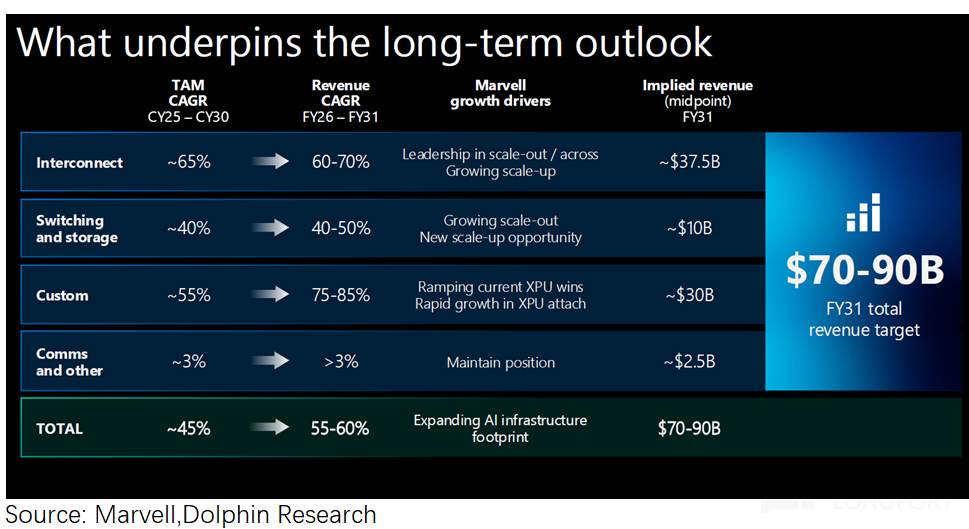
② Interconnect Business: This is Marvell’s core segment and the primary driver of its current high growth. The $2 billion revenue upgrade for FY2028 is largely attributable to the interconnect business.
Given the company’s projection that the TAM for the interconnect market will reach $65 billion by 2030, its $37.5 billion revenue target for FY2031 (corresponding to 2030) would represent approximately a 58% market share. Since the company currently holds around a 60% share in the interconnect market, its expected 5-year CAGR aligns closely with the overall market growth rate of 65%.
The interconnect business is expected to be the primary growth driver in the short term and a key contributor to the company’s overall revenue CAGR exceeding 50% over the next five years.
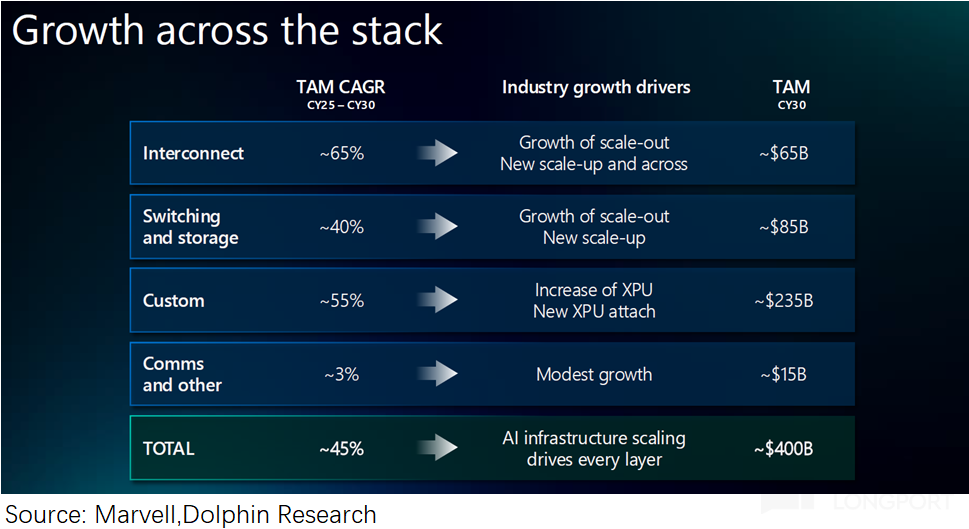
From Marvell’s outlook, by 2030 (corresponding to FY2031), the company expects to hold a 58% share in the interconnect market and a 12-13% share in switching, storage, and custom ASICs.
This positioning reflects the company’s ambition to maintain a “monopoly-like” status in the interconnect market while acting as a “challenger” in switching and custom ASICs.
To sustain its “monopoly” with a 60% share in interconnects, the company implicitly relies on two expectations: first, that DSPs will continue to outperform Broadcom in the 1.6T/3.2T cycle; second, that as optics move into racks and toward NPO/CPO architectures, value will not be captured by wafer foundries, switch chip vendors, or GPU manufacturers.
3.Overall Perspective
Marvell’s management directly provided its FY2031 outlook at the Investor Day, demonstrating confidence in sustained high growth for AI data centers. Notably, it specified 5-year CAGRs of 60-70% for interconnects and 75-85% for custom ASICs. Market expectations had previously anticipated a sharp slowdown after FY2029, but the company’s outlook explicitly indicates “continued high growth.”
Based on this positive outlook, its valuation requires reassessment. Assuming a relatively high discount rate of 14% and a perpetual growth rate of 3%, Marvell’s DCF valuation suggests a market capitalization of $400 billion, or $450 per share.
However, this DCF valuation depends on the company delivering on its outlook. Given that FY2031 (corresponding to 2030) is still four years away, uncertainties (e.g., an AI cycle stall or macroeconomic events) could arise.
From a shorter 2-year perspective, the incremental information provided by Marvell at this Investor Day includes:
① A $2 billion revenue upgrade for FY2028, primarily driven by the interconnect business;
② A $2 billion upgrade in FY2029 custom ASIC guidance to $12 billion, with significant incremental growth and “large-scale Google collaboration” expected only after FY2029.
In summary, while Marvell’s Investor Day presented a positive outlook, the upgrades were more substantial for growth after FY2029, with only modest adjustments for FY2027-FY2029. Most of the growth is projected to occur after FY2029.
Given uncertainties beyond FY2029, the market is unlikely to fully accept the FY2031 outlook and will place greater confidence in the FY2028-FY2029 projections.
Overall, Marvell’s Investor Day clearly conveyed management’s confidence, but most of the guidance upgrades were concentrated in the latter half of the FY2026-FY2031 period.
The longer the time horizon, the greater the uncertainty. For FY2027-FY2029, only minor upgrades were made, and the market is more inclined to trust these near-term projections.
Regarding Marvell’s Investor Day, the market is more likely to believe the guidance for FY2029 and earlier, while viewing the “FY2031 outlook” with skepticism.
- END -
// Reproduction Authorization
This article is an original work by Dolphin Research. Reproduction requires authorization.
// Disclaimer and General Disclosure
This report is for general informational purposes only, intended for users of Dolphin Research and its affiliates for general reference and data analysis. It does not consider the specific investment objectives, product preferences, risk tolerance, financial situation, or unique needs of any individual receiving this report. Investors must consult independent professional advisors before making investment decisions based on this report. Any person using or referring to the content or information in this report for investment decisions assumes all associated risks. Dolphin Research shall not be liable for any direct or indirect consequences arising from the use of the data contained herein. The information and data in this report are based on publicly available sources and are provided for reference only. Dolphin Research strives to ensure but does not guarantee the reliability, accuracy, or completeness of such information and data.
The information or opinions expressed in this report shall not, under any jurisdiction, be construed as an offer to sell or a solicitation to buy securities, nor as a recommendation, inquiry, or endorsement of any securities or related financial instruments. The information, tools, and data in this report are not intended for distribution to, or use by, any person or resident in a jurisdiction where such distribution, publication, provision, or use would contravene applicable laws or regulations or subject Dolphin Research and/or its affiliates or related companies to registration or licensing requirements in that jurisdiction.
This report reflects only the personal views, insights, and analytical methods of the relevant contributors and does not represent the stance of Dolphin Research and/or its affiliates.
This report is produced by Dolphin Research, with copyright solely owned by Dolphin Research. No institution or individual may, without prior written consent from Dolphin Research, (i) reproduce, copy, duplicate, reprint, forward, or create any form of copies or replicas in any manner, and/or (ii) directly or indirectly redistribute or transfer them to any unauthorized person. Dolphin Research reserves all related rights.
-
![]()
Navigating the Complexities: A Closer Look at Global Market Access Rules for Chinese Automakers
-
![]()
Can the U.S. Prevent Huawei from Licensing Patents to Qualcomm?
-
![]()
Qualcomm Refutes Paying Huawei, Yet Bloomberg’s Revelation of 680 Patents Can’t Be Overlooked
-
![]()
Marvell: Aggressive Long-Term Guidance—Is It “Confidence” or “Pie in the Sky”?
-
![]()
Micron: Without the Frenzied Surge, Can Long-Term Agreements Really Sustain the Storage Resurgence?
-
![]()
Leapmotor Cuts Ties with Kevin Tsai Amid Controversy: Upholding Unwavering Principles
-
![]()
From Green Leaves to Flowers: How AI Inference Transforms NAND's Destiny?
-
![]()
Paris Auto Show Transforms into a Chinese Auto Extravaganza: AITO Showcases Full Lineup, Geely Occupies 5 Halls