Qualcomm Refutes Paying Huawei, Yet Bloomberg’s Revelation of 680 Patents Can’t Be Overlooked
 10/08 2026
 483
483
Qualcomm paid Huawei but later claimed it hadn't. That's not necessarily a lie; it's a matter for the FTC to investigate.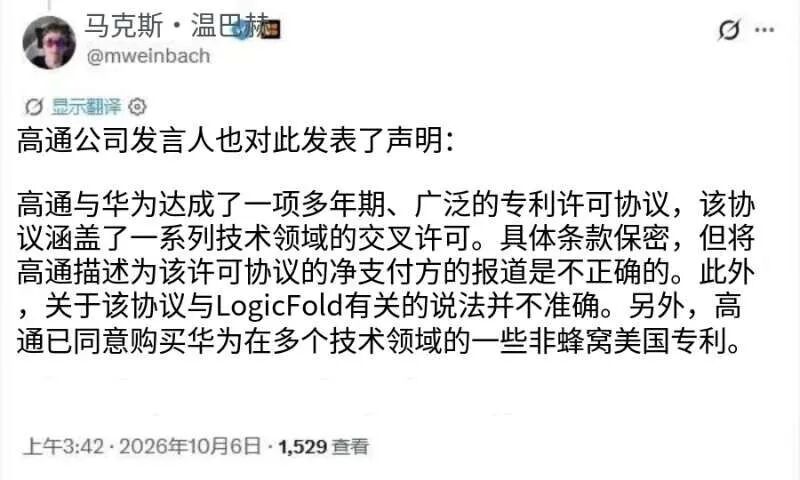
Bloomberg reported that Qualcomm had secured Huawei's logic folding authorization, a claim that Qualcomm swiftly dismissed as "false." However, the patent list uncovered by foreign media is more significant than the mere label of "net payer."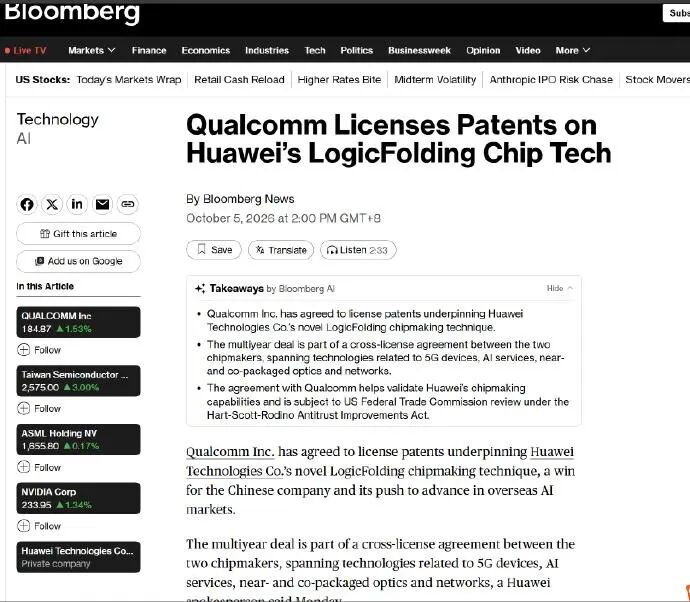
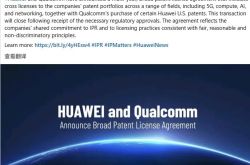
On October 5, Huawei and Qualcomm unveiled a multi-year patent licensing pact. Bloomberg reported the same day that Qualcomm had secured a license for patents related to Huawei's 'logic folding' chip technology, positioning it as a 'net payer' under the agreement. Qualcomm promptly refuted this, stating that the 'logic folding' claim was false and the 'net payer' description was inaccurate. Yet, amid these denials, Qualcomm did confirm one point: it had agreed to acquire some of Huawei's U.S. patents in computing, AI, networking, and other domains.
I. Revealed: 680 Patents, Just a Fraction of the Whole
Nikkei Asia provided more detailed insights: Qualcomm paid Huawei for the use of over 680 patents, some of which are registered in the United States.
These 680+ patents constitute only 0.23% of Huawei's 296,248 granted or pending patents. However, this 0.23% represents the cutting-edge in AI and networking. According to Shenzhen News, which confirmed with Huawei, the authorization covers near-package optical interconnect technology and related patent licenses supporting Huawei's logic folding chip technology. Logic folding is Huawei's core strategy to circumvent EUV lithography machines. By vertically stacking and high-speed interconnecting, signals are accelerated without reducing transistor size. The Kirin 9050 and 9050 Pro already employ this technology, with the 9050 Pro debuting in the Mate XT 2.
II. Doubts: Semiconductor Experts Cast Doubt on Qualcomm and Apple's Interest in Logic Folding
Qualcomm's denial is not just politically motivated but also technically grounded.
A report by tech media outlet Wccftech cited an analysis from a semiconductor expert: Logic folding imposes significant thermal constraints on clock speeds, potentially leading to overheating issues. The expert stated that this is the primary reason why Qualcomm and Apple are "not interested in using logic folding for their mobile chips." This skepticism warrants serious consideration. Logic folding vertically stacks logic circuits, doubling heat density, making heat dissipation the biggest engineering challenge. Huawei's implementation in the Kirin 9050 Pro suggests it has found a solution, but whether Qualcomm, after its own evaluation, deems this technology suitable for its product line is another question.
III. Qualcomm's True Position: Acknowledging the Deal, Disputing the Claims
Qualcomm's official statement requires careful scrutiny.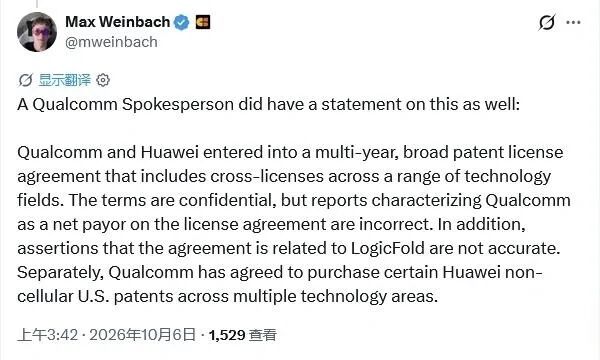
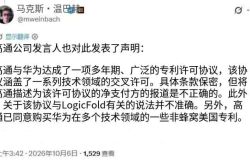
According to a statement obtained by Creative Strategies analyst Max Weinbach from Qualcomm, a Qualcomm spokesperson said: "Qualcomm and Huawei have reached a multi-year, broad patent licensing agreement covering cross-licensing in multiple technology areas. The specific terms of the agreement are confidential, but reports describing Qualcomm as a net payer under this licensing agreement are not accurate. Additionally, claims that the agreement is related to logic folding are also not accurate." Note the keywords: "not accurate," not "untrue."
These terms carry different legal connotations. "Not accurate" may imply "the direction is correct, but the details are off," while "untrue" means "completely non-existent." Qualcomm opted for a more ambiguous phrasing. Qualcomm CEO Cristiano Amon revealed a crucial detail in the 2025 fiscal year report: The U.S. Department of Commerce revoked Qualcomm's export license to sell 4G and certain other chips to Huawei in May 2024, and Qualcomm does not anticipate receiving product revenue from Huawei anymore. With hardware sales no longer feasible, patent licensing has become one of the few remaining connections between Qualcomm and Huawei. In this context, Qualcomm needs this agreement but cannot publicly admit to being a "net payer."
IV. Prediction: The FTC Review Is the Real Challenge
This deal also faces an unavoidable obstacle: antitrust review by the U.S. Federal Trade Commission.
Under the Hart-Scott-Rodino Antitrust Improvements Act, transactions involving patent acquisitions valued at over $133.9 million must undergo FTC review.
Nikkei Asia reported that the agreement amount between Huawei and Qualcomm exceeds this threshold. Huawei remains on the Entity List. Qualcomm's acquisition of Huawei's U.S. patents involves technology export and national security reviews. The FTC's review is not just a legal formality but also a political one. If the FTC determines that the transaction may harm market competition, it has the authority to veto it directly.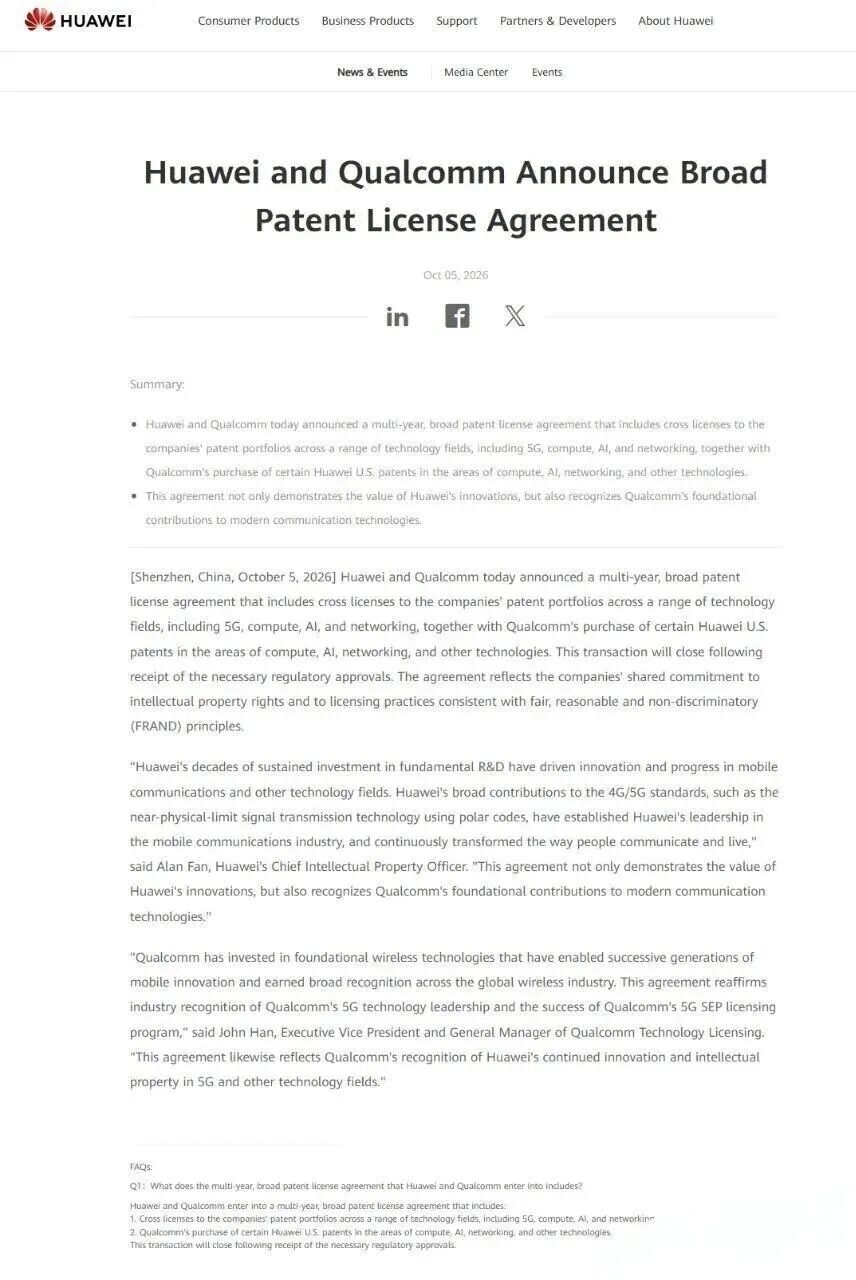
Fan Zhiyong, Huawei's Chief Intellectual Property Officer, stated: "This agreement not only underscores the value of Huawei's innovation but also reflects Qualcomm's foundational contributions to modern communication technology." John Han, General Manager of Qualcomm's Technology Licensing Business, said: "This agreement reaffirms the industry position of Qualcomm's 5G technology and its 5G standard-essential patent licensing program."
Both sides emphasize "mutual recognition" rather than who is conceding to whom. The choice of words speaks volumes. Saying "not accurate" while signing an authorization for 680 patents. Qualcomm disputes the narrative but signs the contract. Whether the FTC will allow this contract to take effect is the next big悬念 (uncertainty).
Do you think Qualcomm is just being obstinate, or is it putting on a show for Washington? Share your thoughts in the comments. #QualcommPaidHuaweiButStillWontSellChips
#680Patents #FTCReview #CanTheUSStopHuaweiFromSellingPatentsToQualcomm?
-
![]()
Navigating the Complexities: A Closer Look at Global Market Access Rules for Chinese Automakers
-
![]()
Can the U.S. Prevent Huawei from Licensing Patents to Qualcomm?
-
![]()
Qualcomm Refutes Paying Huawei, Yet Bloomberg’s Revelation of 680 Patents Can’t Be Overlooked
-
![]()
Marvell: Aggressive Long-Term Guidance—Is It “Confidence” or “Pie in the Sky”?
-
![]()
Micron: Without the Frenzied Surge, Can Long-Term Agreements Really Sustain the Storage Resurgence?
-
![]()
Leapmotor Cuts Ties with Kevin Tsai Amid Controversy: Upholding Unwavering Principles
-
![]()
From Green Leaves to Flowers: How AI Inference Transforms NAND's Destiny?
-
![]()
Paris Auto Show Transforms into a Chinese Auto Extravaganza: AITO Showcases Full Lineup, Geely Occupies 5 Halls