Can the U.S. Prevent Huawei from Licensing Patents to Qualcomm?
 10/08 2026
 369
369
After over a decade of intense competition, Huawei and Qualcomm have unexpectedly joined forces. 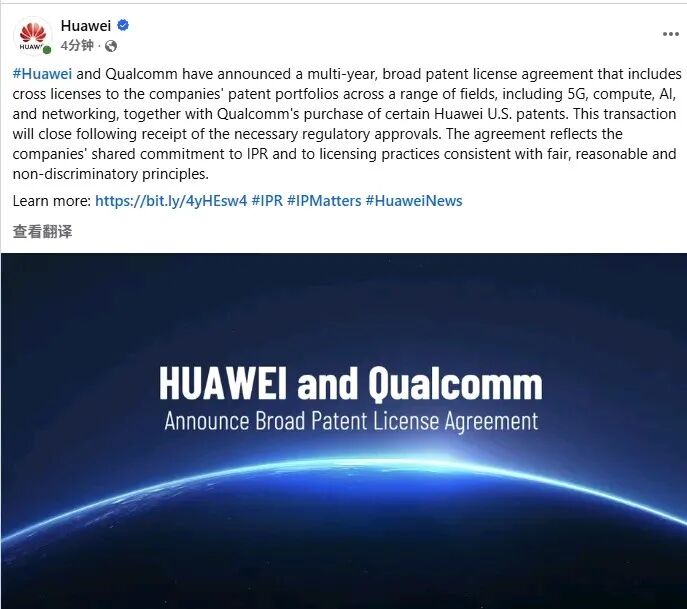
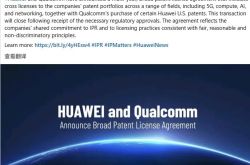
On October 5, the two tech giants announced a comprehensive, multi-year patent licensing agreement encompassing four key domains: 5G, computing, AI, and networking. Significantly, Qualcomm will acquire a selection of Huawei's U.S. patents in computing, AI, networking, and related fields.
Huawei anticipates that, upon the agreement's fulfillment, the cumulative value of its patent licensing deals will surpass $6.9 billion.
I. Unveiling the Reality: It's a Deal, Not a Reconciliation
What does Qualcomm gain? The license for logic folding chip technology. This represents Huawei's proprietary method for circumventing the need for EUV lithography machines, leveraging architectural innovation to enhance performance. By securing this license, Qualcomm gains access to Huawei's strategy of prioritizing architectural innovation over traditional process node advancements.
What does Huawei obtain? Patent licensing fees and a global platform for its AI technology. Qualcomm's extensive global reach and influence in the chip market provide Huawei with a vital launchpad to navigate through sanctions.
In essence, Huawei is monetizing its patents, while Qualcomm is investing in its future. Both parties secure what they require.
II. Debate: Who Holds the Upper Hand?
On the surface, Huawei appears to be the one selling patents. However, a closer look reveals that Huawei's patent licensing business has been generating positive revenue since 2021. By 2025, its R&D expenditure exceeded 192.3 billion yuan, with a global portfolio of over 165,000 valid patents, more than 90% of which are invention patents.
Huawei's challenge lies not in a shortage of patents, but in finding a conduit to translate these patents into global influence.
What about Qualcomm? Although Qualcomm's stock price surged by approximately 20% in 2026, the emergence of Apple's self-developed baseband and Huawei's resurgence with the Kirin chip are encroaching on its core business. Qualcomm requires Huawei's 5G and AI patents to bolster its standard essential patent portfolio and sustain its lucrative licensing model.
This is not a scenario of one party pleading with the other; rather, it's a mutually beneficial exchange.
III. Insight: This Is Merely the Start
The agreement between Huawei and Qualcomm will not become effective until it secures approval from U.S. regulatory authorities. Given Huawei's continued presence on the Entity List, the FTC's scrutiny will be rigorous.
However, the broader implication is that Huawei is leveraging its patents as a strategic tool to gain entry into the global AI market. In August, it inked a Wi-Fi patent deal with HP, followed by a 5G/AI agreement with Qualcomm in October.
While discussions persist regarding Huawei's chip manufacturing capabilities, the company is already reaping the benefits of its patent portfolio.
Huawei's transition from product sales to patent licensing represents a paradigm shift. Who do you think will be the next to follow suit? Let's engage in the discussion in the comments.
#HuaweiQualcommPatentAgreement #MaoQiyingAICircle
-
![]()
Navigating the Complexities: A Closer Look at Global Market Access Rules for Chinese Automakers
-
![]()
Can the U.S. Prevent Huawei from Licensing Patents to Qualcomm?
-
![]()
Qualcomm Refutes Paying Huawei, Yet Bloomberg’s Revelation of 680 Patents Can’t Be Overlooked
-
![]()
Marvell: Aggressive Long-Term Guidance—Is It “Confidence” or “Pie in the Sky”?
-
![]()
Micron: Without the Frenzied Surge, Can Long-Term Agreements Really Sustain the Storage Resurgence?
-
![]()
Leapmotor Cuts Ties with Kevin Tsai Amid Controversy: Upholding Unwavering Principles
-
![]()
From Green Leaves to Flowers: How AI Inference Transforms NAND's Destiny?
-
![]()
Paris Auto Show Transforms into a Chinese Auto Extravaganza: AITO Showcases Full Lineup, Geely Occupies 5 Halls