From Benchmark Tables to Interactive Screens: How Qwen4-Max Reflects the Second Half of Domestic Large Models' "Scenario Breakthrough"
 11/23 2026
 471
New Game Theory
When Qwen4-Max officially debuted in mid-November, the industry's first instinct was, as usual, to refresh the major benchmark leaderboards. As the new flagship of the Tongyi Qianwen series, its paper results directly set the waterline for the first tier of domestic large models.
But unlike previous benchmark refreshes in years past, which were accompanied by flood-style discussion, the market reaction this time was much quieter. As the general capabilities of leading models collectively enter a high range, simple score fluctuations can hardly stir the industry's nerves anymore. The truly noteworthy signals are often hidden outside standardized leaderboards.
After the release of Qwen4-Max, a large number of practical tests circulating in developer communities and among creators show that its performance in end-to-end interactive generation is more worth discussing than its paper benchmark scores: generating a complete, playable web mini-game in minutes, building a 3D interactive scene with physics rules from a single instruction, and automatically completing the product logic of mature categories under minimal prompts.
These non-standardized implementation capabilities have no unified scoring standard, yet they are closer to the real form of large models moving toward productivity tools. This may be where the true value of Qwen4-Max lies. It has secured a ticket to the first tier with solid benchmark capabilities, and through efficiency and native generation capabilities, it has touched the boundary of large models moving from answering questions to creating products.
Benchmark Capability and Efficiency Both Rise
More Than Just a Rise in Leaderboard Rankings
As the annual flagship model, the foundational capabilities of Qwen4-Max have always been a core yardstick for industry evaluation. Currently publicly available authoritative evaluation data has clearly outlined its capability positioning.
In the OpenCompass Sinan leaderboard, the most credible neutral evaluation system in China, data from the V3.0 version updated on November 17, 2026 shows that Qwen4-Max (xhigh tier) scored 70.60 points on the comprehensive evaluation benchmark, ranking 9th globally; on the text-only evaluation benchmark it scored 71.82 points, rising to 7th globally.

In specialized dimensions, it performs prominently in coding and agent tracks. In the officially announced Code Arena coding leaderboard, it entered the global top six, and it is in the leading tier in the Agents' Last Exam long-horizon agent test and the Work360 full-scenario workflow benchmark.
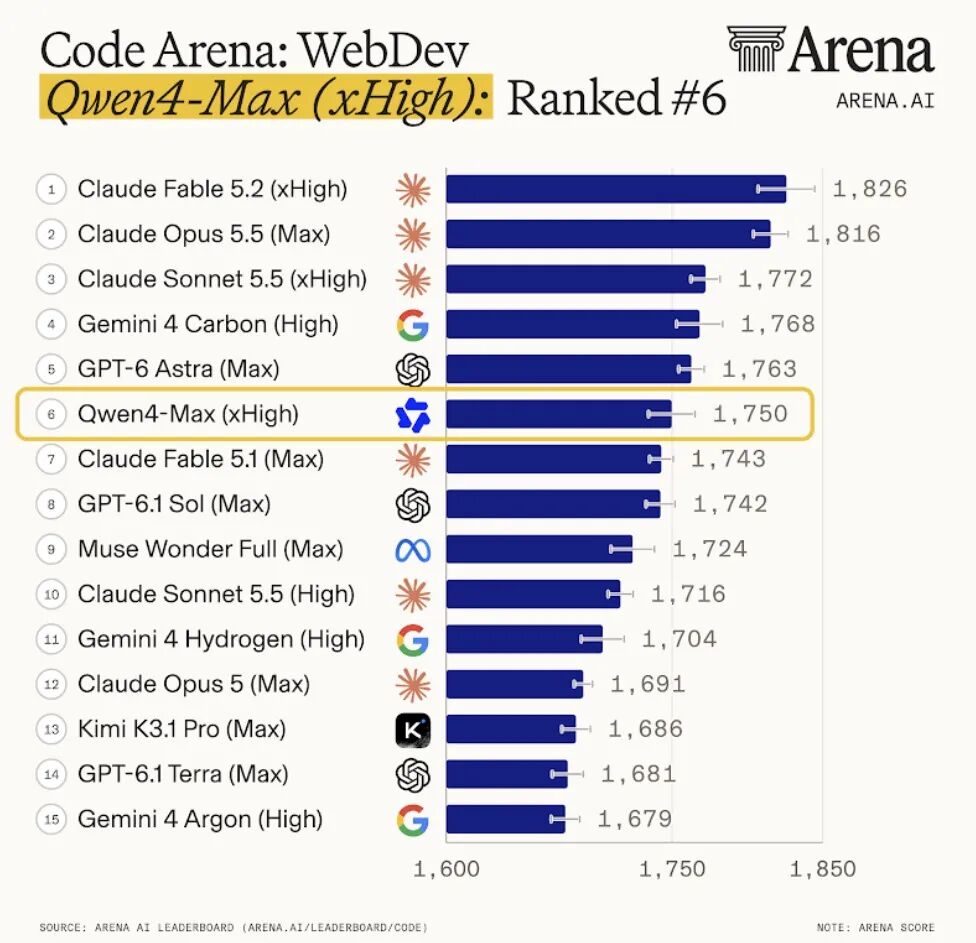
If one looks only at absolute rankings, this result meets market expectations, though it is not exactly stunning. But in the industrial context, a more important change is often overlooked: the capability improvement of this generation of models has always been accompanied by simultaneous optimization of cost and efficiency, and this is precisely a feature rarely seen in previous rounds of flagship iterations.
According to technical parameters officially announced by Alibaba, Qwen4-Max continues the sparse MoE architecture with 2.4 trillion total parameters, but through the new Qwen4 architecture optimization, only 71 billion parameters are activated per inference, 25% fewer than the previous generation Qwen3.8-Max. Combined with the GDN+QSA hybrid attention mechanism and N-gram embedding lookup table design, under a million-token context window, its reading speed is more than 7 times faster than the previous generation, while greatly reducing memory usage and inference costs for long contexts.
Directly reflected in end use is a significant decline in token consumption and per-task cost. The official Work360 benchmark test shows that under the same inference intensity, Qwen4-Max's per-task token usage decreases by 24% in the Xhigh tier and 35% in the High tier; in the Terminal-Bench terminal task, the token usage drop is nearly 50%. Combined with API price cuts, comprehensive estimates show that the average per-task cost is about 60% lower than the previous generation, with an even more obvious cost advantage in long-session caching scenarios.
The significance of this set of data is far more than simply being cheaper. It means domestic large models have passed the extensive stage of "stacking parameters, chasing scores, and ignoring costs," and have begun to enter a mature period that emphasizes both capability and efficiency. For enterprise customers and developers, a model that can stably run long-chain tasks while bringing down per-task cost is far more practically valuable than a few tenths of a point more on a leaderboard.
Of course, this does not mean benchmark scores have lost their meaning. On the contrary, solid general capabilities are the foundation for implementing all complex scenarios. The 1M token context window, native multimodal understanding capability, and stable long-chain reasoning performance—these technical features that support leaderboard scores—will ultimately translate into delivery stability in complex tasks. Without sufficient foundational capability as support, so-called "end-to-end generation" would only be a flawed demo.
But from the perspective of industry evolution, benchmark scores are degenerating from the core decisive factor into a basic admission ticket. When all leading players have crossed the threshold of sufficient general capability, the marginal benefit of simply competing on scores begins to decline rapidly. The next round of competition is destined to shift from paper data to scenario value. Whoever can transform the general intelligence accumulated in models into productivity in specific scenarios can gain the initiative in the next stage.
End-to-End Generation Practical Tests
Native Creativity with Clear Boundaries
Compared with the fixed scores of standardized leaderboards, unofficial practical tests scattered across developer communities and creator groups often better reflect a model's real implementation capability. After the release of Qwen4-Max, a large number of creators and technology enthusiasts conducted multi-angle tests around its multimodal generation and end-to-end interaction capabilities, intuitively demonstrating the model's capability leap from outputting code snippets to delivering complete products.
We tested multiple directions including web mini-games, 3D interactive scenes, and game prototypes. Among them, basic interactive generation performed most stably. Under clear instructions, the model can quickly deliver complete runnable products. For example, for the requirement of a fruit-catching web mini-game including core elements such as scoring, health points, and controls, the model output a complete runnable version in a short time, with a start interface and rule explanation, support for both mouse and keyboard controls, real-time updates of score and health points, automatic triggering of the end interface when lives are exhausted, and one-click restart, all without manual debugging.
3D interactive generation better reflects the model's capability boundaries and adaptation characteristics. In testing, we tried based on the movie poster of "The Legend of 1900" to have Qwen4-Max transform the scene into an interactive 3D version in Minecraft style and implement multiple interactions such as character movement and physical effects. Although the final product had basic scene form and an interaction framework, its visual completeness and detail refinement fell short of expectations.
This result was not caused by a single factor. The requirement simultaneously stacked multiple highly difficult tasks such as poster information extraction, cross-style transfer, 3D scene construction, and physical interaction implementation. It was an extremely complex composite instruction and a challenge for any large model. At the same time, the instruction constraints were scattered and the core scene narrative direction was vague, which to some extent dispersed the computational focus and affected the final completeness.
When the instruction strategy was adjusted to remove redundant constraints and only propose a clear request to "build a classic 3D famous scene from The Legend of 1900," the output effect improved significantly. The model autonomously chose the classic segment "The Magic Waltz on the Stormy Night" and delivered an interactive scene with high completeness.

The hull rolls and pitches with the waves, the grand piano realistically slides and bounces according to gravity components, and tables, chairs, and chandeliers sway along with the hull; the interface sets a wind and wave adjustment slider and a brake button, reproducing the classic plot of "releasing the piano wheel lock"; it also includes real-time synthesized waltz music and ambient sound effects, with preset multi-view switching. After only one iteration to fix a slight clipping issue, the overall product was already close to the level of a mature interactive display work.
This feature that "instruction clarity determines the upper limit of the product" has also been cross-validated by similar tests at home and abroad. Recently, a large number of independent tests in developer communities at home and abroad show that under the premise of clear instructions and clear scenario boundaries, Qwen4-Max is in the first tier in end-to-end interactive generation. Some developers used a single-sentence instruction to generate a 2D pinball table with a complete physics engine, some creators quickly built a roamable indoor 3D scene, and some educators used it to generate an interactive physics principle demonstration page.
These tests jointly confirm that when requirements focus on clear scenarios and functions, the model can autonomously complete a large amount of industry common sense and product details, greatly reducing the implementation cost from idea to prototype.
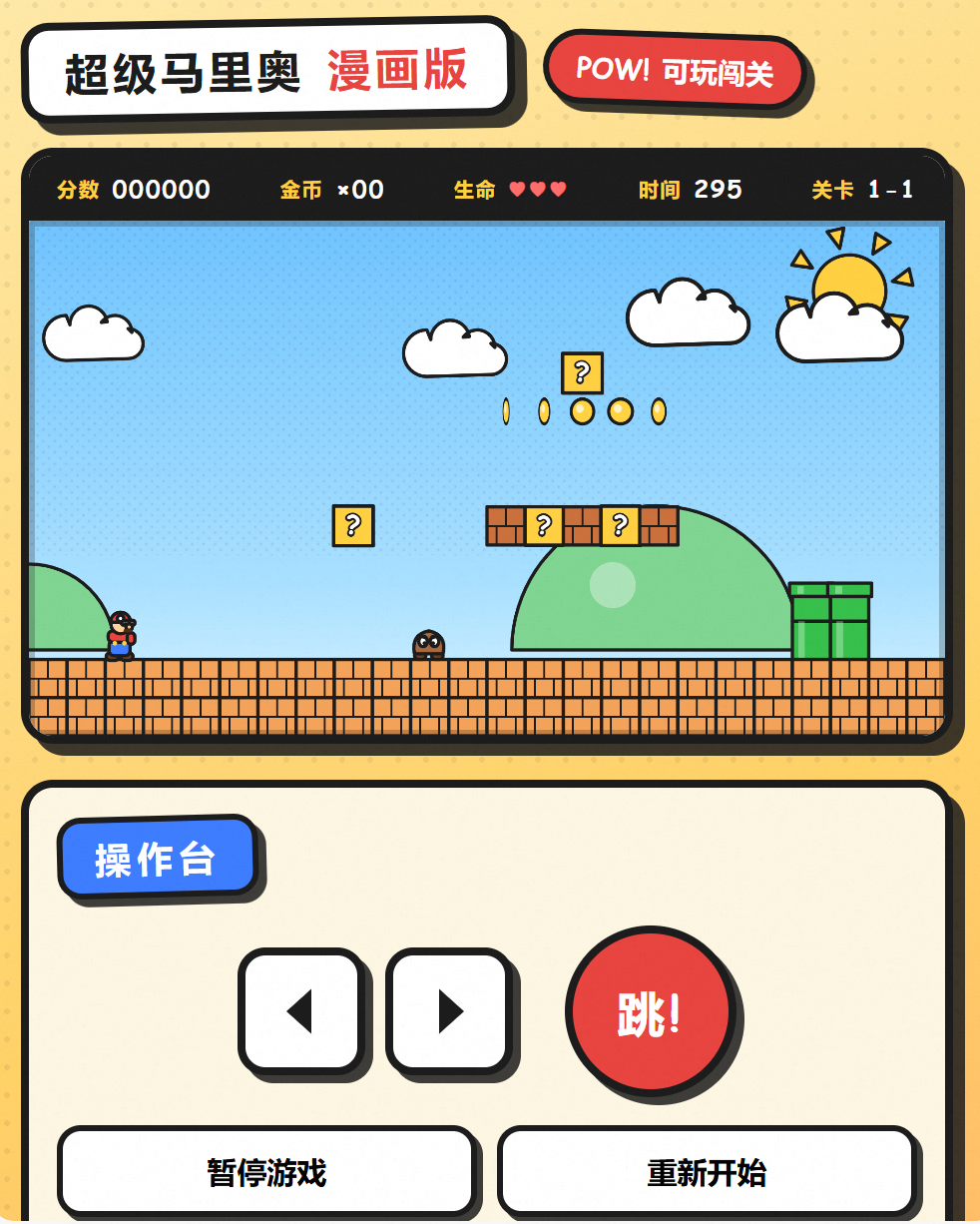
In generation tests for vertical categories, the model's ability to internalize mature product paradigms is even more evident. In the evaluation, a comic-style "Super Mario" mini-game generated with only minimal instructions automatically covered complete level-clearing gameplay, a top UI status bar, a right-side virtual control pad, and comic-style presentation, and even adapted to narrow-screen device layouts. In the test of a Genshin Impact-style monster-fighting scene, the model also autonomously completed the corresponding art style, core gameplay mechanics, and control UI. Without listing rules one by one, the model can automatically fill in standardized designs that meet user expectations based on its cognition of mature game categories.
Objectively speaking, current native generation capability still has its natural boundaries. In areas such as strongly customized style transfer, ultra-complex multi-task stacking, and high-precision industrial-grade details, there is still room for improvement. The output products are more positioned as "high-quality prototypes" and "rapid validation versions," and there is still a gap from the industrial-grade output of professional teams.
But these shortcomings are more like natural characteristics of the current stage of technological development rather than capability defects; moreover, product quality is highly related to instruction precision and scenario adaptability, and a single test result cannot define the upper limit of the model's capability.
New Proposition for the Evolution of Domestic Models
From Benchmark Chasing to Scenario Definition
The comprehensive performance of Qwen4-Max in benchmark capability, efficiency optimization, and native generation is not a single-point breakthrough of one model. Placed in the trajectory of the domestic large model industry's evolution, it precisely confirms the deep shift taking place in the industry.
Statistics in 2026 from multiple industry research institutions all point to the same conclusion: the stage of domestic large models catching up in general capabilities has basically concluded. The flagship models of the top five domestic vendors have narrowed the gap with the overseas first tier in mainstream general benchmark tests to within 5%, and have even achieved overtaking in dimensions such as Chinese understanding and local compliance.
Correspondingly, the market weight of benchmark scores is rapidly declining. When enterprise customers choose models, the proportion listing general benchmark scores as a core indicator has fallen sharply compared with two years ago, replaced by vertical scenario implementation efficiency, deployment cost, and the threshold for secondary development. This means the logic of the first half of domestic models has become invalid.
Over the past several years, the industry followed a clear benchmarking route: overseas defined the technical direction and evaluation standards, and domestic vendors chased along the same path, with leaderboard rankings as the most intuitive measure of victory or defeat. This model was extremely efficient when the technical gap was obvious, enabling domestic models to complete in three years a technological journey that took overseas players nearly ten years.
But when all leading players have crossed the threshold of sufficient general capability, the dilemma of homogeneous competition follows. Parameter scale, context window, and inference precision—these once core differentiators—are rapidly becoming standard equipment, and the marginal returns of simply stacking computing power and chasing leaderboards have visibly declined.
The key to breaking the deadlock lies in the unique demands of the local market. China boasts the world's largest digital content industry and the most vibrant creator ecosystem. The mini-game market exceeds 100 billion yuan annually, with millions of developers forming a vast long-tail supply chain; demand continues to grow for content in short video, interactive marketing, and online education, leaving an enormous gap in lightweight interactive content; and a large number of small and medium-sized teams and individual creators—lacking professional technical teams but eager to bring ideas to life quickly—represent a pressing need.
These fragmented, lightweight, high-frequency production needs are local dividends that overseas markets simply do not offer, and they are precisely the scenarios where general large models can best deliver value. Against this industrial backdrop, the differentiated competition among domestic models is tilting toward native generation capability.
Not only Tongyi Qianwen but also multiple leading domestic large model vendors ramped up investment in 2026 in areas such as end-to-end interactive generation, 3D scene construction, and light game prototype generation. The technical route has shifted from single-point code assistance and image generation to one-stop delivery of fully runnable products. The competitive dimension of the track has likewise extended from whose answer is more accurate to who can turn ideas into usable works faster. This is not the choice of a single vendor but a collective shift across the entire industry—from technical benchmarking to scenario definition.
From the evolution path of the global AI industry, this is also the conventional logic for latecomers seeking to change lanes. When the underlying gap in general technology is gradually leveled, real competitiveness often comes from deep adaptation to local needs. Overseas leading models optimize more toward enterprise-level workflows, professional code assistance, and scientific research computing support; domestic large models, by contrast, can fully leverage the huge C-end creator ecosystem and content industry foundation to establish their own advantage standards in areas such as native interaction, lightweight content, and creative implementation. They do not need to prove themselves by others' yardsticks but instead use scenario value to define a new capability coordinate system.
Of course, all of this is still in an early stage. At present, interactive works generated by large models are mostly prototype-level products, and there is still room for refinement before they reach industrial-grade finished goods; the standards, ecosystem, and business models of the entire native generation track are still being explored. But the direction is clear enough: the endgame of large models is never about being a high-scoring contestant in an exam room but about being a production tool in industry.
For domestic large models, this is an opportunity more worth seizing than leaderboard rankings. When the waterline of technology is collectively leveled, the real moat is never in the tables of benchmark tests but in one real demand scenario after another. Whoever can first sink general intelligence into specific industries and achieve implementation depth that others do not have can truly walk out its own second half.
New Game Theory (ID: newgametheory)
-
![]()
Toyota's October Sales in China: A Breakdown of the Two Joint Ventures
-
![]()
BYD's Two Bodies
-
![]()
IM Motors October Sales: 7,846 Vehicles, LS6 Accounts for 66% — Where Is the Second Mainstay Model?
-
![]()
The AI Bubble You Can't Escape
-
Token Economy: Top 10 Companies with the Fastest Growth and Strongest Profitability
-
![]()
Alibaba's AI Spending Is Starting to Pay Off
-
![]()
From Benchmark Tables to Interactive Screens: How Qwen4-Max Reflects the Second Half of Domestic Large Models' "Scenario Breakthrough"
-
![]()
60-Day Payment Terms a Year and a Half On: Automakers Turn the Invoice Date Into a Loophole