60-Day Payment Terms a Year and a Half On: Automakers Turn the Invoice Date Into a Loophole
 11/23 2026
 330
「Payment pressure reaches the end of the chain」
"These days automakers all stick religiously to their pledge to pay within 60 days of invoicing, but some OEMs are pretty aggressive about annual price cuts. And when the annual price hasn't been settled, some automakers simply refuse to issue invoices on the grounds that pricing isn't finalized — and that can drag on for months." That's how Wang Meng (a pseudonym), the finance head at a leading Tier 1 supplier to automakers, described the situation to Bangning Studio recently.
The remark carries several layers of meaning: the deadline exists, and automakers really are honoring it — but what they honor is those 60 days after invoicing. And before invoicing? Which day the countdown starts, whether it can start at all, and how it ends — all of that is left open.
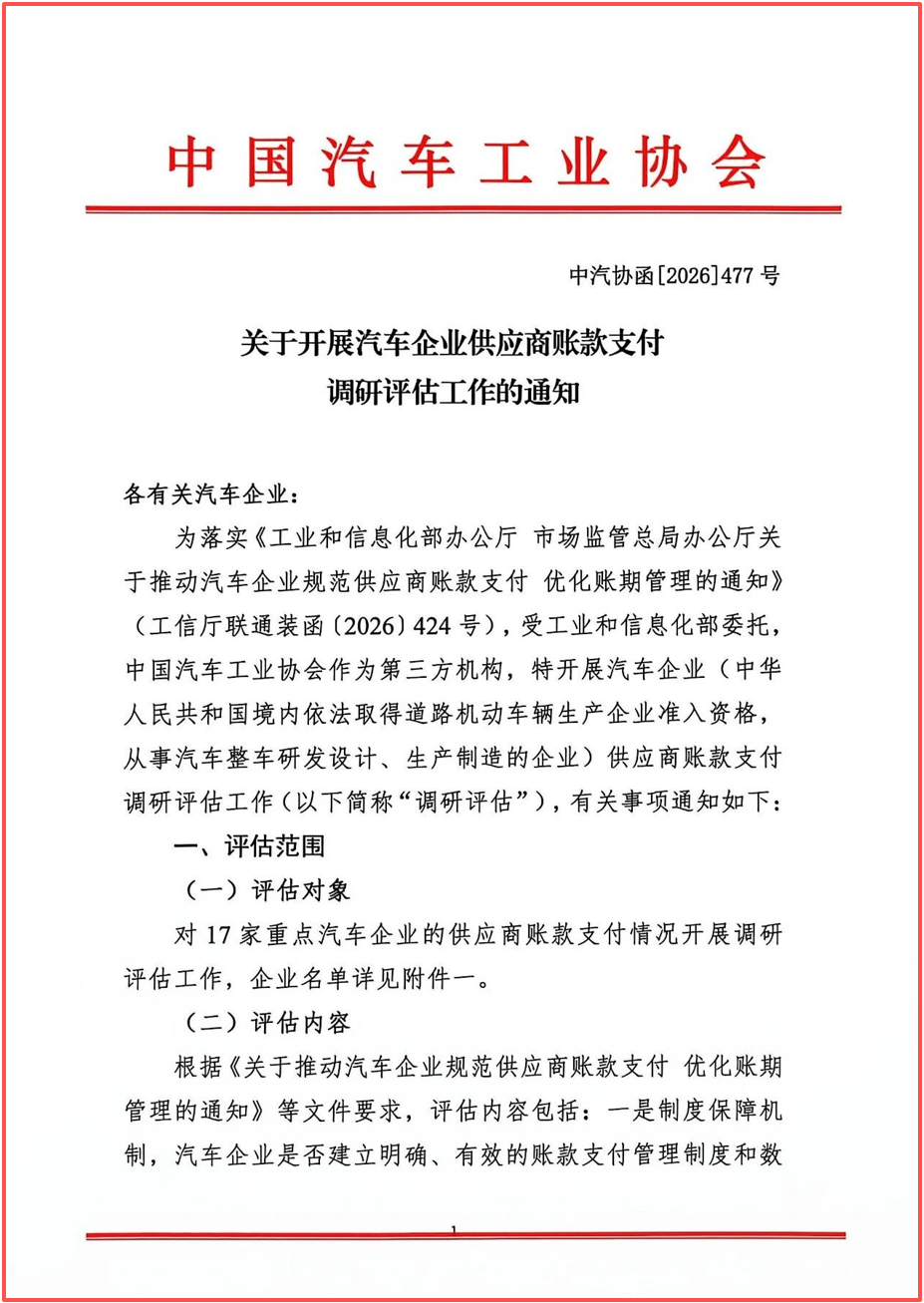
On November 16, 2026, the China Association of Automobile Manufacturers (CAAM), at the commission of the Ministry of Industry and Information Technology (MIIT), launched an annual survey and evaluation of supplier payment practices at 17 major automakers. The evaluation runs once a year: automakers must submit the previous year's data by January 31, no fewer than 15 suppliers are randomly audited per company, and results are made public. Enterprises carrying large accounts payable, deliberately stretching payment terms, or drawing a heavier volume of complaints will be summoned for talks by MIIT together with relevant departments and ordered to rectify.
It is a major test of a commitment made a year and a half ago.
On June 1, 2025, the newly revised Regulations on Ensuring Payments to Small and Medium-sized Enterprises took effect, and many automakers pledged that "payment terms shall not exceed 60 days." That same month, Guo Chuan, chairman of Konghui Technology, published a proposal titled "I Have a Dream," voicing his wish that "payment be received within one month of invoicing, and wire transfer be the only accepted method."
It is arguably the most basic — and the hardest to fulfill — demand in the automotive industry.
On October 29 this year, Guo Chuan published another piece, "A Letter to All Supplier Partners." It barely mentioned payment terms at all, dwelling instead on how "reasonable suggestions and legitimate business demands from some suppliers cannot be effectively communicated or smoothly resolved at Konghui" — for instance, "certain departments at Konghui may be imposing improper penalties or excessive claims on suppliers." To that end, the company opened a dedicated mailbox reaching straight to the compliance department and the chairman.
From "payment within one month" to "there's someone you can turn to when problems arise," the direction of the two documents has shifted. And on payment terms, there has been genuine progress. In February this year, a CAAM survey showed that the average payment term from major automakers to small and medium-sized suppliers had been compressed to roughly 54 days — about 10 days shorter than before the commitment.
Another set of figures, however, points the opposite way.
Mid-year financial reports show that the turnover days of accounts and notes payable at 14 listed Chinese vehicle enterprises rebounded to 187.5 days in the first half of 2026 — 23.1 days longer than the 164.4 days recorded at the end of 2025.
Both figures are correct; they just aren't measuring the same thing. Zhang Hong, a member of the expert committee of the China Automobile Dealers Association, explained that CAAM counts from acceptance and reconciliation, and treats notes as paid under its survey methodology. Financial reports, by contrast, are derived backwards from "365 × accounts payable ÷ operating cost," counting both bank and commercial acceptance bills as unpaid — and the starting point doesn't correspond.
"The payment terms automakers publicly promise have indeed gotten shorter, but the capital occupation reflected in financial reports is still very long — and still worsening," Zhang Hong said.
That is where the real problem lies. This round of reform changes the payment date; what it cannot change is the financing structure and the distribution of profits.
▍01 Honoring "60 days after invoicing"
To understand why payment terms are so hard to change in substance, you first have to trace the path of a batch of auto parts.
According to Wang Meng, parts are rarely delivered straight to the vehicle plant's workshop. In most cases, suppliers first ship goods to a warehouse near the OEM's production base — known in the industry as a "third-party warehouse," involving the automaker, the supplier, and the warehousing party. The goods sit there, the inventory still on the supplier's books, waiting for the OEM to allocate them according to its production rhythm.
But that warehouse isn't in the payment term.
Bangning Studio learned that the warehouse is rented by the supplier itself, located right next to the OEM's production base. Goods are delivered to the warehouse first and allocated only when the OEM schedules production — rolling off the line a day or two after transfer. Once the whole month has passed, reconciliation takes place from the 8th to the 15th of the following month, the two sides verify the previous month's delivery quantities and amounts, invoices are issued at month's end once confirmed, and payment is collected 60 days after invoicing.
The payment term starts from the day of invoicing; everything before that is carried by the supplier. From delivery to the warehouse to invoicing takes more than a month. Add it all up, and from the moment a batch of goods leaves the supplier's factory gate to the moment payment lands, it actually exceeds 90 days.
Before July 2025, the collection cycle was even longer. Wang Meng said payment within 90 days of invoicing was the norm back then, and some automakers stretched to 120 days. Now, though, automakers all implement 60 days, and that link is enforced very strictly — "no OEM fails to do so these days."
In September this year, MIIT and the State Administration for Market Regulation jointly issued the Notice on Promoting Automobile Enterprises to Standardize Supplier Payment and Optimize Payment Term Management, which targets precisely this link. The notice stipulates that for productive materials such as auto parts, acceptance shall in principle be completed within 3 working days of receipt; if the time limit is exceeded without acceptance, the goods shall be deemed qualified; and where vehicle installation verification is genuinely needed, a separate inspection period shall be set.
The 60 days do not start from the day goods are delivered. The so-called starting point — from which day the payment term runs — can commonly be delivery, acceptance, invoicing, or vehicle installation. Which method is used directly determines when the supplier gets paid.
Zhang Hong said that in the survey, each of these starting methods accounts for about 30%. For the same batch of goods, different calculation methods can mean a difference of dozens of days. For enterprises that count from vehicle installation, goods may sit in the warehouse for two months before reaching the production line, and the 60 days are counted from the day of installation — with all the waiting time before that uncounted.
This means regulators can control the length of the countdown, but not from which day the 60-day countdown starts.
Invoice eligibility is another stumbling block.
Wang Meng revealed that if the annual price isn't agreed, the automaker won't sign the price agreement, the price won't be entered into the system, and the supplier can't issue an invoice. No invoice means no booking, and payment collection is delayed accordingly. The so-called annual price is the annual supply price renegotiated each year between automaker and supplier; once agreed, it is signed into an annual price agreement, and only then is the settlement price entered into the system.
Such situations account for 20% to 30% of Wang Meng's company's business, and delays of several months are not uncommon. "The goods have all been delivered, the acceptance and settlement data in the customer's system are already out, but just because the price hasn't been agreed, the invoice can't be issued." Consumers are already driving cars equipped with its products, yet payment remains stuck on an unsigned agreement.
The notice issued in September this year states that during price negotiations for continuous supply, payment shall first be made by reference to the most recently effective contract price — generally no less than 90% — with the difference refunded or supplemented once the price is determined. But in enterprises' specific execution, a gap remains.
From this vantage point, as long as the power to issue invoices stays in the automakers' hands, 60 days can turn into "wait for notice" at any moment.
Payment instruments are yet another hurdle.
Wang Meng told Bangning Studio that OEMs currently pay Tier 1 suppliers roughly through acceptance bills and wire transfer, in a ratio of about 9 to 1.
"Acceptance" refers to bank acceptance bills, paid by the bank at maturity. Commercial acceptance bills are paid by the enterprise itself, and discounting them is harder and costlier. What automakers hand over is basically the former. Wire transfer means a bank transfer. Once a bill is issued, payment is deemed complete — the cashing happens afterwards.
Pressure is transmitted downward, layer by layer. Wang Meng's company currently pays upstream suppliers mainly by acceptance and wire transfer. Before 2023, the ratio of acceptance to wire transfer was 2 to 8; after 2025 it became 5 to 5. "We really can't bear the pressure transmitted down from the OEMs."
Time cost is also buried in the term of the bills.
Zhang Hong ran the numbers: a contract stipulating a 3-month payment term plus a 6-month acceptance bill means that, if fully executed as written, it takes 9 months before the supplier sees cash. Bank acceptance bills can be extended by up to another 6 months, and discounting commercial bills is even harder.
From delivery to the starting point, from the starting point to bill maturity, from bill maturity to discounting and cash in hand — these three segments together make up the real collection cycle.
CAAM's compliance line on the evaluation form for non-SMEs is that cash and bank acceptance bills together account for no less than 80%. Counting bills as paid, the books show 60 days as compliant — while the supplier is still holding an undue bill. That means the payment term hasn't disappeared; it exists in another form.
At the same time, payment terms cover only funds, not the other costs suppliers incur to keep pace with the OEM's rhythm. Production scheduling is one of them.
Zhang Tao (a pseudonym) works at another Tier 1 supplier, responsible for supplier management and quality. He said the OEM's production scheduling plan determines everything upstream. If the order forecast is accurate and scheduling is rhythmic, costs are correspondingly lower; if the forecast is unstable — sudden surges and sudden drops — suppliers must figure out for themselves how to schedule production, without cutting off supply to the OEM or building up large inventories.
Such parts are customized for complete vehicles. Once they pile up as inventory and the model sells poorly, they may be unusable for a long time — what the industry calls dead stock — and the disposal cycle often exceeds expectations. This is a common scheduling problem across the industry.
Most of what enterprises can change internally has already been changed. But payment terms aren't on that list; they're set by the other end of the contract. Policy focuses on the layer with the strongest bargaining power in the chain, but pressure gets redistributed outside that layer.
▍02 Suppliers find it hard to collect payment — and even harder to make money
Payment terms are a cash flow issue; profit is another matter entirely. The former cannot substitute for the latter.
In Wang Meng's view, OEMs receive cash when they sell cars — consumers don't extend automakers any payment terms — while complete vehicles keep cutting prices, and new-model facelifts often add equipment while lowering prices. The reduced part has to be recovered somewhere in the supply chain eventually. "Cash flow is only a cash flow problem."
Public data show that in the first half of the year, the average profit margin of the vehicle manufacturing segment fell to 1.5%; the sales profit margin of the whole industry was 3.3%, profit fell 23% year-on-year, and cost growth outpaced revenue growth.
The way to recover it is annual price cuts. Annual price cuts — annual price reductions — mean automakers require suppliers to lower supply prices every year, a convention in the automotive industry.
Li Zhen (a pseudonym) handles settlement at a parts enterprise. He said that around December every year, they receive the OEM's annual price cut requirements for the coming year; procurement staff come to negotiate, and Tier 1 suppliers then simultaneously draw up annual price cut plans for downstream, transmitted downward level by level.
But the annual price cut written into the contract and the one actually executed are usually two different things.
According to Li Zhen's experience, foreign OEMs typically agree to reduce prices by 1% per year starting from mass production, for 4 consecutive years, and execute strictly per contract. Some domestic OEMs write a reduction of 3% per year for 4 consecutive years into the contract — but the actual reduction they propose may reach 6%, 8%, or even higher.
He did not name specific companies, saying only that "everyone has demands in this regard, but the requirements vary."
The scale of the cuts is not entirely without room for negotiation.
Li Zhen offered an example: an OEM once proposed a 15 percentage point price cut, which ultimately settled at 3 to 5 percentage points. By late November this year, two automakers had already sent annual price-cut requirements to Li Zhen's employer.
When asked about the reduction ratio automakers are demanding for the coming year, Li Zhen declined to disclose it, saying only that it was "very high."
The agreed cuts will continue to be passed down the chain. Wang Meng explained that vehicle price cuts ripple through the supply chain—Tier 1 suppliers press Tier 2, Tier 2 press Tier 3—"someone always has to sacrifice margin, or everyone gives up a little to meet the OEM's annual price-cut target."
According to Zhang Hong, some automakers treat shortened payment terms as leverage to demand supplier price cuts, and the actual payment suppliers receive may not increase. What suppliers gain is faster money—and possibly thinner money. If improved payment collection does not affect pricing, it amounts to turning a cash flow problem into a gross profit problem.
How to solve these problems? The interviewees were remarkably consistent: the length of payment terms and when they begin should not be determined by which party holds more bargaining power, but should be codified into a set of verifiable rules.
At the operational level, three things need to change.
First, decouple settlement from price negotiation.
Wang Meng's suggestion: regardless of whether the annual price has been agreed upon, settle first at the previous year's price and rebate after agreement. Rebating the difference means that once the price is settled, the gap between the new price and the amount already paid is returned to the customer as a rebate.
"OEMs can hold onto it for a month or two, but if everything starts at six months, no enterprise can bear it." Wang Meng's company has relatively ample capital reserves and can still absorb short-term advances. Small and medium-sized suppliers with weak cash reserves lack this buffer and are easily dragged under—"a healthy enterprise, if its payments are long overdue from customers, proves it is not healthy."
Some OEMs have already adopted this practice—not using the price agreement as a precondition for invoicing, but first reconciling and invoicing with suppliers at the previous year's price. Once this year's price is agreed, suppliers then make up the difference to the OEM as a rebate. According to Wang Meng, his company and its upstream suppliers handle annual supplier price cuts in this way, and supplier-side evaluations are significantly higher.
Second, disclose using a different set of metrics.
Zhang Hong believes that more meaningful than "how many days the payment term is" is the aging distribution of receivables—along with the proportions of cash, bank acceptance bills, commercial acceptance bills and electronic vouchers, and the time distribution from acceptance and reconciliation to the supplier actually receiving cash.
To judge whether an enterprise's payment collection has genuinely improved, he suggests looking at five indicators: the collection rate of due receivables, the overdue rate, the proportion of receivables aged over one year, the concentration of receivables from the top five customers, and whether the bad debt provision ratio is lower than that of peers.
"For payment collection, you should check whether it is the customer's own payment in the bank statement; large payments at year-end that are transferred out again at the beginning of the year, or payments made by a third party, are mostly just beautifying the aging." he analyzed.
Third, extend the constraints downstream of the chain.
This evaluation reflects the situation on the automaker side. Tier 1 suppliers are not on the evaluated list, and Tier 2 and Tier 3 suppliers are basically not covered by the policy. To judge whether upstream-downstream relationships have truly eased, it is still necessary to observe the payment situation of Tier 1 suppliers themselves, as well as the actual experience of enterprises further downstream.
Zhang Hong predicts that over the next two or three years, industrial chain collaboration will stratify: core links will shift toward long-term orders, joint development and equity binding, while general standard parts will remain dominated by short cycles and order-based price comparison. The variables determining the direction include irreplaceability, switching costs, whether exclusive assets are formed, the scale of external risks, and whether joint development can create incremental value.
"Payment term improvement is more like a 'life extension' than a 'turnaround.' Companies with technology and customers that cannot be replaced can use the opportunity to recover; companies that are easily replaced and compete only on price, after catching their breath, will still have to face the quotation sheet," Zhang Hong added.
(Some images were created with AI)
-
![]()
Toyota's October Sales in China: A Breakdown of the Two Joint Ventures
-
![]()
BYD's Two Bodies
-
![]()
IM Motors October Sales: 7,846 Vehicles, LS6 Accounts for 66% — Where Is the Second Mainstay Model?
-
![]()
The AI Bubble You Can't Escape
-
Token Economy: Top 10 Companies with the Fastest Growth and Strongest Profitability
-
![]()
Alibaba's AI Spending Is Starting to Pay Off
-
![]()
From Benchmark Tables to Interactive Screens: How Qwen4-Max Reflects the Second Half of Domestic Large Models' "Scenario Breakthrough"
-
![]()
60-Day Payment Terms a Year and a Half On: Automakers Turn the Invoice Date Into a Loophole