Alibaba's AI Spending Is Starting to Pay Off
 11/23 2026
 510
Alibaba's AI cloud and computing power services revenue reached 109.41 billion yuan in half a year
Produced by | Meigang Tan'an
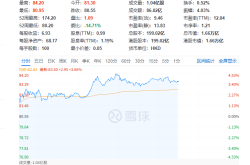
After Alibaba released its financial report on November 19, its US shares rose more than 4% during intraday trading before ultimately closing down 1.26%. The US stock plunge was simply too brutal.
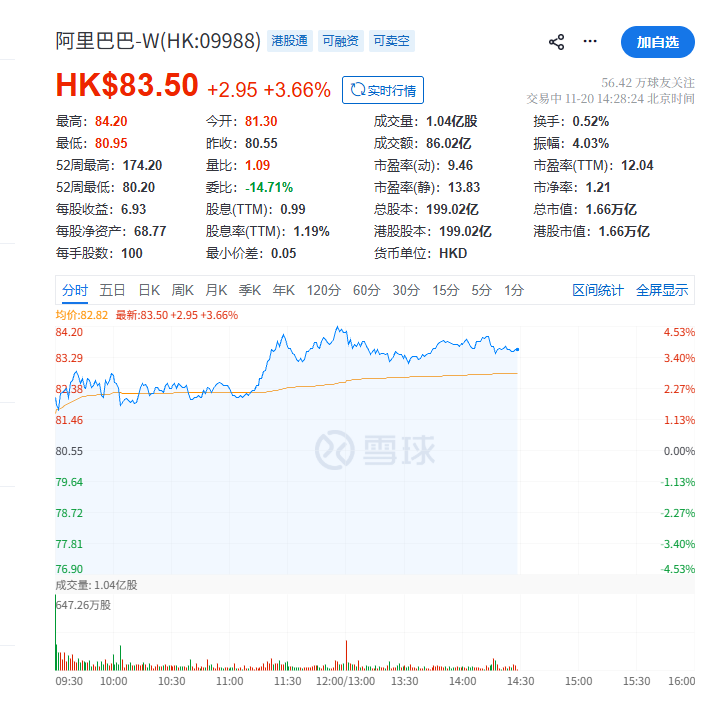
Fortunately, Hong Kong stocks held steady today. Even as the Hang Seng Index fell 2%, Alibaba still surged 3.6%. Actually, just look at the data and you'll understand.
This quarter, Alibaba's revenue was 271.5 billion yuan, up 10% year-on-year, slightly beating expectations, and adjusted EBITA surged 260%. But on the other hand, free cash flow showed a net outflow of 34.5 billion yuan, 12.6 billion yuan more than the same period last year.
To put it plainly, Alibaba's problem now is not that it can't make money, but that the AI business burns too much money. With tens of billions poured in every quarter, investors naturally want to know when this money will be earned back.
After going through the financial report, I think several numbers are quite worth pondering. Alibaba Cloud in particular—the cards it spent heavily on last year are now indeed starting to make money.
Alibaba Cloud: A Brilliant Bright Spot in the Cold Winter
First, let's look at Alibaba's AI, cloud, and computing power services segment.
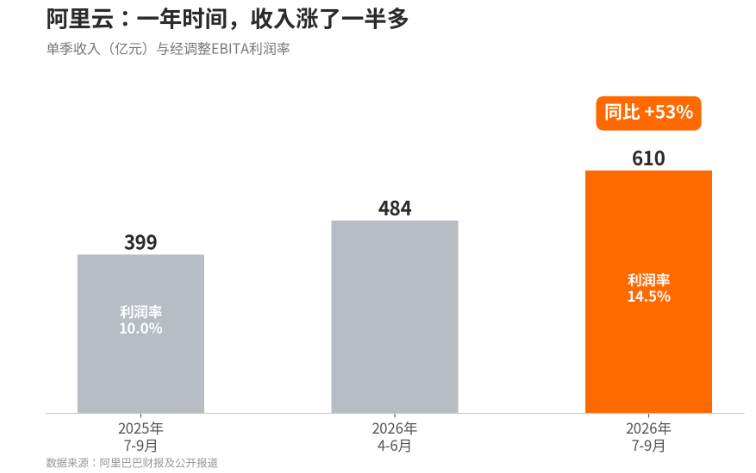
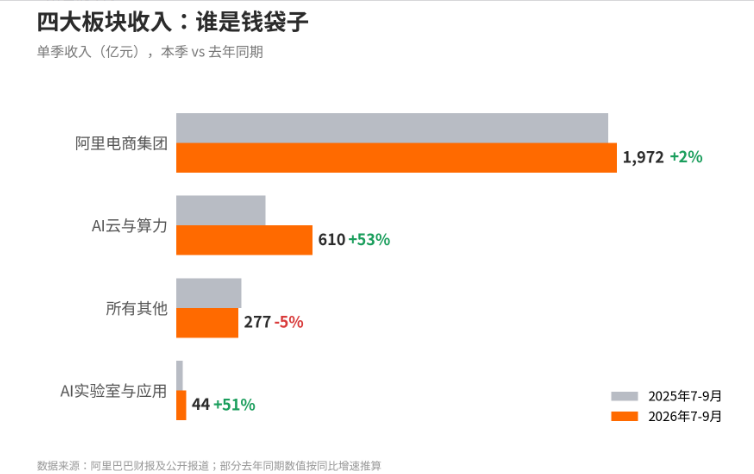
Revenue from Alibaba's AI, cloud, and computing power services segment reached 61 billion yuan, up 53% year-on-year; external customer revenue reached 47 billion yuan, up 64% year-on-year, accelerating growth for the tenth consecutive quarter. Excluding revenue from computing power equipment solutions, external customer recurring revenue grew 67% year-on-year to 37 billion yuan.
Against total revenue of 270 billion yuan, AI cloud service revenue has risen to about 22% of the entire group.
Why do I value the latter number more?
A year ago, Alibaba Cloud's quarterly revenue was still less than 40 billion yuan; now it has grown by more than half. Compared with last quarter's 48.4 billion yuan, this is also a clear acceleration.
What's even more rare is the quality of growth:
External customer revenue grew 64%, showing it is not relying on Alibaba's own businesses in a "left hand to right hand" manner.
Excluding revenue from selling computing power equipment, external recurring revenue grew 67%, and this part is the most stable "subscription-style" revenue.
AI-related product revenue was 17.9 billion yuan, growing triple digits for the 13th consecutive quarter. At this rate, that's more than 70 billion yuan a year.
Selling equipment is a one-off deal—once it's sold, it's over. But cloud services are different: if customers use them this month, they will most likely still use them next month.
Moreover, cloud services have a characteristic: the deeper customers use them, the less likely they are to switch.
For example, an e-commerce company initially tries AI customer service and may use whichever model is cheaper. But once tens of thousands of inquiries a day are handed over to AI, and order, inventory, and refund systems are all connected, switching suppliers is no longer so easy.
So what if another provider is 20% cheaper? The system needs to be re-integrated, the business needs to be re-tested, and if something goes wrong during a major promotion, the money saved may not even be enough to cover the losses.
This is also why I think the truly valuable part of Alibaba Cloud is not just how much computing power it sells, but whether it can keep customers for the long term.
Customers may initially buy only computing power, but later they also use databases and model services. Alibaba does not need to find new customers again and can earn more money from the same customer.
Of course, we cannot yet directly say that Alibaba Cloud has entered a high-profit stage. But this quarter the adjusted EBITA margin of the cloud business has reached 14.5%, which at least shows that after scale expansion, there is room for profit improvement.
Management also mentioned on the earnings call that computing power supply is currently tight and the pricing environment is relatively favorable.
With demand and prices available right now, Alibaba Cloud certainly has an easier time making money. What is truly worth looking forward to is whether these customers will stay after computing power is no longer so tight.
If they stay, Alibaba Cloud's future profit margin may look much better than now.
Of course, given the degree of domestic involution, I do not think cloud profit margins can reach the overseas level of 30%, at least not in the medium term. I think a 15% profit margin is already good, with growth revised down to 30%. Using AWS as an anchor, discounting growth to 78% and profit margin to 40%, the implied PS is about 3.12 times, so Alibaba Cloud is worth about 717.6 billion yuan (FY2027E estimated revenue of 230 billion yuan x 3.12 times PS valuation).
A personal view: currently, the best profit model for AI is still 2B, because AI is more like a library or a teacher, and you need to use your brain to interact with it. In daily life, most people do not want to use their brains, and at present it cannot replace physical labor, so dependence in personal daily life does not feel very high, and free versions are basically enough. At work, some platforms and systems are quite effective when empowered by AI, and enterprises are still willing to pay.
How Much Is T-Head Worth After Listing? I Care More About How Much It Can Deliver
There was another noteworthy piece of news on this earnings call: T-Head plans to list in Hong Kong.
The valuation certainly leaves a lot of room for imagination, but I think what matters most right now is not valuation, but production capacity.
Wu Yongming revealed that Alibaba has begun using this year's self-developed chips to train the next generation of models, and Zhenwu V900 is planned for large-scale commercial use in the second quarter of 2027.
He also gave growth expectations for the cloud business over the next two years: next year's growth rate is initially estimated at 30% to 45%, and by 2028, as domestic computing power further scales up, there is hope of returning to 50% or even higher.
There is actually a quite realistic problem hidden in this.
AI computing power demand is so strong now, and customers are willing to spend money, but cloud vendors may not necessarily have enough cards.
In the cloud business, the worst thing is when customers have money and demand, but you cannot deliver. Customers cannot wait for you forever; if they cannot wait, they go elsewhere.
So T-Head's significance to Alibaba is not just that there is one more chip company that may list.
More importantly, if self-developed chips can be supplied stably, Alibaba Cloud can be less constrained by external supply chains.
Orders that could not be accepted before because of card shortages may be accepted in the future. And if the overall cost of self-developed chips is more advantageous, the profit of the cloud business may also have a chance to improve further.
Of course, chip announcement and truly large-scale delivery are two different things. How many V900 units can be delivered next year and how effective the actual deployment is still need to be watched.
But at least Alibaba is already trying to truly connect chips, models, and cloud services.
Spending 17.2 Billion Less—Is Alibaba Almost Past the Cash-Burning Period?
Let's also talk about what the market worries about most: capital expenditure.
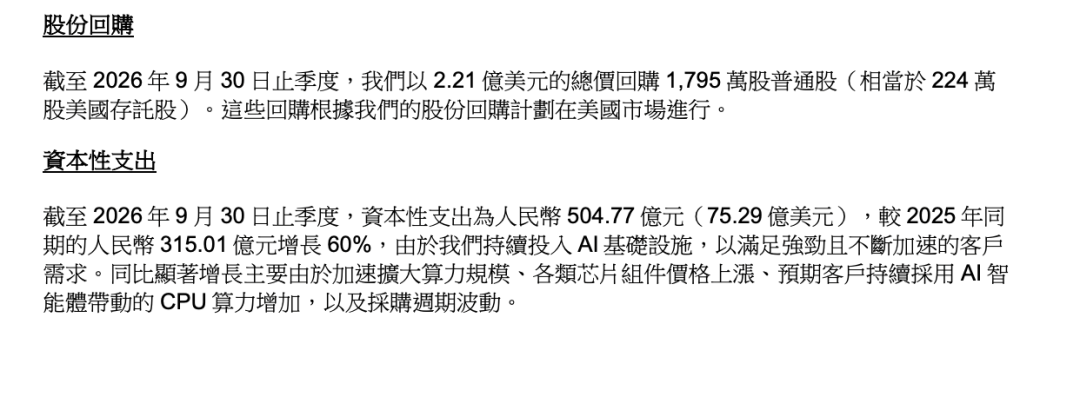
This quarter Alibaba's capital expenditure was 50.5 billion yuan, up about 60% year-on-year, but down about 17.2 billion yuan from last quarter.
Seeing the quarter-on-quarter decline, some may think: is Alibaba's current round of AI investment almost peaking?
I think we cannot say that yet.
Management has already explained that the quarter-on-quarter pullback in capital expenditure was affected by procurement cycles, and over the next two years, domestic chip production capacity will continue to be expanded.
So Alibaba will certainly continue to spend money. It's just that how it spends later and how long it takes for the money spent to pay back may be more important than simply comparing who spends more.
Another number worth noting is buybacks.
This quarter Alibaba repurchased US$221 million of shares. Compared with massive capital expenditure, the buyback scale is indeed not large.
But this is not hard to understand. Right now is the time to seize the market in AI computing power, and using available money first to expand production capacity is more in line with Alibaba's current-stage choices than buying back shares.
If capital expenditure growth slows in the future and the cloud business can continue to contribute profit, Alibaba will naturally have more room for shareholder returns.
However, this still depends on when free cash flow truly improves. After all, no matter how good paper profit looks, equipment bills still have to be paid in real money.
Instacart-Like Flash Shopping Loses Less Money, and E-Commerce Can Finally Breathe a Sigh of Relief
Besides the cloud business, there was another change this quarter that I think the market may not have paid enough attention to.
Alibaba's e-commerce group adjusted EBITA grew 243% year-on-year, and one of the main reasons was the narrowing of losses in flash shopping.
Everyone should still remember how fierce the food delivery war was last year. Subsidies, delivery, merchant incentives—every one of them costs money.
If such a war continues, market share is certainly important, but investors will sooner or later ask: when exactly can losses be reduced?
Now at least some changes are visible.
According to management, flash shopping's market share has stabilized, average order value is rising, and losses have begun to narrow.
This is actually a good signal.
For high-frequency businesses like food delivery, if users can only be retained through large subsidies, then no matter how large the scale is, it may not be worthwhile. But if market share can stabilize and subsidies can slowly come down, the entire business becomes much easier to calculate.
Of course, Taobao and Tmall's main site cannot yet be said to have fully resumed growth.
This quarter customer management revenue fell 5% year-on-year. Even after excluding the impact of revenue offsets from new business plans, it grew only 1% on a comparable basis.
So we cannot say that Alibaba's e-commerce has completely turned around just because e-commerce profit surged.
But the fact that flash shopping can begin to reduce losses at least means Alibaba no longer has to keep using money earned from its main business to fill the holes of new businesses.
This is also a real help for improving cash flow.
Finally, Why I Am Still Relatively Optimistic
You will see an interesting phenomenon: the market's pricing of e-commerce and cloud is much more conservative than the value they actually create, especially cloud, which is almost treated as "free." This is not to say Alibaba is undervalued—rather, it tells you that the market is now only willing to pay for "certain profit" and puts a question mark on all "future growth."
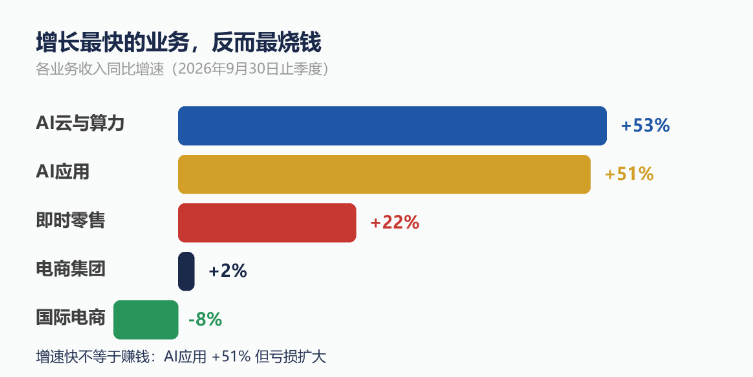
The problems in this financial report are actually obvious: capital expenditure remains high, free cash flow is still flowing out, and Taobao and Tmall's growth is not ideal either. Through the above analysis, the market's attitude becomes clear: it assigns almost zero value to Alibaba Cloud and basically no valuation to Ant equity, equivalent to betting on a pessimistic assumption—AI cloud is worthless, and e-commerce has reached its end.
But cloud revenue growing 53% and profit margin at 14.5% are hard data, and these two sides clearly do not match. Part of the market's pessimism may be sentiment, not entirely based on facts.
I think, rather than just looking at these numbers, what is more worth noting is that the effects of Alibaba's spending are beginning to show.
Cloud business revenue grew 53%, and recurring revenue grew 67%, showing that the computing power invested earlier is continuously being converted into revenue. If T-Head's chips can smoothly scale up next year, Alibaba Cloud can also take on more orders.
On the other hand, flash shopping has finally begun to reduce losses.
Looking at these two things together is actually quite interesting.
Previously, Alibaba was spending heavily on AI while also having to spend money on the food delivery war. Now the cloud business's ability to make money is strengthening, and flash shopping has begun to lose less, so at least the operating situation is moving in a good direction.
I think in the next few quarters, it is enough to watch two indicators: one is whether Alibaba Cloud's recurring revenue can continue to grow rapidly, and the other is whether flash shopping's losses can continue to narrow.
As long as these two trends remain unchanged, Alibaba has a chance to rely on money it earns itself to bear an increasing share of AI investment.
By then, even if capital expenditure remains high, cash flow pressure may also gradually ease.
Everyone has experienced the cruelty of Hong Kong stocks during this period. Negative news does not often land and turn into positive news as it sometimes does in A-shares. Once results fall short of expectations, the selling is merciless.
Alibaba has not yet reached harvest time, but at least the money spent before has begun to make a sound.
Disclaimer: This article is based on the public company status of listed companies. Meigang Tan'an strives to ensure that the content and views contained herein are objective and fair, but does not guarantee their accuracy, completeness, timeliness, or otherwise; the information or opinions expressed in this article do not constitute any investment advice, and Meigang Tan'an assumes no responsibility for any actions taken based on this article.
-
![]()
Toyota's October Sales in China: A Breakdown of the Two Joint Ventures
-
![]()
BYD's Two Bodies
-
![]()
IM Motors October Sales: 7,846 Vehicles, LS6 Accounts for 66% — Where Is the Second Mainstay Model?
-
![]()
The AI Bubble You Can't Escape
-
Token Economy: Top 10 Companies with the Fastest Growth and Strongest Profitability
-
![]()
Alibaba's AI Spending Is Starting to Pay Off
-
![]()
From Benchmark Tables to Interactive Screens: How Qwen4-Max Reflects the Second Half of Domestic Large Models' "Scenario Breakthrough"
-
![]()
60-Day Payment Terms a Year and a Half On: Automakers Turn the Invoice Date Into a Loophole