The AI Bubble You Can't Escape
 11/23 2026
 564
To succeed, an AI investor must—at least to some degree—accurately predict a daunting list of variables: how the technology will evolve, how much computing power will be needed, how the competitive landscape will shift, who will capture the value, whether financing will remain available, and the timing of every one of these factors. Assessing all of this is extraordinarily difficult.
What is certain, however, is that the birth of each wave of disruptive technology does not automatically deliver returns to investors. In fact, most people end up taking heavy losses in technology bubbles.
Technology does eventually deliver on its promise—but most investors cannot escape the bubble along the way.
Text | Haoran Cover image | "The Backrooms" This article is an original article by Shangyin Society. For reprinting, please contact
"Black Friday"
Global stock markets have recently weakened in unison, with tech stocks under particular pressure. On Friday, US stocks even ushered in a "Black Friday," with all three major indices suffering heavy losses. Over the week, more than $4 trillion in tech-stock market value evaporated.
The Dow and the S&P have both fallen nearly 10% from their highs, while the Nasdaq—more purely tech—has dropped nearly 18% from its peak, erasing all of this year's gains and touching the threshold of a bear market.
At the corporate level, AI-related emerging cloud computing and chip companies such as Nvidia, the Philadelphia Semiconductor Index, SanDisk, Micron Technology, Broadcom, and Marvell Technology generally saw double-digit declines. Nvidia's share price has nearly halved compared with early October.
The Chicago Board Options Exchange Volatility Index (VIX), known as the "fear index," touched 40 at one point—the highest level since the tariff turmoil of April 2025.
The selloff was driven by a combination of adverse factors: mounting doubts in the market about AI investment returns; Nvidia—the "flag and faith" of AI—running into stiff regulation; the Federal Reserve continuing to signal interest rate hikes; and the Democratic Party, which advocates slowing AI development, winning a landslide victory in the midterm elections.
Investors had initially hoped that AI star company Anthropic, which went public this week, could revive enthusiasm for tech stock trading. Instead, after a brief rise, Anthropic's share price fell more than 10%, only accelerating the market's decline.
As global tech stocks have logged consecutive gloomy days, warnings about the AI boom have also multiplied since the second half of this year.
Recently released minutes of the Federal Reserve meeting show that almost every Fed official is worried about the same question: if the AI boom disappoints investors, what will happen to the financial system?
In addition, according to Cailian Press, European Central Bank policymakers pointed out in a recently released report that the global debt-driven artificial intelligence investment boom has "similarities" with the subprime bubble that triggered the global financial crisis nearly two decades ago.
Bridgewater founder Ray Dalio warned that a large amount of debt funds is currently being used to support investment in the AI field. As interest rates continue to rise and financing costs continue to climb, the market will gradually approach the critical moment when the bubble begins to burst.
Former US Securities and Exchange Commission (SEC) Chairman Gensler warned that the AI boom has formed a bubble, which may burst before the US presidential election in November 2028 and trigger an economic recession.
……
When exactly will the AI bubble burst?
That is difficult to predict. As Oaktree Capital co-founder Howard Marks said in a recent interview, to succeed, an AI investor must—at least to some degree—accurately predict a daunting list of variables: how the technology will evolve, how much computing power will be needed, how the competitive landscape will shift, who will capture the value, whether financing will remain available, and the timing of every one of these factors. Assessing all of this is extraordinarily difficult.
What is certain, however, is that the birth of each wave of disruptive technology does not automatically deliver returns to investors. In fact, most people end up taking heavy losses in technology bubbles.
Technology does eventually deliver on its promise—but most people cannot escape the bubble along the way.

Lessons from Three Technology Bubble Bursts
"Bubble" is a neutral word—not a bad thing in itself. Technological innovation is inevitably accompanied by investment impulses and entrepreneurial impulses. It is precisely these initially seemingly "wildly imaginative" impulses that have driven industrial progress.
But when more and more people join in, becoming overly optimistic about technological innovation, and technological change moves from small-scale experiments to large-scale promotion, it can easily become detached from reality. In this way, the ever-inflating bubble gradually evolves into an unavoidable systemic risk, harboring deep crises.
Every major disruptive innovation is almost inevitably accompanied by bubbles and crashes. Technology may succeed greatly, but behind it are investors whose assets have been wiped out.
The steam era had the canal bubble and the railway bubble.
After Britain launched the Industrial Revolution in the 18th century, cargo ships initially shouldered the task of bulk transportation, so Britain set off a frenzy of canal digging, investing enormous funds and manpower. The price index of canal shares soared sharply, and canals also became a high-risk investment that required a long operating cycle to recover costs.
People caught up in the frenzy at the time did not expect how quickly railways would replace canals, and eventually canal share prices collapsed.
Similar to canal investment, after railways appeared, they were also touted as the "vascular lifelines" of the new industrial era. A large amount of funds poured in, and many people invested with leverage. As a result, railway lines were laid everywhere, including remote poor areas without commercial support. The industry-wide rate of return continued to decline, and the revenue generated was only a quarter of what builders expected. Extremely high share prices could no longer be sustained, and coupled with interest rates shifting from loose to tight, this speculative movement came to an abrupt end.
In the electrical era, investment booms in aviation, automobiles, and power facilities also triggered local crises. Quite a few investors suffered heavy losses in these technological changes, because from the emergence of a technology to its large-scale rollout, it must undergo a long exploration in terms of technical routes and business models. Ordinary people find it difficult to grasp the opportunities, but very easy to fall into pitfalls.
Take the automobile industry. In the early stage, even the technical route could not be determined, forming three power routes including improved steam engines, electric motors, and gasoline engines.
We now all know that gasoline cars ultimately won. But standing at that time, it was actually difficult to see clearly. The more mature steam power and the seemingly more promising electric motors still occupied the vast majority of market share.
Even if you had then set your sights on gasoline cars and planned to invest in this type of company, you might still have failed—at its peak, there were hundreds of automobile manufacturers in the United States, and more than half of them did not survive six years.
Even if you found General Motors and Ford, which would later achieve great success, among so many companies, you also needed to buy in in time and sell at the right time—General Motors was on the verge of bankruptcy twice in the early 20th century. Many people gave up too early and did not wait for its turnaround. During the Great Depression, automobile stocks, including General Motors, suffered sharp declines again, causing many people to fall into pitfalls once more.
So on the road to investing in tech stocks, there is always a pit waiting for you.
The information age blew up an unprecedented huge bubble. After this huge bubble burst around 2000, most stock markets took at least more than a decade to emerge from the shadow of previous losses.
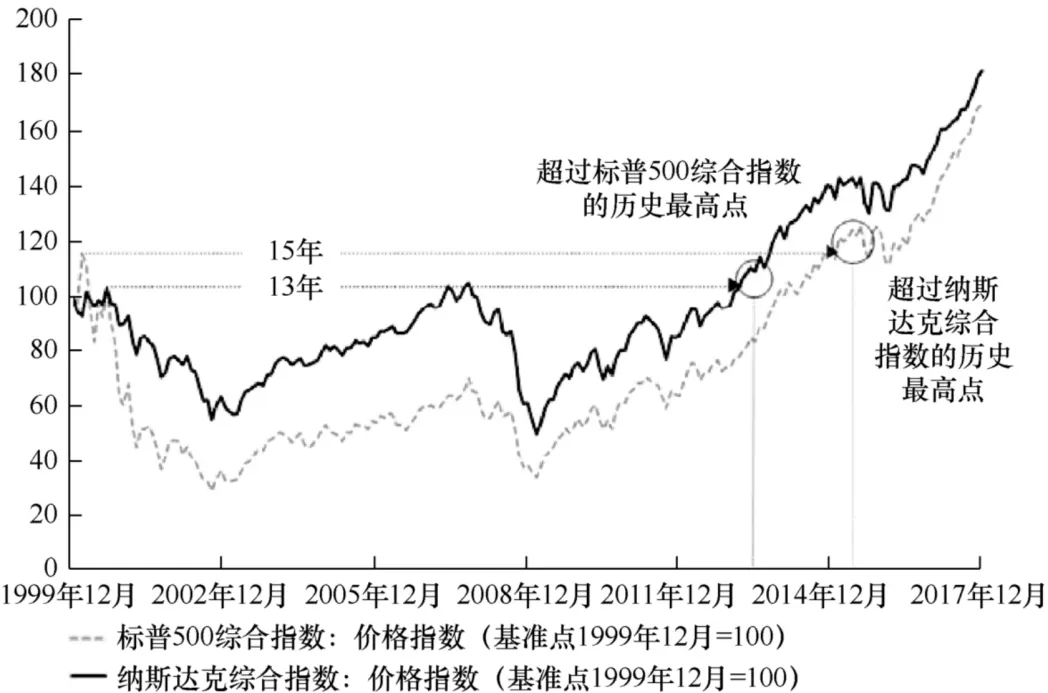
Why was the damage caused this time so great?
Investors were overly optimistic about the short-term disruptive power of the internet and firmly believed that the internet would completely subvert traditional business models.
The problem is that the internet did indeed disrupt, but that was something slowly figured out many years later. At the time, there was no reliable business model. Netscape, which made profits by selling browser licenses, and the portal website Yahoo were used as benchmark companies, and their share prices soared.
Some emerging companies without even a formed business could also obtain high valuations. Even a business plan with an "e-" in front and a ".com" at the end could exchange for tens of millions of dollars in real money.
Moreover, at that time the United States stood out in the global economy. The Soviet Union had disintegrated, Japan's economy was in downturn, and the Asian financial crisis had broken out. Only the US economy was growing. All of these were regarded as super positive factors for the US stock market. Investing in US stocks, like investing in real estate in recent years, became a belief in many people's minds of "steady profit without loss," and the market had ample liquidity.
Internet stocks were hard to obtain, and Wall Street continuously launched IPO projects to meet the public's demand for internet stocks.
The stock market bubble seemed not to have a hissing process, but burst all at once.
On March 10, 2000, the Nasdaq hit its historical high. Within a few days, the financial reports of major internet companies came out and generally fell short of expectations, and investors began to panic. At that time, a report pointed out that among more than 200 internet companies, 71% had negative profits, and 51 would burn through their cash within a year. The report was titled "Burned Out."
The Federal Reserve also felt the bubble was too large and began raising interest rates; some star companies that had once soared but lacked profit models began to be ordered to delist. By October 2002, the Nasdaq index had fallen to only a quarter of its peak level.
At the time, the media predicted that $5 trillion in wealth had vanished in this bubble burst.

The Essence of a Bubble Burst
The burst of technology bubbles is essentially caused by the split between financial capital and productive capital.
Productive capital is capital used to buy raw materials and equipment and hire labor, directly participating in the production and circulation of goods; financial capital enters the production field indirectly through investment, lending, securities trading, and so on.
Productive capital deals with the real economy: it requires buying machines, researching and developing technology, recruiting and training talent, opening markets, and doing after-sales service well. Financial capital plays with the virtual: it realizes "money making money" by discovering and investing in good projects. This also determines that the cycle for obtaining returns through productive capital is longer, while that of financial capital is shorter.
Observing from this angle, it is not difficult to see that the degree of harm caused by the three technology bubbles depends on the degree of separation between financial capital and productive capital.
In the electrical era, industries such as automobiles and airplanes produced only local bubbles. Their degree of harm was much smaller than that of the railway bubble and the internet bubble, precisely because financial capital did not excessively detach from productive capital. This is somewhat like today's new energy vehicle industry. Although dozens of brands are competing and there is also a bubble, it is more regarded as a manifestation of industry involution and excessive competition.
The railway bubble and the internet bubble, however, completely entered a frenzied stage seriously detached from cash flow and dominated by financial capital. At this time, financial capital believed it was fully capable of creating wealth through its own actions, and productive capital was merely an object manipulated and speculated on by financial capital, causing a disproportion between book wealth and real wealth, and between real profits or dividends and capital gains, ultimately ending in collapse.
Economist Carlota Perez introduced the relationship between financial capital and productive capital at different stages in the book "Technological Revolutions and Financial Capital." The stage in which the two are severely divided is when the bubble is blown up, and it is also the period when technological change is most destructive.
But at the same time, new technologies also use abundant funds at this stage to conduct frantic trial and error, lay new infrastructure, and popularize new technologies and new industries through short-term wealth creation, making it a "common sense" to use new technologies to do things.
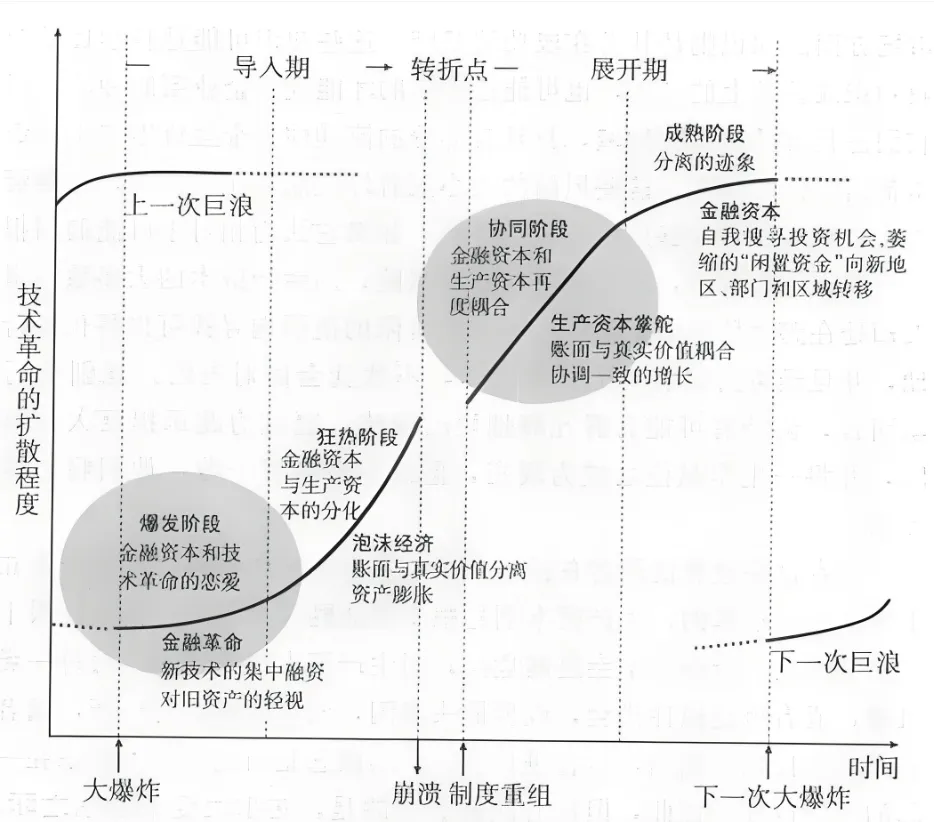
The stage of coordination between the two after the bubble bursts is the "golden period" when technology truly transforms industry.
Financial capital returns to reality, is constrained by new rules and institutions, and once again serves productive capital. Most industries also begin to widely use new technologies, with productive capital once again at the helm, creating real growth and dividends.
This has also been confirmed in reality. During the "railway bubble," share prices were pushed up by high expectations around 1850 and crashed in 1857 due to panic. The real production dividend only appeared in the early 1860s after the national road network was completed.
Similarly, after the internet bubble burst, the real dividend was truly realized in the first decade of the 21st century, beginning to transform all industries.
Financial capital, therefore, serves to absorb uncertainty in advance, whereas productive capital requires time to build infrastructure and reshape organizational forms. In the end, however, wealth creation still hinges on real output.

The Unknowability of Bubbles
On the subject of bubble warnings, the book Bubbles and Crashes: The Boom and Bust of Technological Innovation sets out a key principle: technology alone does not create bubbles. A speculative frenzy is ignited only when "high uncertainty, a compelling narrative, and a tradable vehicle" resonate together.
The Uncertainty Dimension
Uncertainty chiefly encompasses technical pathways, market competition, business models and value chains, and market demand. The greater the uncertainty across these factors, the greater the likelihood of sharp swings. Conversely, once they become clear, the likelihood of a bubble diminishes.
The Narrative Dimension
"Before a company truly takes shape, it is really just a story about an 'imagined future.'" In other words, behind every "technology narrative" lie expectations and conjectures about the future—essentially people's "bets" on where the future is headed.
Whether a "technology narrative" is compelling depends first on the room for imagination. The more future scenarios a technology can conjure in people's minds, the more likely it is to draw a larger following.
In the railway bubble, for instance, railways were not merely the arteries of bulk freight transport; they were also tied to urban expansion. Built to everyone's doorstep, they would ease daily travel and greatly benefit the upgrading of international trade—thus drawing in more investors.
The internet, too, initially painted a rosy vision of transforming every aspect of clothing, food, housing, and transportation, drawing people from all walks of life to invest in the future.
Second, it depends on how long the narrative takes to resolve. The longer a narrative goes unverified, the greater the possibility of a bubble. Canals, railways, electricity, the internet, and AI all require lengthy periods to lay infrastructure, and during such periods a great deal of speculative behavior breeds.
Finally, there is the threshold of understanding for the narrative. Technology is generally highly complex. If a complex technology is explained in an extremely accessible way, close to ordinary life, and the investment threshold is relatively low, it will prove more contagious, spread more widely, and attract a larger following.
The Tradable Vehicle
This refers, in fact, to companies tightly bound to a given technology and carrying its narrative. Investors see them as explorers through whom the technology can be realized, and buy into the "technology narrative" by buying their stocks.
Tesla, for example, stands as a symbol of new energy vehicles, and Musk is a figure who constantly draws public attention. But Tesla ultimately delivered on the promises in its story. That wave of new energy vehicle manufacturing, however, was not only about Tesla; a string of names—Fisker, Dyson, Bright, Coda—flashed by in quick succession, and they too carried this narrative and attracted investors.
AI investment refers to companies tied to industry chains such as cloud computing, chips, and large models. When there are too many such vehicles and most lack any real performance to support them, valuations can only be driven by story hype, and the bubble grows ever larger. During the internet bubble, more than 70% of the 200-plus internet companies had negative profits—already an extremely dangerous signal.
If the above three points are broken down, one can actually gain some understanding of tech bubbles. For instance, one can verify the key points related to uncertainty: whether there have been technological breakthroughs, the volume of mass production, whether competitive barriers have formed, and the state of the profit model; whether the core narrative of a given technology or company still holds, and whether it is gradually collapsing or becoming more solid; and the real performance of participating companies, and whether there is a risk of cash flow rupture.
But as mentioned earlier, assessing these key elements is extremely difficult—so difficult that most people simply cannot do it—so it remains hard to escape the AI bubble.
Welcome to communicate and discuss with the author~
-
![]()
Toyota's October Sales in China: A Breakdown of the Two Joint Ventures
-
![]()
BYD's Two Bodies
-
![]()
IM Motors October Sales: 7,846 Vehicles, LS6 Accounts for 66% — Where Is the Second Mainstay Model?
-
![]()
The AI Bubble You Can't Escape
-
Token Economy: Top 10 Companies with the Fastest Growth and Strongest Profitability
-
![]()
Alibaba's AI Spending Is Starting to Pay Off
-
![]()
From Benchmark Tables to Interactive Screens: How Qwen4-Max Reflects the Second Half of Domestic Large Models' "Scenario Breakthrough"
-
![]()
60-Day Payment Terms a Year and a Half On: Automakers Turn the Invoice Date Into a Loophole