Twitter Founder Returns to the Spotlight with a Blockbuster Offline Chat 'Tool'
 10/29 2026
 503
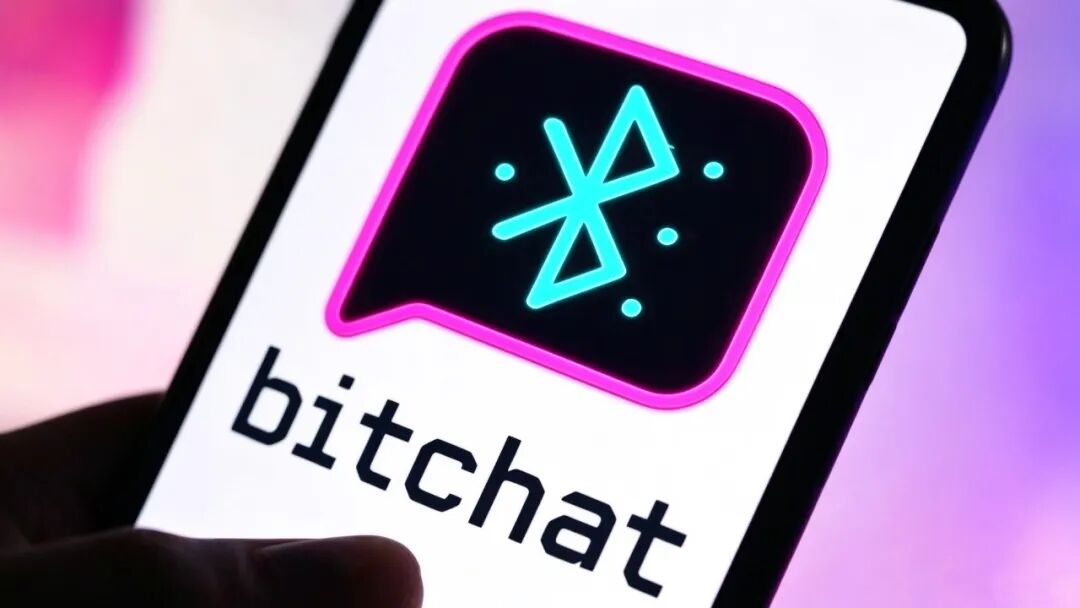
Bitchat Tops France's App Store.

An offline chat app is sweeping through France.
In late October, large-scale street protests erupted across France, while a major telecom giant suffered a nationwide outage lasting nearly 10 hours. As millions of French people feared losing contact, a chat app named Bitchat emerged unexpectedly.
What makes Bitchat special is that it doesn't require the internet at all. No SIM card, no Wi-Fi, and not even an account registration—messages can be sent as long as Bluetooth is enabled on the phone.
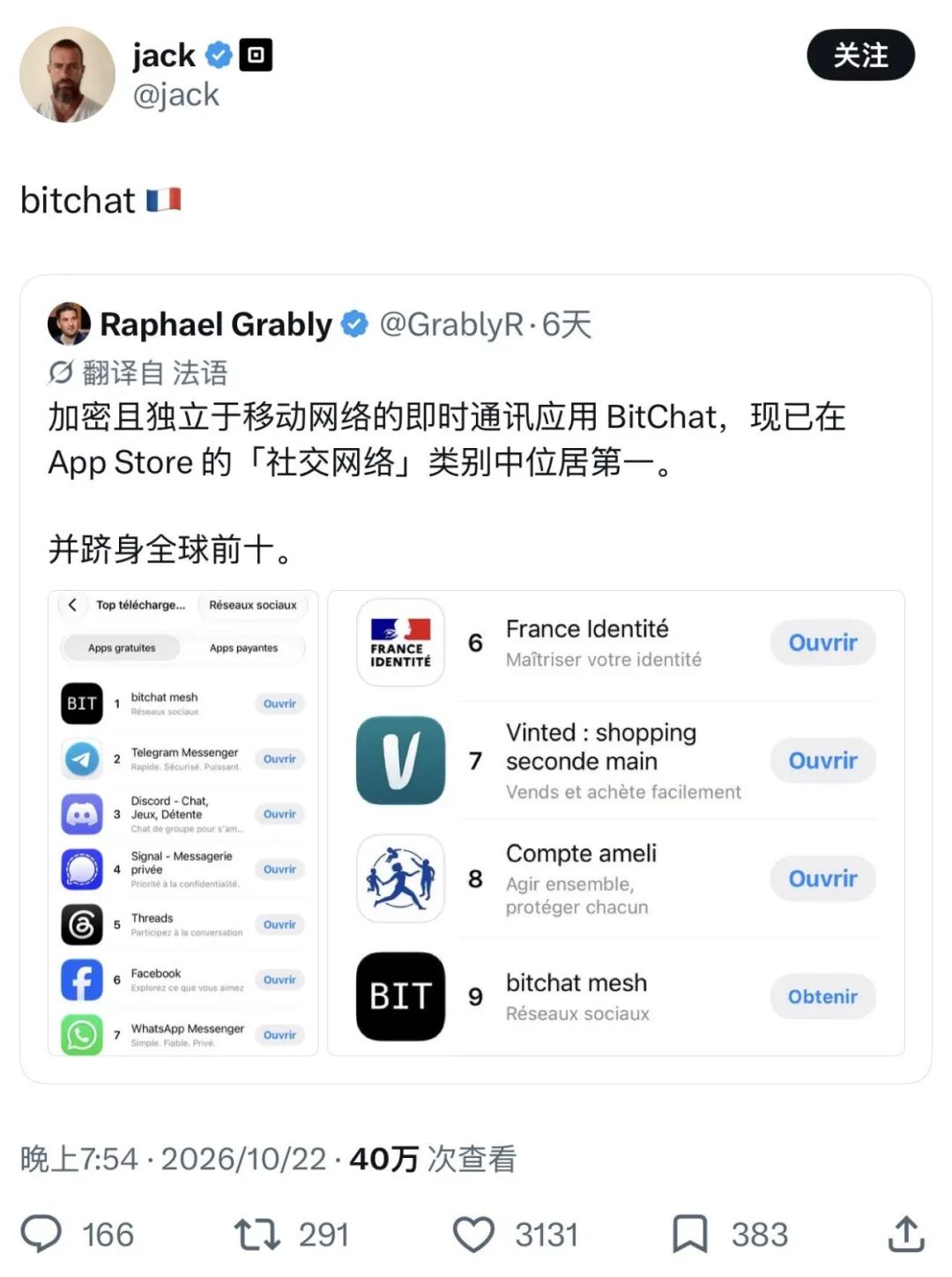
On October 22, Bitchat soared to the top of France's App Store free social networking chart, leaving behind established messaging apps like Telegram, Signal, and Threads.
The creator of Bitchat is none other than Twitter co-founder Jack Dorsey. Why would the architect of a social media giant that once connected hundreds of millions worldwide choose to build an offline app that abandons centralized servers, sparking a download frenzy across multiple countries?

During network outages, the French propelled Bitchat to the top spot.
On October 17, French citizens launched large-scale protests over rising living costs and soaring fuel prices. Demonstrations quickly spread to multiple cities, escalating tensions in the streets. The ensuing clashes heightened social unease across France.
As people worried about potential social media shutdowns, real-world communication networks also faltered. On October 21, Orange, France's largest telecom operator, suffered a nationwide outage, disrupting calls, texts, and mobile data for nearly 10 hours and affecting millions. This marked Orange's third major nationwide outage of the year.
The French took action, with social media quickly spreading calls to “install Bitchat immediately for the next protest on October 24.”
The impact was immediate. According to tech media iGeneration, on October 22, the app “bitchat mesh” topped France's App Store free social networking chart and maintained its lead on October 26; Android downloads also surpassed one million.
On October 22, the app's founder, Dorsey, posted a minimalist tweet on X: just the word “bitchat.”
So, how does Bitchat enable chatting without the internet?
The answer: it bypasses cell towers and servers, instead using Bluetooth to create a network of nearby phones.
After opening the app, your phone automatically searches for nearby devices also using Bitchat and connects them into a local network via Bluetooth. Each phone acts as both a sender and a “relay station” for messages, which hop from device to device like a game of hot potato, covering roughly 300 meters theoretically.
This makes Bitchat highly effective in crowded settings like concerts or protests. The denser the crowd—and the more likely traditional infrastructure is to fail—the better Bitchat performs.
Bitchat also prioritizes privacy to an extreme degree. The app is free, ad-free, and requires no account, phone number, or email. Even temporary identities are reset periodically.
If connected to the internet, Bitchat can overcome Bluetooth's range limits to communicate with distant users. In emergencies, users can trigger “panic mode” by triple-tapping the logo, instantly wiping all local data.
A clear pattern emerges from Bitchat's rise: it surges in popularity wherever networks go down.
In September 2025, Nepal’s government blocked multiple social platforms, sparking youth protests. Bitchat saw over 48,000 new downloads in Nepal on September 8 alone.
Simultaneously, protests in Madagascar drove downloads, pushing Bitchat's global cumulative downloads past 360,000 by month’s end. Later, internet restrictions in Uganda and Iran repeatedly fueled download spikes.
The fiercest clash occurred in India. In July 2026, youth protests erupted over exam leaks, with mobile networks cut in some regions. Bitchat downloads soared.
Sensor Tower data shows that from July 17–23, Bitchat was downloaded over 91,000 times in India, with its global share jumping from 1% to 85%. On July 19, daily downloads surged 32-fold, with over 330,000 active users.
The download surge drew Indian government crackdowns. On July 23, India’s Cyber Crime Coordination Center demanded GitHub block three Bitchat code repositories within three hours. However, with over 3,000 public forks of the main repository, the move failed to halt code distribution.
In October, India escalated, ordering Apple and Google to remove Bitchat and blocking its website and TestFlight downloads. The Internet Freedom Foundation (IFF) criticized the move, stating it restricted not just an app but users' ability to communicate during outages.
From network crises in developing nations to the streets of developed France, why did Dorsey create a tool that gives regulators headaches?

From Twitter to Bitchat: Dorsey’s decentralized vision.
Reviewing Dorsey’s recent moves reveals that Bitchat wasn’t a sudden impulse but the culmination of years of planning.
In 2006, Dorsey co-founded Twitter to amplify individual voices globally. In 2009, he launched payment company Square to democratize financial access. Both grew into industry giants, but Dorsey grew disillusioned.
He believed both companies strayed from their mission to “return power to individuals.” Twitter became algorithm-driven and ad-dependent, while Square remained shackled to banking systems and complex regulations.
Critically, centralized platforms kept control in corporate hands. If servers shut down or faced external pressure, users lost their voice.
By 2021, Dorsey shifted focus to decentralized technologies. That year, he stepped down as Twitter CEO, renamed Square to Block, and pivoted toward open technology and Bitcoin ecosystems.
After leaving traditional tech giants, Dorsey criticized Silicon Valley’s “fake decentralization.”
In late 2021, he tweeted: “You don’t own Web3. VCs and their LPs do. It’s ultimately a centralized entity with a different label.”
When top VC Chris Dixon of a16z quoted Gandhi in response, Dorsey retorted: “You’re a fund trying to build a media empire, not Gandhi.”
For Dorsey, true decentralization meant no single company or capital group controlled the network—even if wrapped in blockchain.
He championed open protocols without corporate oversight. Dorsey had funded decentralized social project Bluesky but later exited its board to support the open-source protocol Nostr, summing it up as: “Nostr has no board.”
To advance open networks, Dorsey invested heavily. In 2022, he donated 14 bitcoins to Nostr’s founder, fiatjaf. In 2024, his Start Small Foundation gave $21 million to OpenSats, an open-source donation platform, and pledged $5 million to Bitcoin developer group Brink.
Viewed chronologically, Bitchat—launched in July 2025—embodies Dorsey’s decentralized ethos: local Bluetooth networks, online reliance on Nostr, payments via Cashu, with no servers or corporate control.
Bitchat’s GitHub page quotes Eric Hughes’ 1993 *Cypherpunk Manifesto*: “Privacy is necessary for an open society in the electronic age.”
Two decades ago, Jack Dorsey built Twitter, a digital town square that erected walls. Today, he’s dismantled servers to place communication power in ordinary people’s Bluetooth connections.
References:
“Twitter Founder Creates Internet-Free Chat App, Goes Viral in France,” Shenchao TechFlow;
“85% of Users From India: This ‘Offline Chat’ App Faces Total Ban by MeitY,” TMTPost;
“French Government Plans Temporary Social Media Blockades Amid Rising Protests,” The Citizen;
“India Ordered GitHub to Delete Jack Dorsey's Bitchat in Three Hours. The Code Is Still Up,” The NE Times;
“Apple, Google remove Bitchat in India on govt order: Those determined to bypass it will, the ordinary user gets locked out,” Alt News;
“Jack Dorsey Unveils ‘Personal Experiment’ Bluetooth-Based Messaging App,” PYMNTS.
THE END
-
![]()
Fuyao Glass Reports 14.97% Drop in Net Profit to 6.006 Billion Yuan for First Three Quarters, While Dimming Glass Yield Soars from 10% to 90%
-
![]()
GPS is Vulnerable to Interference, This Startup Aims to Provide a Centimeter-Level Alternative with 258 Satellites
-
![]()
Desay SV’s Q3 Revenue Hits 9.519 Billion Yuan, Up 23.75%; Overseas Gross Margin at 31.34%, Domestic at 17.58%
-
![]()
Automotive Parts Behemoth Huayu Reports 45.5 Billion Yuan in Q3 Revenue, Net Profit Dips 6.4% to 1.687 Billion Yuan, Yet Stays Robust
-
![]()
Li Auto Shifts Focus: Can Chips, Batteries, and L4 Tech Drive the Next Phase of Competition?
-
Suzhou: Not Just Aiming for Daily Access to Driverless Cars, but Transforming the Entire City into a 'Testing Ground' for Embodied AI
-
![]()
Who Benefits More from the Split of FAW-Audi and SAIC-Audi?
-
40-Year Reversal in Technology Flow: Why Did Volkswagen Transform China from a Factory into a Global Development Hub?