Fuyao Glass Reports 14.97% Drop in Net Profit to 6.006 Billion Yuan for First Three Quarters, While Dimming Glass Yield Soars from 10% to 90%
 10/29 2026
 481
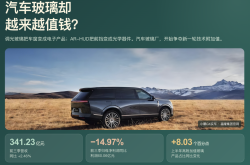
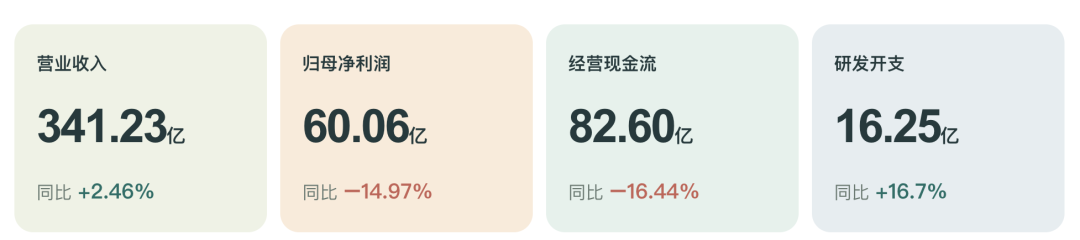
Fuyao Glass reported a revenue of 34.123 billion yuan for the first three quarters of 2026, marking a year-on-year increase of 2.46%. However, its net profit attributable to shareholders decreased by 14.97% to 6.006 billion yuan during the same period.
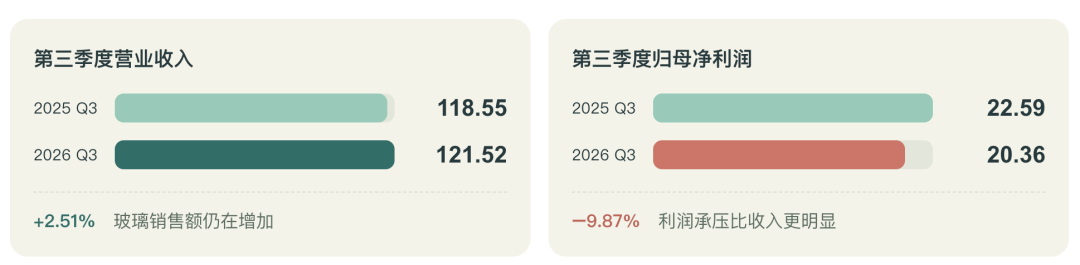
On October 20, Fuyao unveiled its Q3 2026 financial results, revealing a quarterly revenue of 12.152 billion yuan, up 2.51% year-on-year, while net profit attributable to shareholders fell by 9.87% to 2.036 billion yuan.
Over the first nine months, the company's revenue reached 34.123 billion yuan, a 2.46% increase year-on-year, with net profit standing at 6.006 billion yuan, down 14.97%. Operating cash flow also declined by 16.44% year-on-year to 8.260 billion yuan.
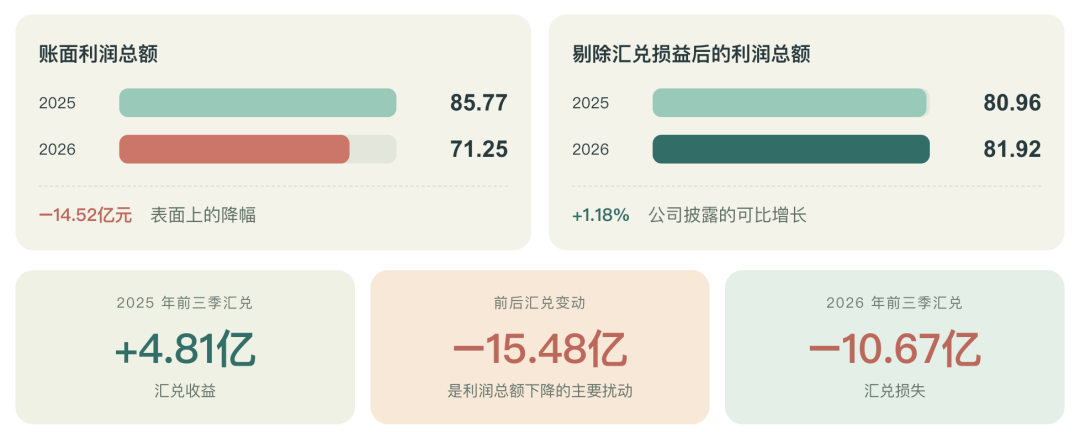
Fuyao incurred exchange losses totaling 1.067 billion yuan in the first three quarters, a stark contrast to the exchange gains of 481 million yuan recorded a year earlier, resulting in a difference of 1.548 billion yuan. Consequently, total profit dipped from approximately 8.577 billion yuan to 7.125 billion yuan, a decrease of about 1.452 billion yuan. After excluding exchange gains and losses, Fuyao estimated that its total profit actually increased by 1.18% year-on-year.
In Q3, the group's gross margin stood at approximately 38.0%, showing a marginal year-on-year increase of about 0.1 percentage point but a quarter-on-quarter decrease of about 2.1 percentage points. R&D expenses for the first three quarters amounted to 1.625 billion yuan, up about 16.7% year-on-year. The extent to which new revenue translates into profit still hinges on factors such as new capacity ramp-up, overseas operations, and R&D investment.
Merely analyzing Fuyao through automotive production and sales volumes offers limited insights. Glass is assuming an increasingly multifaceted role in vehicles.
01
The Value of Glass per Vehicle is Rising,
Yet the Challenge Lies in Processing and System Capabilities
Traditionally, automotive glass had clearly defined primary functions: the front windshield ensured safety and visibility, side windows could be rolled up and down, the rear windshield had defrosting capabilities, and the sunroof provided illumination. Procurement focused on aspects such as yield, shatter resistance, sealing, optical distortion, weight, and cost.
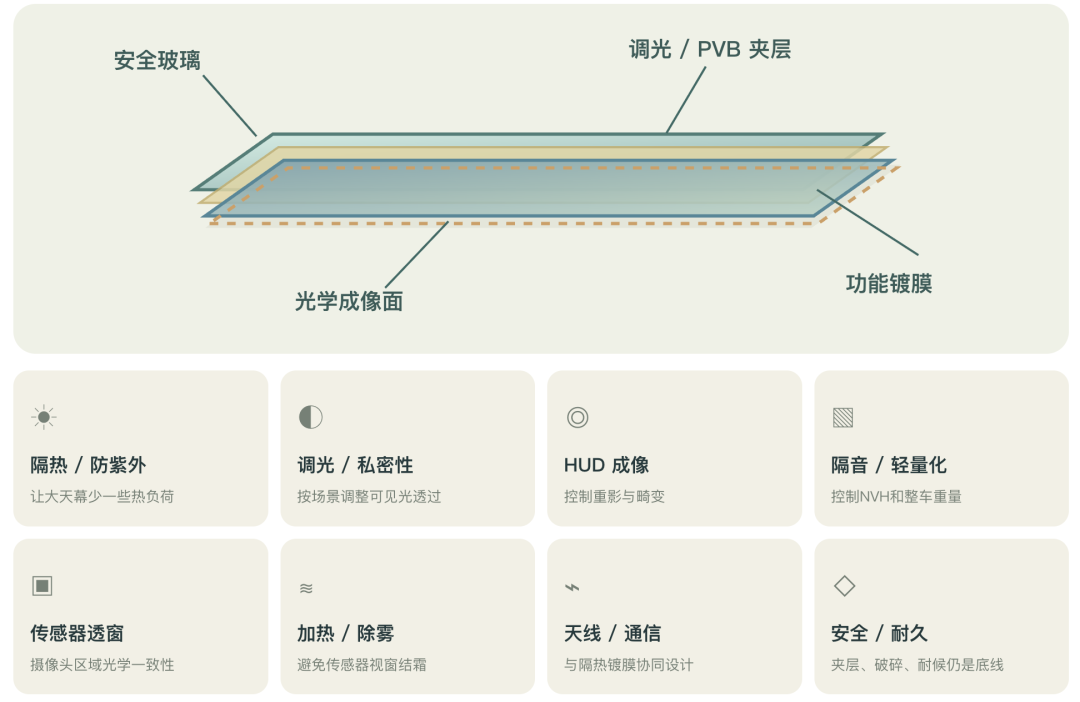
Today, while these requirements persist, automakers have introduced additional functions like heat insulation, sound insulation, privacy, dimming, HUD imaging, camera windows, and antennas.
The glass area is also undergoing changes, with large panoramic sunroofs transforming the roof into a transparent section with a high thermal load. Users now care about sun exposure in summer, one-touch shading for rear seats, and stable navigation arrow projection on the front windshield.
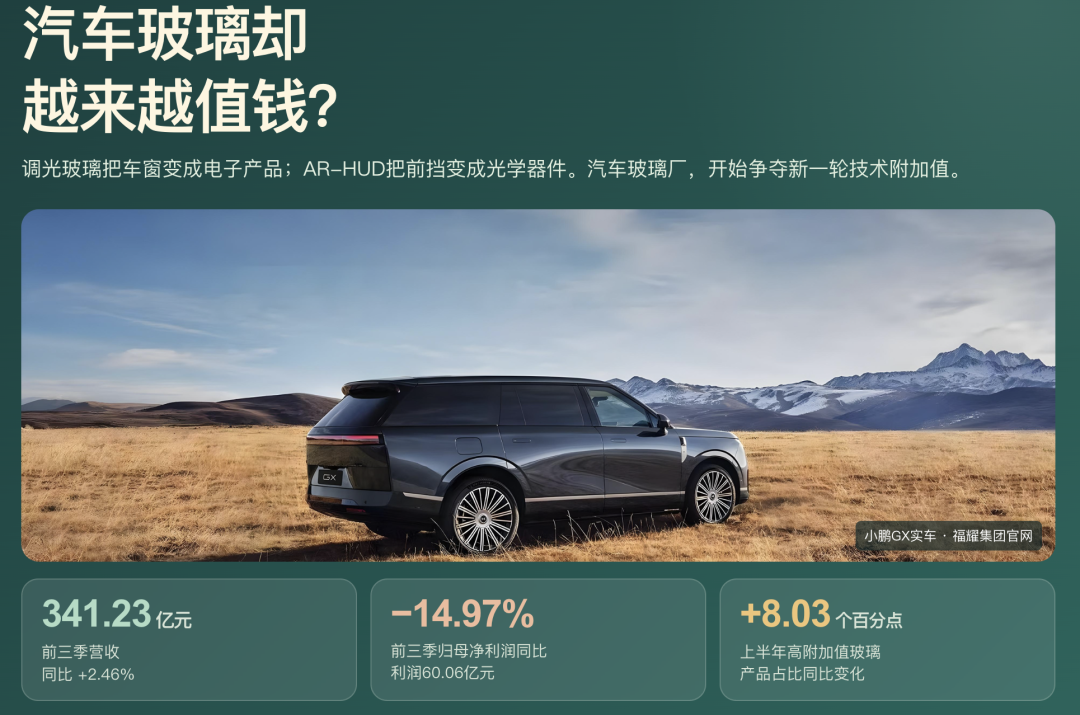
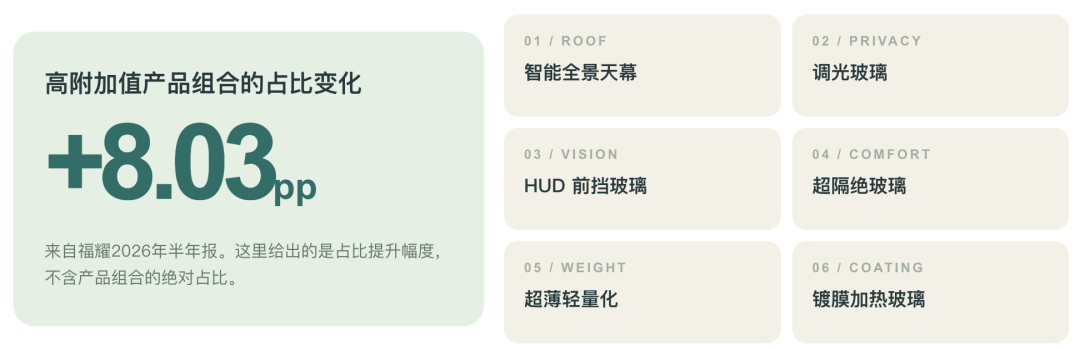
Fuyao disclosed in its 2026 half-year report that the proportion of high-value-added products, such as smart panoramic sunroofs, dimming glass, head-up displays, super-insulation, ultra-thin lightweight, and coated heating glass, increased by 8.03 percentage points year-on-year.
This figure reflects the change in the share of high-value-added products within the overall portfolio, whereas the penetration rate of dimming glass as a standalone product is measured differently. Profit per vehicle also hinges on factors such as unit price, cost, and yield.
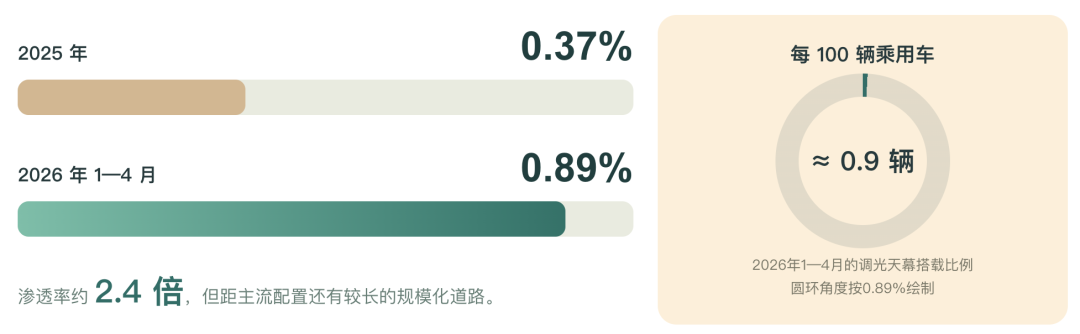
Specifically, the adoption of dimming glass is still in its nascent stages.
Fuyao's August industry report cited data from the Gasgoo Automotive Research Institute, stating that from January to April 2026, the penetration rate of dimming sunroofs in domestic passenger vehicles was 0.89%, up from 0.37% in 2025.
The base remains relatively small, with automakers extending dimming functions from sunroofs to side windows, rear compartments, and even implementing zoned control. Fuyao reported that in 2025, over 20 models featured its dimming products, with cumulative adoption exceeding 50 models.
Four technical routes are becoming increasingly distinct:
◎ PDLC (Polymer Dispersed Liquid Crystal) switches between transparent and frosted states, prioritizing privacy and line-of-sight blocking (engineering challenges include haze, heat shielding, and power-off state).
◎ EC (Electrochromic) alters absorbance and color through electrochemistry, enabling continuous brightness adjustment (challenges include response speed, uniformity, and low-temperature performance).
◎ SPD (Suspended Particle Device) relies on electric fields to arrange particles for light transmission adjustment, offering a wider range but at the cost of film cost, driving, and long-term stability.
◎ LC (Liquid Crystal) dye liquid crystals focus on rapid, low-haze, multi-level privacy adjustment, with the toughest challenges being curved forming, color difference, and local uniformity.
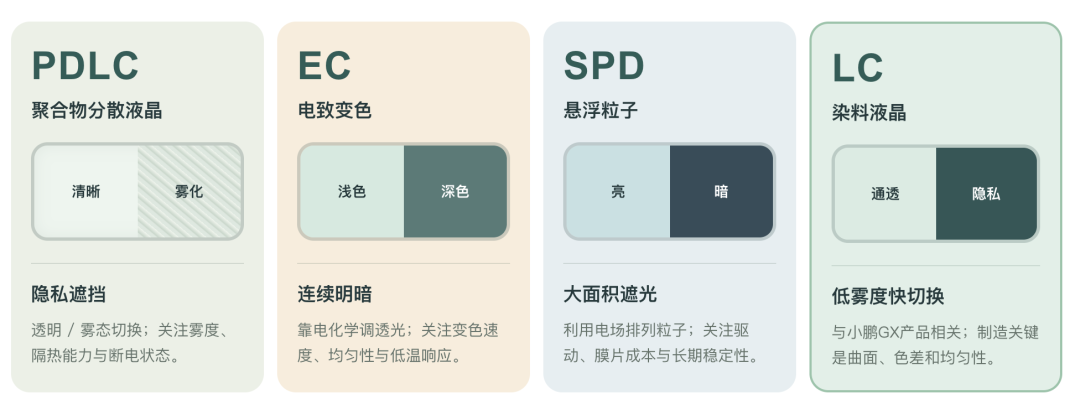
Fuyao's AI dimming privacy glass, which went into mass production with the XPENG GX this year, utilizes a dye liquid crystal solution.
The company disclosed that the transition from a transparent to a private state takes about 160 milliseconds, with the reverse transition taking 16.9 milliseconds. In its darkest state, it reduces light transmission to 0.6%; under specific test conditions, UV blockage reaches 99.9%, and infrared blockage 85%. This solution requires coordination with vehicle-side light sensing and control strategies for automatic light transmission adjustment.
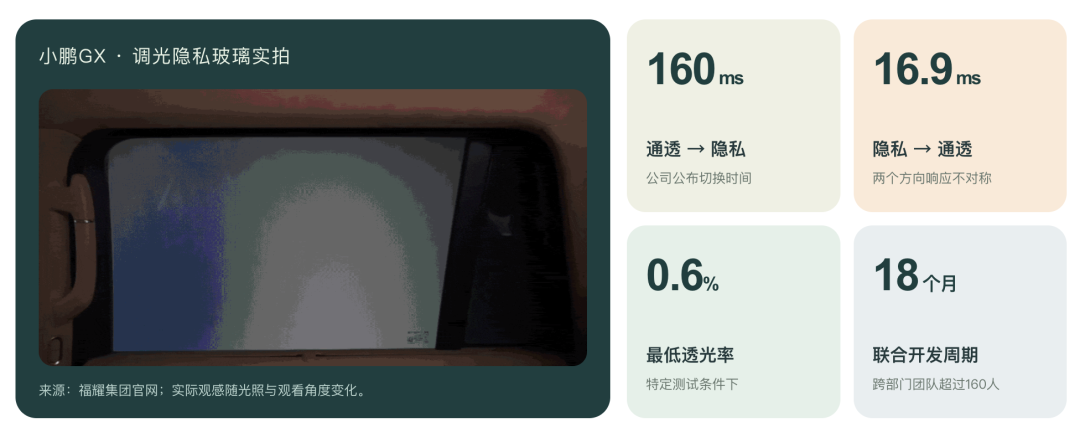
The joint development with XPENG took 18 months, with Fuyao investing a cross-departmental team of over 160 people.
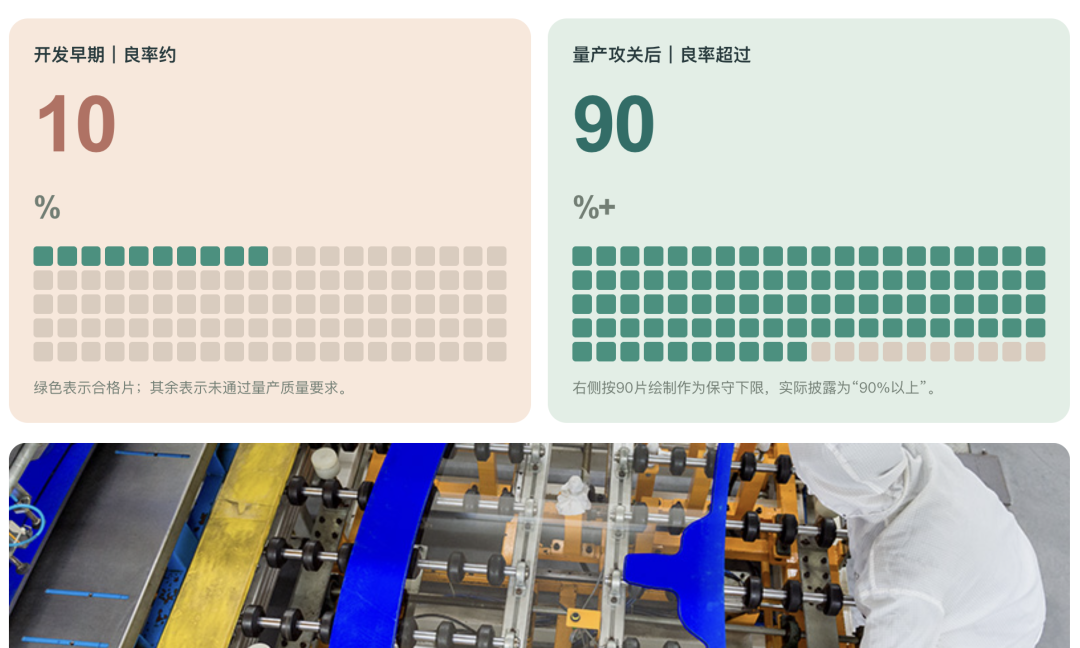
To address issues such as film thickness, edge wrinkles, black spots, and edge injection molding on large curved surfaces, product yield improved from about 10% in the early stages to over 90%.
This achievement carries more weight than a concept car's dimming video: producing 100 pieces with only 10 qualified versus 90 qualified results in entirely different scrap and manufacturing costs per qualified unit.
Fuyao is also venturing into electronic control.
Its intelligent dimming glass, jointly developed with Forvia Hella, entered mass production in August 2025, with Hella providing the controller and electronic control capabilities.
This illustrates that the increased value of glass is attracting film material suppliers, body electronics firms, software companies, and automakers to participate; the added value must be redistributed across the supply chain.
02
AR-HUD Transforms the Windshield into an Optical Component,
With International Peers in Direct Competition
Dimming alters light transmission, while AR-HUD changes the imaging precision of the windshield.
Traditional HUDs project speed and navigation information into the driver's field of view.
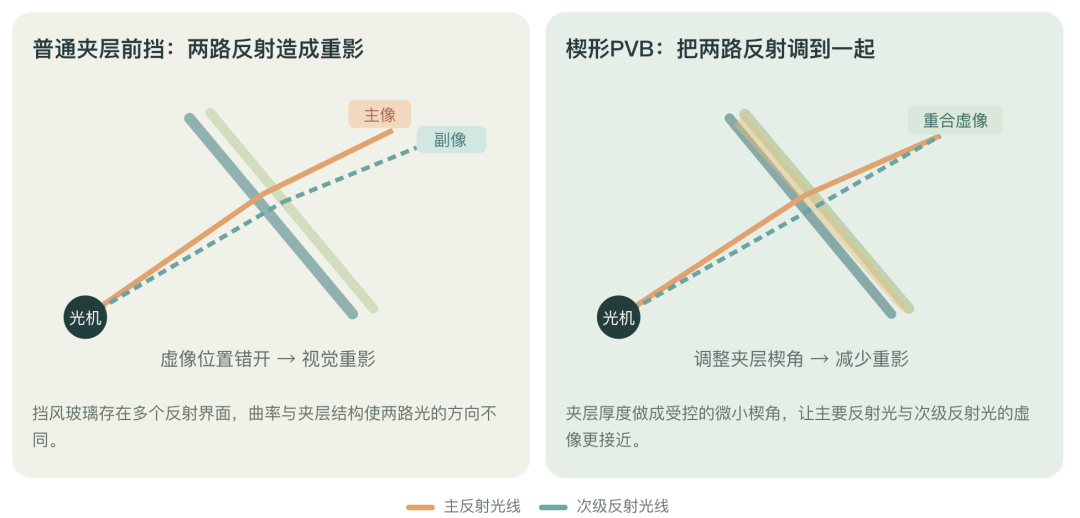
The front windshield, composed of two glass layers and an interlayer, causes HUD light to encounter multiple reflective interfaces, often resulting in two slightly misaligned virtual images, known as "ghosting." Even slight curvature or local surface errors in ordinary glass can amplify imaging distortion.
AR-HUD requires a larger display area, longer virtual image distance, and more stable visual alignment with the real road, imposing much higher demands on the front windshield.
Currently, two mainstream approaches exist:
◎ One adjusts the direction of two reflected light paths using a wedge-shaped PVB interlayer to align the primary and secondary images as closely as possible.
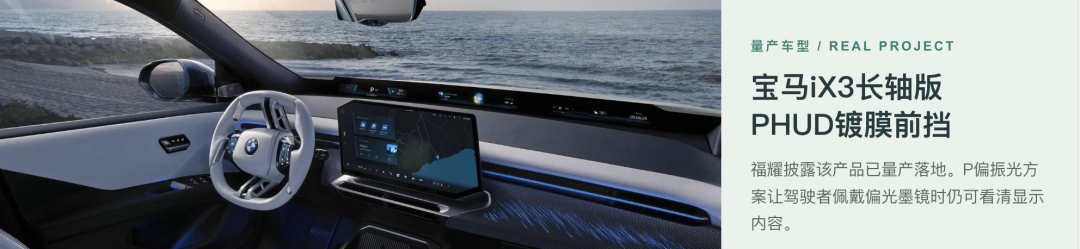
◎ The other adds a transparent optical coating to the glass, enhancing the primary image and suppressing the secondary image through selective reflection of polarized light.
Fuyao's official website showcases both wedge film and coating routes, emphasizing the latter's potential in terms of display area and development cycle.
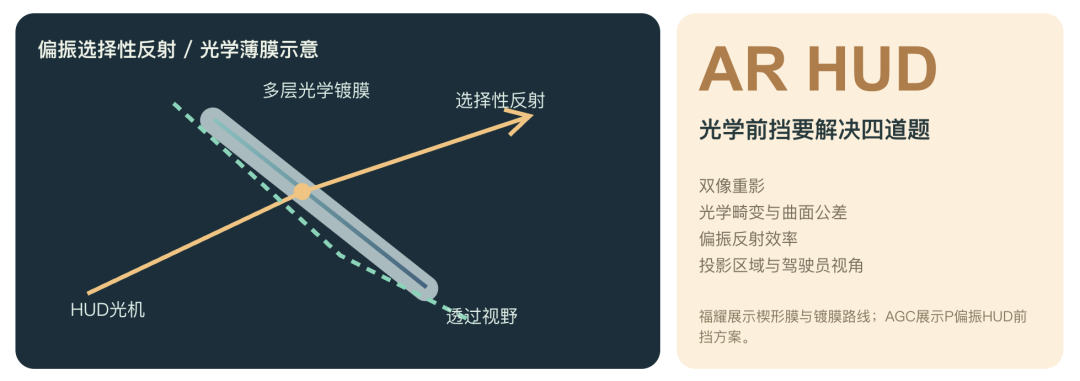
The international competition in this technical arena is direct.
Japan's AGC introduced P-polarized Black Band HUD this year: using nano-multilayer coatings on the inner surface of the front windshield to improve reflection efficiency for specified polarized light, reduce ghosting, and expand the display area across a wider front windshield range.
AGC's solution serves as a reminder to Chinese glass manufacturers that future core competitions will include optical coatings, curved surface precision, and joint calibration with vehicle projectors.
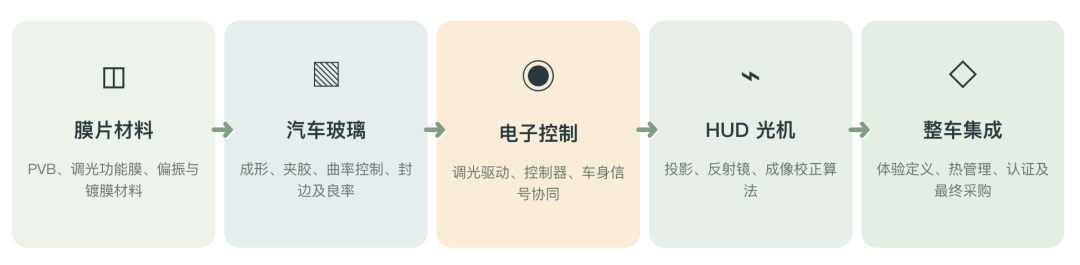
HUDs also require projectors, free-form mirrors, and software algorithms.
Larger projectors, wider fields of view, and longer image distances make coordination between glass and projectors more challenging. Ultimately, automakers procure a complete display effect, with the HUD projector's value recorded under HUD suppliers, while the glass side only captures the added value of the optical front windshield.
Window intelligence has a third layer: sensor, heating, and communication integration.
◎ Camera areas on the front windshield must control fog, frost, distortion, and optical transmittance.
◎ Hidden LiDAR requires specific wavelength windows.
◎ Heat-shielding coatings and wireless communication antennas must resolve mutual interference.
The glass industry's original material and safety certification barriers are now compounded by automotive-grade electronic and optical validations.
The competitive landscape is also shifting.
◎ Fuyao possesses automotive-grade float glass, forming, coating, laminating, and global supply systems.
◎ AGC continues to advance dimming sunroofs and polarized HUDs.
◎ Film and electronic control firms are becoming essential partners for glass manufacturers.
Whoever can control the optical consistency, manufacturing rhythm, and system costs of the entire glass piece will more easily secure high-value-added orders.
Summary:
As Glass Becomes Smarter, Fuyao Must Still Overcome Cost Hurdles
Fuyao's Q3 2026 report reveals two simultaneous changes: exchange losses depressed reported profits, while product upgrades created new value per vehicle for automotive glass. The former may recur in future quarters; the latter is already reflected in models, mass production lines, and R&D budgets.
However, dimming and AR-HUD still face cost barriers. Dimming requires addressing high/low temperature performance, long-term cycling, film encapsulation, and yield; AR-HUD must ensure curved surface consistency, display ghosting, clarity across view angles, and subsequent maintenance and replacement.
The more models and complex glass shapes there are, the harder it becomes for suppliers to cover all projects with a single standard part.
From a consumer perspective, dimming glass is about sun exposure in summer and privacy when resting; AR-HUD is about clear navigation and driving assistance prompts. From an industry perspective, a single glass piece now simultaneously meets material, optical, electronic, and software requirements.
Automotive glass is indeed becoming smarter!
-
![]()
Fuyao Glass Reports 14.97% Drop in Net Profit to 6.006 Billion Yuan for First Three Quarters, While Dimming Glass Yield Soars from 10% to 90%
-
![]()
GPS is Vulnerable to Interference, This Startup Aims to Provide a Centimeter-Level Alternative with 258 Satellites
-
![]()
Desay SV’s Q3 Revenue Hits 9.519 Billion Yuan, Up 23.75%; Overseas Gross Margin at 31.34%, Domestic at 17.58%
-
![]()
Automotive Parts Behemoth Huayu Reports 45.5 Billion Yuan in Q3 Revenue, Net Profit Dips 6.4% to 1.687 Billion Yuan, Yet Stays Robust
-
![]()
Li Auto Shifts Focus: Can Chips, Batteries, and L4 Tech Drive the Next Phase of Competition?
-
Suzhou: Not Just Aiming for Daily Access to Driverless Cars, but Transforming the Entire City into a 'Testing Ground' for Embodied AI
-
![]()
Who Benefits More from the Split of FAW-Audi and SAIC-Audi?
-
40-Year Reversal in Technology Flow: Why Did Volkswagen Transform China from a Factory into a Global Development Hub?