Li Auto Shifts Focus: Can Chips, Batteries, and L4 Tech Drive the Next Phase of Competition?
 10/29 2026
 526
Produced by Zhineng Technology
Li Auto recently convened its autumn 2026 strategic meeting. Facing sales and profitability challenges, the company has decided to refocus its resource allocation on complete vehicle products.
According to a confidential meeting reported by 36Kr, Li Auto intends to de-prioritize "embodied intelligence" in its external communications and short-term product planning. Instead, it will concentrate its investments on self-developed chips, batteries, intelligent driving technologies, and vehicle efficiency.
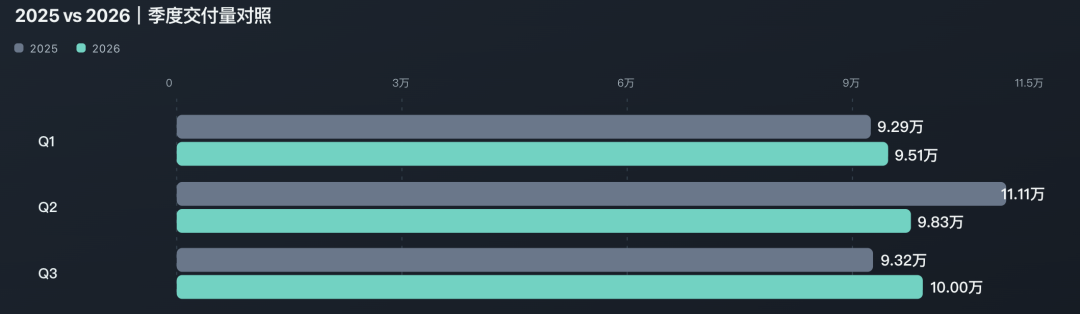
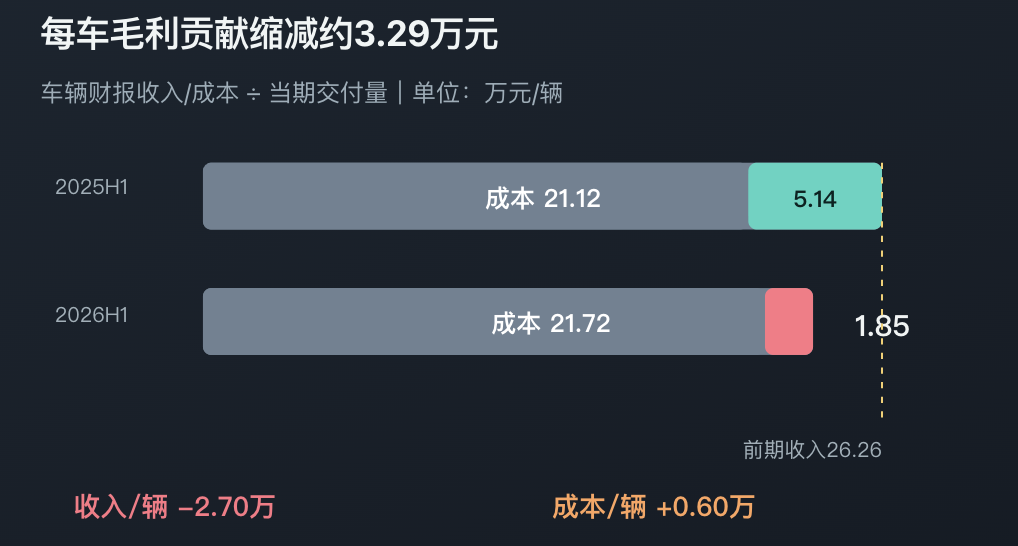
In the second quarter of 2026, Li Auto delivered 98,300 vehicles, marking an 11.5% decrease year-on-year. The gross margin for complete vehicles stood at 9.4%, a significant drop of 10 percentage points from the same period the previous year. The net loss for the quarter amounted to 1.7 billion yuan.
Sales have shown signs of recovery, with 99,964 vehicles delivered in the third quarter, representing a year-on-year increase of approximately 7.2%. However, cumulative deliveries for the first three quarters still lagged by about 1.3% compared to the same period last year.
As of the end of September, Li Auto had 485 retail stores in China, a net decrease of 63 from the end of the previous year.
Cash reserves stood at 87.5 billion yuan at the end of the second quarter. However, the free cash flow for the first two quarters was approximately -8.7 billion yuan, with projections indicating a free cash flow of -12.8 billion yuan for 2025.
While Li Auto has the financial capacity to continue investing, its funds must support vehicle iteration, R&D, energy supplementation, and overseas expansion. Therefore, it is not feasible to allocate equal priority to multiple new directions over the long term.
De-emphasizing "embodied intelligence" signifies a realignment of product language and R&D priorities.
The new-generation L9 integrates the Mach M100, a self-developed VLA model, active suspension, and brake-by-wire technology into a single vehicle, marking a significant technological advancement. However, branding such a car as an "embodied intelligent robot" may not directly assist users in making purchasing decisions.
Vehicle-end intelligence capabilities can be categorized into three levels:
◎ Perceptible user experience: This includes smoother highway and urban driving assistance, improved parking success rates, steadier decision-making at complex intersections, and better suppression of road undulations by the active suspension.
◎ Reusable platform capabilities: This encompasses unified data interfaces, model deployment, software updates, sensor and actuator coordination, and fault diagnosis capabilities.
◎ Long-term cross-scenario research: This involves general robot operation, spatial understanding, and physical interaction. These areas are technologically related but further from direct commercialization in the automotive sector.
Li Auto has not abandoned its exploration of embodied intelligence but has reduced the short-term priority of related concepts and features. Instead, it is prioritizing issues that directly impact user safety, experience, purchasing decisions, and maintenance costs.
Large model architectures like VLA represent a technological path, while L4 is a system capability goal. Voice control, automatic parking, and active chassis are user functions that enhance the driving experience.
By September 2026, Li Auto had deployed MACH VLA 2.0 via OTA to nearly 1 million AD Max vehicles equipped with Orin-X and Thor platforms.
Going forward, Li Auto's flagship models, the L9, i9, and MEGA, must redefine their value propositions to justify high-price purchases. Meanwhile, the L6 and i6 models will drive sales volume.
Both ends of the product spectrum will share a technology platform but will differ in size, price, and experience. If joint investments in chips, batteries, and VLA aim to create flagship premiums and mid-range cost advantages, the technology system must achieve operational closure.
The Mach chip is a critical component. In October 2026, Mach Heart Technology announced a total equity subscription of 1.625 billion yuan, with 1 billion yuan from the Li Auto ecosystem and 625 million yuan from external investors. This resulted in a post-investment valuation of approximately 16.63 billion yuan, with an additional maximum of 500 million yuan in subsequent subscription rights.
The Mach M100 is already in use in mass-produced vehicles, and its economic efficiency hinges on actual load utilization and software migration costs.
Li Auto is focusing on cell design and standards led by the vehicle manufacturer, with suppliers participating in manufacturing. The company is strengthening PACK and BMS integration, concentrating on two solutions: 5C ternary lithium and 5C lithium iron phosphate. This move provides larger batteries for the new i6 while controlling costs, which is crucial for competitiveness.
Li Auto views L4 as a long-term goal, which will incur validation and redundancy costs. R&D efforts should not replace mass-production auxiliary driving experience evaluation with "larger models."
In the European market, the i6, branded as the "Li 6," made its debut at the Paris Motor Show. Initial deliveries are planned for Norway and the Netherlands in the first quarter of 2027. For overseas expansion, quality should be judged in the short term by order conversion rates, delivery cycles, after-sales coverage, and per-unit gross profit contribution.
Summary:
In essence, Li Auto is now grounding its strategy in vehicles as its core foundation, adopting a more pragmatic approach than before!
-
![]()
Fuyao Glass Reports 14.97% Drop in Net Profit to 6.006 Billion Yuan for First Three Quarters, While Dimming Glass Yield Soars from 10% to 90%
-
![]()
GPS is Vulnerable to Interference, This Startup Aims to Provide a Centimeter-Level Alternative with 258 Satellites
-
![]()
Desay SV’s Q3 Revenue Hits 9.519 Billion Yuan, Up 23.75%; Overseas Gross Margin at 31.34%, Domestic at 17.58%
-
![]()
Automotive Parts Behemoth Huayu Reports 45.5 Billion Yuan in Q3 Revenue, Net Profit Dips 6.4% to 1.687 Billion Yuan, Yet Stays Robust
-
![]()
Li Auto Shifts Focus: Can Chips, Batteries, and L4 Tech Drive the Next Phase of Competition?
-
Suzhou: Not Just Aiming for Daily Access to Driverless Cars, but Transforming the Entire City into a 'Testing Ground' for Embodied AI
-
![]()
Who Benefits More from the Split of FAW-Audi and SAIC-Audi?
-
40-Year Reversal in Technology Flow: Why Did Volkswagen Transform China from a Factory into a Global Development Hub?