1.2 Trillion Market Opportunity Strikes: Computing Power Leasing Ushers in a Golden Cycle!
 11/27 2026
 517
Computing power leasing sounds new, but in the industry it is simply IDC—Internet Data Center.
Build a data center, rent it out, then lie back and collect money—this is the beautiful imagination most people have about this business. A Frost & Sullivan report also gave a figure: by 2030, the domestic IDC market size is expected to grow to 1.2 trillion yuan.
But only after truly entering this industry do you realize that being a "landlady" is not so easy.
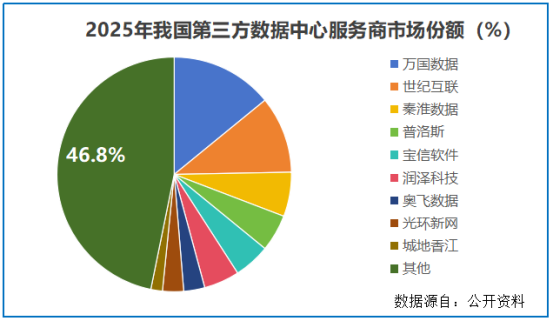
On one hand, the IDC industry has a high degree of product homogeneity and low entry barriers; all kinds of cross-industry players are crowding in, and currently nearly 50% of market share is dispersed among small and medium-sized vendors.
On the other hand, downstream demand is concentrated; big orders all rest in the hands of a few leading platforms such as Alibaba, ByteDance, and Tencent, and IDC vendors remain in a passive position during negotiations.
When products cannot be differentiated and pricing power lies with others, the path of simply building better computer rooms and selling racks more cheaply is a dead end.
Those who can run to the end in the IDC industry must be companies that have stepped outside this coordinate system.

Seeking Differentiation Inward
When people say IDC is homogeneous, what is homogeneous is the product—rack specifications and bandwidth standards look about the same across vendors.
The real gap lies at the layer of production factors: land, electricity, and energy consumption quotas are constrained by policies and resource endowments, and money alone may not buy them. Whoever holds these three items can raise their competitive barriers and leave thicker profit margins.
Baosight Software is the one that saves money by relying on ready-made factors.
Backed by Baowu Group, it directly leased the group's Luojing Steel Plant for IDC business.
The Luojing Steel Plant area is located in Baoshan District, Shanghai, covering about 2.82 square kilometers; existing factory buildings, dual-circuit power supply, and a self-owned water plant are all readily available. Baosight Software utilizes the plant resources for renovation, naturally keeping construction costs low.
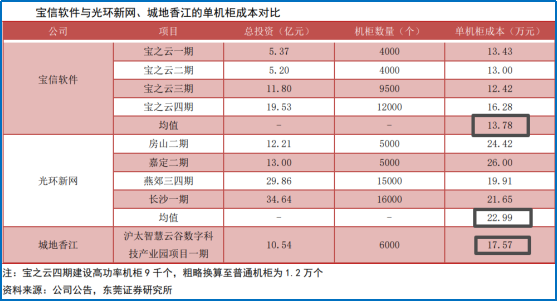
A rough calculation shows that for its Baozhiyun Phase I to IV projects, the average construction cost per rack is only 137,800 yuan, lower than peers such as Sinnet and Chengdi Xiangjiang.
Most companies cannot obtain such ready-made production factors and can only pay for them themselves—this refers to pure third-party IDC enterprises such as Runze Technology, GDS, and Chindata.
Their data center site selection basically adopts a "core region + hub node" layout, only with different emphases.
Runze Technology follows customers closely, rooted in demand highlands such as the Beijing periphery, Yangtze River Delta, and Greater Bay Area, prioritizing low-latency inference and real-time business, and securing the rigid demand for nearby computing power from big tech.
Chindata follows energy, with main parks located in wind and solar resource-rich East-to-West Computing nodes such as Lingqiu and Ulanqab, relying on computing-power-electricity synergy to lower electricity procurement costs while locking in green power quotas.
Whether approaching customers nearby or going west for computing-power-electricity synergy, the investment in GW-level intelligent computing parks is at the tens-of-billions level; land acquisition, civil construction, power distribution, liquid cooling, and energy storage support all require upfront spending.
Chindata does not disclose much data, so let us look directly at Runze Technology's books.
From 2022 to 2024, Runze Technology's annual capital expenditure remained around 4.8 billion yuan; in 2025 it jumped directly to 12.15 billion yuan, and in 2026 it still maintains this intensity. In terms of volume and growth rate, peers such as Baosight Software and Data Port fall behind.
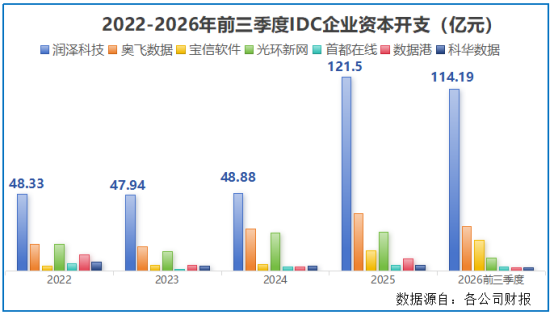
Considering that a GW-level park takes several years from groundbreaking to full production, such tens-of-billions-level investment locks in not only resources but also the time window to turn racks into orders.
"Heavy asset" lock-in also comes at a price.
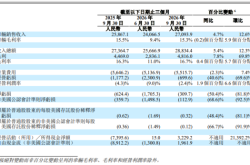
As of the end of Q3 2026, Runze Technology's asset-liability ratio had reached 71.07%, and depreciation and interest will press on the income statement early in the production phase.
Building the park is only the first step; whether racks can become cash flow still depends on the customer list and contract structure. If customers adjust their pace and rack-up is slower than expected, cash flow pressure will also emerge earlier.

Binding Customers Outward
To find a certain outlet for heavy assets, the method is to bind customers.
It is an established fact that customers are concentrated in the hands of a few giants; then the question is not whether to depend on them, but whether the dependence is locked in.
Customized long-term contracts are the most common locking method.
Both Runze Technology and Data Port favor customization for major customers, mostly serving leading internet companies and cloud vendors. In 2025, the top five customers of both companies accounted for over 95% of revenue, and the proportion of the largest customer was likewise not low.
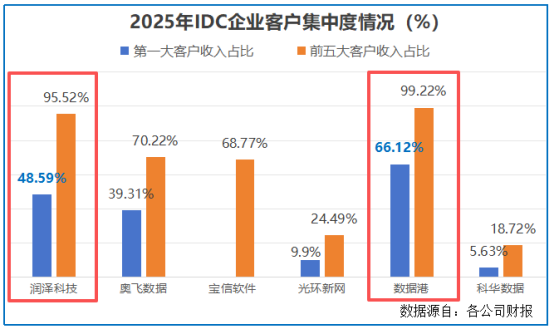
Top five customers together exceeding 95% would look like a risk warning in other industries, but in IDC it looks more like proactive order locking.
Those who can swallow an entire building or an entire park's racks in one go are currently only leading internet companies and cloud vendors. Only their long-cycle demand can support the financing and depreciation of tens-of-billions-level parks.
Once major customers' long-term orders are locked in, rack utilization has a foundation, and when energy consumption quotas tighten, local approval is also easier to obtain.
Binding itself also has depths.
Relying only on low-price long-term contracts to rent out racks still leaves customers with low switching costs; the more stable approach is to bring customers into the asset formation process.
This is the path Data Port has taken.
Major customers first issue letters of intent specifying rack quantity, power, and delivery time; Data Port then invests and builds according to demand. In this way it directly transforms from a mere computer room supplier into a co-builder of customers' computing infrastructure.
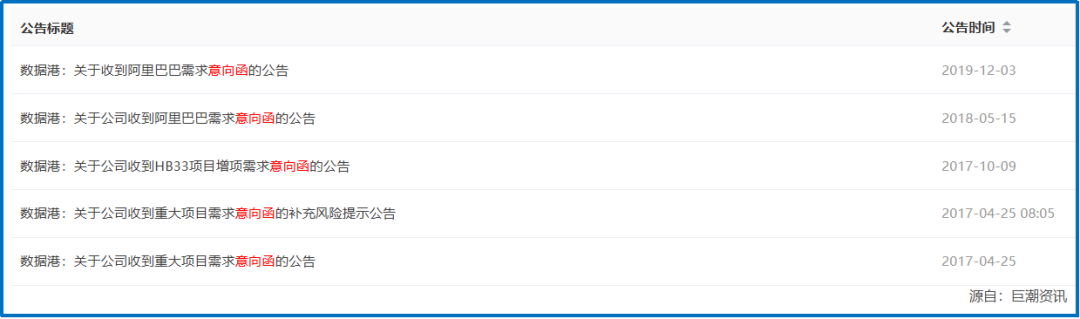
There can be many forms of binding, but there is only one test standard: whether this relationship has turned into real cash flow and contractual constraints.
First look at Data Port: at the end of Q3 2026, its contract liabilities were 280 million yuan, up 3.18% year-on-year. Customer prepayments continue to accumulate, indicating that the demand-intent-first model has indeed collected money in advance.
In the same period, the company's net operating cash flow was 674 million yuan, down 14.49% year-on-year. Prepayments grew but revenue did not expand accordingly, and cash flow was still declining, showing that project delivery is slower than the signing pace.
By contrast, Runze Technology is mostly entering the delivery phase.
In the first three quarters of 2026, its contract liabilities decreased 87.86% year-on-year to 14 million yuan, while net operating cash flow increased 63.1% year-on-year to 4.508 billion yuan. One decrease and one increase show that prepayments were converted into cash, and delivery began to be concentratedly realized.

Each Shows Its Own Magic
Every business has its own positive cycle, and IDC is no exception.
It can be divided into five steps: lock demand through prepayments or long-term contracts, deliver racks on schedule and transfer to fixed assets, energize and bill to recognize revenue, turn operating cash flow positive, and finally cover capital expenditure and interest, freeing up money to open the next park.
In this cycle, factor barriers and customer binding are more like two handles supporting the cycle. Different players choose different handles, and the cycle states they present also differ.
Using data from the first three quarters of 2026, look at each company's net operating cash flow to see whether it is enough to cover interest expenses and capital expenditure. If enough, the cycle can turn on its own; if not, money is still being invested in.
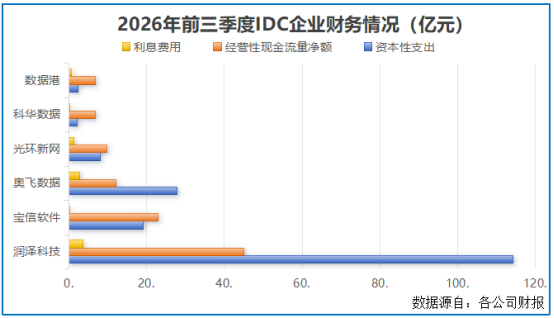
Data Port, Kehua Data, and Sinnet belong to the former type; their common trait is more restrained expansion, with customer orders and construction pace basically aligned, and the cycle turning slowly round by round.
Runze Technology and Aofei Data belong to the latter type; they earn no small amount of cash, but scale still needs to rise, so investment must run ahead of cash.
As IDC companies, the strength of cash flow on the books cannot be directly equated with business quality. Which path is better cannot be judged by a single quarter or a single year; it depends on whether this chain can continue turning.
References:
1. China Economic Times, "Data Center Performance Divergence: Computing Power Layout Accelerates, Capacity Yet to Be Absorbed"
2. Dongguan Securities, "Baosight Software In-Depth Report: Dual Main Businesses of IDC + Software Development Drive Growth, Positive on the Company's Future Prospects"
The above analysis represents only personal views and does not constitute any specific investment advice. Investors need to make decisions independently based on market changes and their own risk tolerance. The stock market carries risks; enter with caution.
-
![]()
Why Is There No "Pinduoduo Narrative" in the AI Era?
-
![]()
Wall Street's "Big Short" Investor Suddenly Boosts Chinese Holdings -
![]()
Memory Price Hikes, Spec Cuts, and Incremental Upgrades: The Smartphone Spec War Hits a Memory Wall
-
AI Is Rewriting the Pricing Logic of Office Software — Kingsoft Software's Bid for the Enterprise Productivity Entry Point
-
![]()
Priced from Over 300,000 Yuan with L3 Architecture: Is the Xiangjie V8 Gunning for the Tengshi D9's Lunch?
-
![]()
How Will Automakers Fight the Final Battle in a Tough 2026?
-
![]()
Automakers Burdened by Collective Debt Double Down on AI Investment
-
![]()
Li Auto to Launch Only 1–2 New Models in 2027