Automakers Burdened by Collective Debt Double Down on AI Investment
 11/27 2026
 336


So what exactly are they so busy with?
Image source: Internet (please contact us for removal if this infringes any rights). Partially AI-generated.
A general manager at a Tier 1 supplier made two decisions in a single quarter.
The first was to lay off one-third of the test engineers on the automotive-grade sensor production line. Not because there were no orders—orders were booked through the following year—but because payment collection was simply too slow.
The contract stipulated "payment within 60 days," yet from last year to this year, the actual redemption cycle of the commercial acceptance bills in his hands had never been shorter than 160 days.
Testing does not directly generate output value; when cash flow tightens, it is the first thing to go.
The second decision was to forward a news article to an industry group chat: the robotics subsidiary of a certain automaker had closed a new funding round, with a post-investment valuation in the billions.
He added a comment: "They're raising money to build the future; we're borrowing money to pay salaries."
Between these two developments lies a layer of something easily misunderstood.
To say that automakers "use suppliers' money to burn on AI" is not accurate in accounting terms: the financing funds of AI subsidiaries come from equity investors, while suppliers' accounts payable remain within the vehicle manufacturing operating entity; the two occupy separate line items on the financial statements.
What is truly worth deconstructing is not which pocket the money comes from, but why, within the same time window, short-term liquidity is systematically retained within the vehicle manufacturing entity while long-term narratives are prioritized for external financing.
Between supplier payment terms and increased AI investment there is no direct pipeline of fund transfer—rather, there is a resource allocation logic driven by valuation stratification and implemented through maturity transformation.

The Same Stress Test, Two Exit Routes
First, let us look at the real picture of payment terms.
In June 2025, 17 automakers publicly committed to "payment terms not exceeding 60 days."
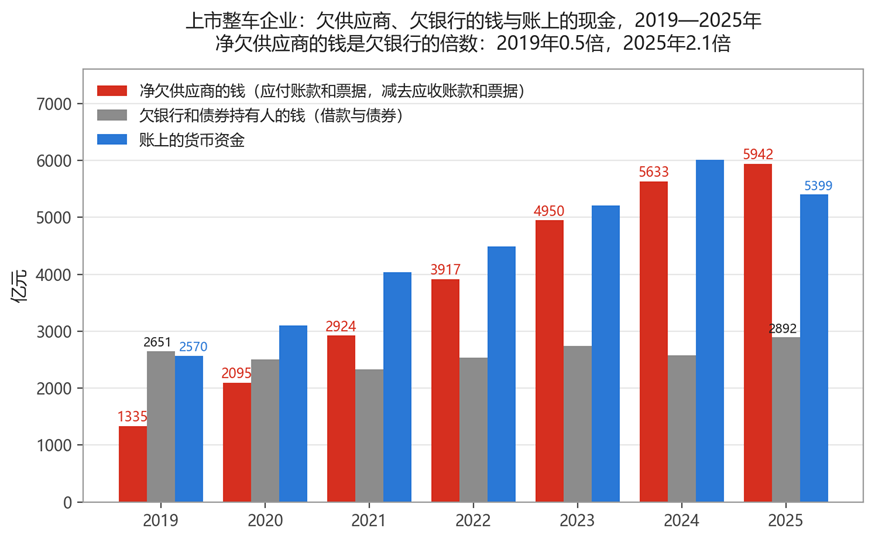
More than a year later, third-party data shows that the median combined payment term of accounts payable and notes payable for these 17 automakers in the first three quarters of 2026 was 169.2 days—still nearly three times the committed threshold.
Another dataset, calculated using the accounts payable turnover days metric, shows that 14 mainstream listed automakers went from about 170 days in mid-2025 to 187 days in mid-2026—23 days longer than before the commitment.
The CAAM survey metric reports "an average of 54 days," but that survey covers only payment nodes from vehicle manufacturers to direct suppliers. Suppliers' real experience also includes acceptance cycles, note discounting cycles, and layer-by-layer payment term gaps.
Meanwhile, the scale of accounts receivable in the automotive manufacturing industry is approaching 3 trillion yuan, with an average turnover of 100 days—34 days longer than in 2020.
This is not the individual behavior of any single automaker; it is a shift in the capital structure of the entire industrial chain. The time funds sit within the vehicle manufacturing segment is systematically lengthening, and pressure is transmitted level by level from Tier 1 suppliers down to Tier 2 and Tier 3 suppliers, ultimately landing on the layer with the weakest bargaining power and the least R&D flexibility.
Now look at the AI side.
NIO's chip subsidiary Shenji was spun off from the parent in June 2025 and completed its first round of equity financing exceeding 2.2 billion yuan in February 2026, with investors including Hefei State Investment, IDG Capital, and SMIC Capital; NIO's stake was reduced to approximately 62.7%.
In the first round of 1.625 billion yuan in financing for Li Auto's subsidiary Mahexin Technology, Li Auto itself contributed 1 billion yuan and external investors contributed 625 million yuan, with a post-investment valuation of approximately 16.6 billion yuan.
XPeng's robotics business raised over $900 million in its first financing round, with a post-investment valuation exceeding $6.3 billion—a record for a single private financing round in domestic embodied intelligence—while XPeng's annual R&D investment in humanoid robots in 2026 is close to 3 billion yuan.
Chery's Moja completed an angel-round external capital increase in January 2026, with a post-investment valuation of 2.5 billion yuan and external shareholders holding approximately 4% in total.
The entities of these financings are, without exception, independent legal entities spun off from the vehicle manufacturing operating entity.
The source of funds is equity capital, with terms measured in years, assessed on valuation growth and exit expectations.
They do not flow through the accounts payable line items of the vehicle business, nor through suppliers' settlement cycles; formally, they are two separate tracks from payment terms.
The coexistence of two tracks is not a problem in itself.
The problem is why they are treated in such starkly different ways at the same time, on the same parent entity.

How Valuation Stratification Drives Maturity Transformation of Funds
The capital market uses two completely different rulers to price vehicle manufacturing businesses and AI assets.
The valuation anchor for vehicle manufacturing businesses—squeezed by price wars and homogeneous competition—increasingly leans toward manufacturing logic: sales volume, gross margin, per-vehicle profitability, cash flow.
In the first three quarters of 2026, the automotive industry's sales profit margin fell to around 3.3%, with total profits down about 23% year-on-year.
At such a profit thickness, the valuation elasticity of vehicle assets in the public market is limited.
Even if an automaker sells hundreds of thousands of vehicles a year, its P/E ratio can hardly break out of the manufacturing range.
But once a chip business or robotics business grown within the same automaker faces equity investors as an independent entity, the pricing anchor switches.
Chips are valued on domestic substitution space and shipment expectations; robots are valued on track positioning in embodied intelligence and mass production timelines.
There is a significant gap between the valuation multiples of these assets in the private market and the P/E ratio of the parent's vehicle manufacturing business.
This gap creates a clear incentive structure: packaging AI assets into independent entities for financing is far more "cost-effective" in capital efficiency than keeping them within the vehicle entity and slowly nurturing them with operating cash flow.
The equity funds raised do not require principal or interest payments, do not enter the accounts payable cycle, do not consume the liquidity released by supplier payment terms, and the financing itself allows the parent company to recognize a considerable asset appreciation.
Thus, resources begin to flow in the direction of valuation signals.
The role of the vehicle manufacturing operating entity gradually shifts from "profit center" to "cash flow foundation."
Its task is no longer to generate enough free cash flow to cover all investments, but to keep operating—and maintain the appearance of "blood generation"—until AI assets complete independent financing and valuation realization.
The more abundant the short-term liquidity, the more solid this foundation; and the variable most easily stretched for short-term liquidity is precisely suppliers' accounts payable—it is dispersed, non-public, does not directly enter the valuation narrative, and is operationally "quieter" than cutting R&D, layoffs, or postponing capital expenditure.
This is the real connection point of the "convergence narrative": it is not that suppliers' money is directly diverted to invest in AI, but that the vehicle manufacturing operating entity is required to play two roles simultaneously—providing legitimacy for the long-term narrative and providing liquidity for short-term operations—and these two roles place contradictory demands on the maturity of funds.
Supplier payment terms have become the handiest tool for reconciling this contradiction. Retain short-term liquidity so the vehicle entity still looks robust; spin off the long-term narrative so AI assets can obtain the capital they need in another valuation system.
The two books can be separated in accounting, but in the resource allocation decisions of the same parent entity, they have never truly been separated.

Why Automakers Cannot Stop
If this behavior is understood merely as "profit-seeking," a deeper constraint is missed: at the current stage, stopping may be more dangerous than continuing.
For investments like chips and robots, the fixed cost structure determines that they need a continuously expanding denominator to amortize.
NIO Shenji's chips are already installed across the entire new vehicle lineup, but NIO's own vehicle sales alone leave the denominator limited.
Spinning off for financing, introducing external capital, and opening external supply to other automakers and robotics companies is essentially seeking a larger denominator for the same fixed cost.
After completing financing, Li Auto's Mahe chips are already in negotiations for external supply to embodied intelligence companies—the logic is identical.
XPeng's IRON plans to start hardware mass production in 2027, with annual investment close to 3 billion yuan; if the capital layout is not completed before the mass production window, the payback period for early R&D investment will be infinitely stretched.
A deeper constraint comes from the pace of competition. At a stage when technological narratives rapidly absorb capital attention, completing a spin-off financing one step late may mean being passive simultaneously in talent pricing, supply chain discourse power, and the next round of valuation anchoring.
Chery's Moja is preparing for an IPO while its revenue scale is still small and it remains loss-making, with external shareholders holding only about 4% and substantial dilution space in subsequent rounds.
This "grab the position first, fill in the content later" approach is itself a product of window-period anxiety.
So what automakers face is not a multiple-choice question of "whether to increase AI investment," but a constraint problem of "at what pace and with what funding sources to increase it."
When vehicle manufacturing operating cash flow is insufficient to simultaneously cover price wars, product iteration, and AI fixed costs, spinning off AI assets to raise equity capital while retaining as much short-term liquidity as possible within the vehicle entity to maintain operations is an almost inevitable solution under these constraints.
Supplier payment terms are not the "cause" of this solution, but the "buffer cushion" on which this solution depends to hold.
But the way the buffer cushion bears pressure is more hidden than the books show.
The fragility of this logic lies not in the numbers of the two books respectively, but in the form in which damage appears when the buffer cushion is pressed to its limit.
The first form is the chronic attrition of suppliers' R&D capabilities.
When the payment collection cycle lengthens to over 160 days, suppliers' response is not to cut off supply on the spot, but to subtract in unnoticed places: postponing automotive-grade certification tests, compressing technical upgrade budgets for new production lines, and seeking "acceptable lower limits" in material selection.
These adjustments will not immediately show up in vehicle failure rates, but they will settle into technical debt in model iterations two or three years later.
When the vehicle manufacturing operating entity is required to continuously provide a cash flow foundation for the AI narrative, the cost pressure it transmits to the supply chain will ultimately backfire on the denominator itself through a decline in the quality of the denominator.
The second form is that the boundary of the buffer cushion suddenly disappears under specific conditions.
The isolation of the two books depends on one premise: the vehicle manufacturing operating entity's own cash flow cannot experience a systemic rupture.
Neta Auto's trajectory provides an extreme reference: when operating cash flow dried up to the point where normal settlement could not be maintained, supplier arrears, employee salaries, and normal operations all spiraled out of control simultaneously—under such circumstances, AI investment did not even have room to be discussed.
This is not to say that all automakers that spin off for financing will reach this point, but that the thickness of the buffer cushion has a threshold, and where that threshold lies is difficult to precisely calibrate before pressure truly arrives.
The third form is the reverse pricing of capital narratives by commitment fulfillment rates.
When the gap between payment term commitments and actual execution is brought into a verifiable and publicly disclosable track by the regulatory framework, suppliers, investors, and the public market will simultaneously begin to evaluate an automaker's governance quality by "fulfillment rate" rather than "announcement volume."
For an automaker marked as "process-flexible" in supply chain settlement, its AI subsidiary will need to answer an entire extra page of questions in due diligence for subsequent financing rounds.
Part of the dividend from valuation stratification will be eroded by the trust discount.

Treating "automakers with collective debt" as a single group would obscure the real differentiation along this risk spectrum.
For one category of automakers, the vehicle manufacturing business still generates positive operating cash flow, AI investment is mainly self-funded or internally incubated, and external funds from spin-off financing account for a relatively limited share.
Their supplier payment terms are also lengthening, but the vehicle manufacturing operating entity provides a relatively thick underlying buffer.
Their risks fall more on the "efficiency" dimension: whether the maturation pace of AI assets can keep pace with the fluctuation cycle of vehicle cash flow.
For another category of automakers, the vehicle manufacturing business has not yet reached a stable profit range, the fixed costs of AI and robotics investment are already considerable, and the sustainability of spin-off financing depends heavily on the continuation of subsequent rounds.
Their risks fall more on the "timing" dimension: whether the pace of equity financing can keep up with the speed of R&D spending, and whether suppliers' tolerance window can last until AI assets generate independent cash flow.
Li Auto's operating cash flow once showed a net outflow in 2025, and XPeng's cash reserves declined quarter-over-quarter under heavy R&D investment—both are concrete manifestations of this timing problem.
The two types of automakers are not facing the same question. The former has a thicker buffer and greater room for error; the latter has a thinner buffer, and the critical point at which the two sets of accounts are forced to merge is closer.
The tension between payment terms and AI acceleration will not automatically dissolve because of the accounting fact that "the two sets of accounts are independent," nor will it contract because of moral condemnation.
It is a funding maturity transformation mechanism formed under the drive of valuation stratification: short-term liquidity is kept within the vehicle manufacturing entity to sustain operations and legitimacy, while the long-term narrative is split off to be priced and accelerated with equity capital.
Supplier accounts payable are the quietest buffer variable in this transformation mechanism—so quiet that the way they come under pressure will not appear in any party's core financial reporting narrative for a long time.
What deserves sustained attention is not which automaker has announced another robotics milestone, nor which supplier has spoken up again in a payment-chasing group chat.
It is where suppliers' R&D budgets quietly flow after that buffer has been repeatedly compressed; it is whether the vehicle manufacturing operating entity can still single-handedly hold up the partition between the two sets of accounts when the equity financing window narrows; it is whether the yardstick of "commitment fulfillment rate" will one day extend from the supply chain domain to the capital narrative domain, discounting the dividends of valuation stratification.
These questions have no take-a-side answers. But whether an industry's funding structure is sustainable often does not depend on how big a story its loudest financing round tells, but on how fast its quietest accounts payable are being paid.
-
![]()
Why Is There No "Pinduoduo Narrative" in the AI Era?
-
![]()
Wall Street's "Big Short" Investor Suddenly Boosts Chinese Holdings -
![]()
Memory Price Hikes, Spec Cuts, and Incremental Upgrades: The Smartphone Spec War Hits a Memory Wall
-
AI Is Rewriting the Pricing Logic of Office Software — Kingsoft Software's Bid for the Enterprise Productivity Entry Point
-
![]()
Priced from Over 300,000 Yuan with L3 Architecture: Is the Xiangjie V8 Gunning for the Tengshi D9's Lunch?
-
![]()
How Will Automakers Fight the Final Battle in a Tough 2026?
-
![]()
Automakers Burdened by Collective Debt Double Down on AI Investment
-
![]()
Li Auto to Launch Only 1–2 New Models in 2027