Roland Berger Breaks Down the Speed and Cost of Chinese Cars: 33 Months vs. 49 Months, Costs More Than 20% Lower
 11/23 2026
 464
Where exactly does "China speed" in carmaking come from? Of course, we have already explored this from the perspective of the vehicle development process in our previous article, "Ancient-Style Carmaking Takes 4 Years and 10 Months: Where Exactly Is Today's 'Instant Car' Made Instant?"
Recently, a Roland Berger report titled "China's Cost and Speed Advantage," with the subtitle "A Wake-Up Call for Western Companies," broke down the speed of Chinese carmaking from a macro consulting perspective and offered a third-party view of China's carmaking speed. In addition, it also reveals from the side the competitive advantages of China's auto industry going overseas and the competitive counterattack it may face.
First, the report's conclusions.
According to the benchmarking in Roland Berger's report, developing an all-new passenger car today requires:
European automakers: 48 to 60 months, 49 months on average; Chinese automakers: 24 to 40 months, 33 months on average.
For the cost of a pure-electric vehicle, Chinese new-energy challengers are 20% lower than European luxury automakers.
The Roland Berger report also breaks these two gaps down into development milestones and cost items.
After interpreting the report, we have three judgments.
Time is mainly saved at the front end: in one case, of the 14 months saved, 8 months occurred before design freeze, relying on making decisions early, making fewer variants, and letting suppliers enter earlier.
About 60% of the cost difference comes from product design; energy, labor, logistics, and financing together account for only 15%. The bulk of the advantage lies in the approach, with location accounting for only a small part.
So if this set of practices is moved to Europe, 50% to 80% of it can still remain, and Western automakers can also learn the easier half of it.
The following reads the report through four questions: how much faster China speed actually is and whom it is compared with, where speed and savings respectively come from, whether other countries can learn it, and how long this speed can last.
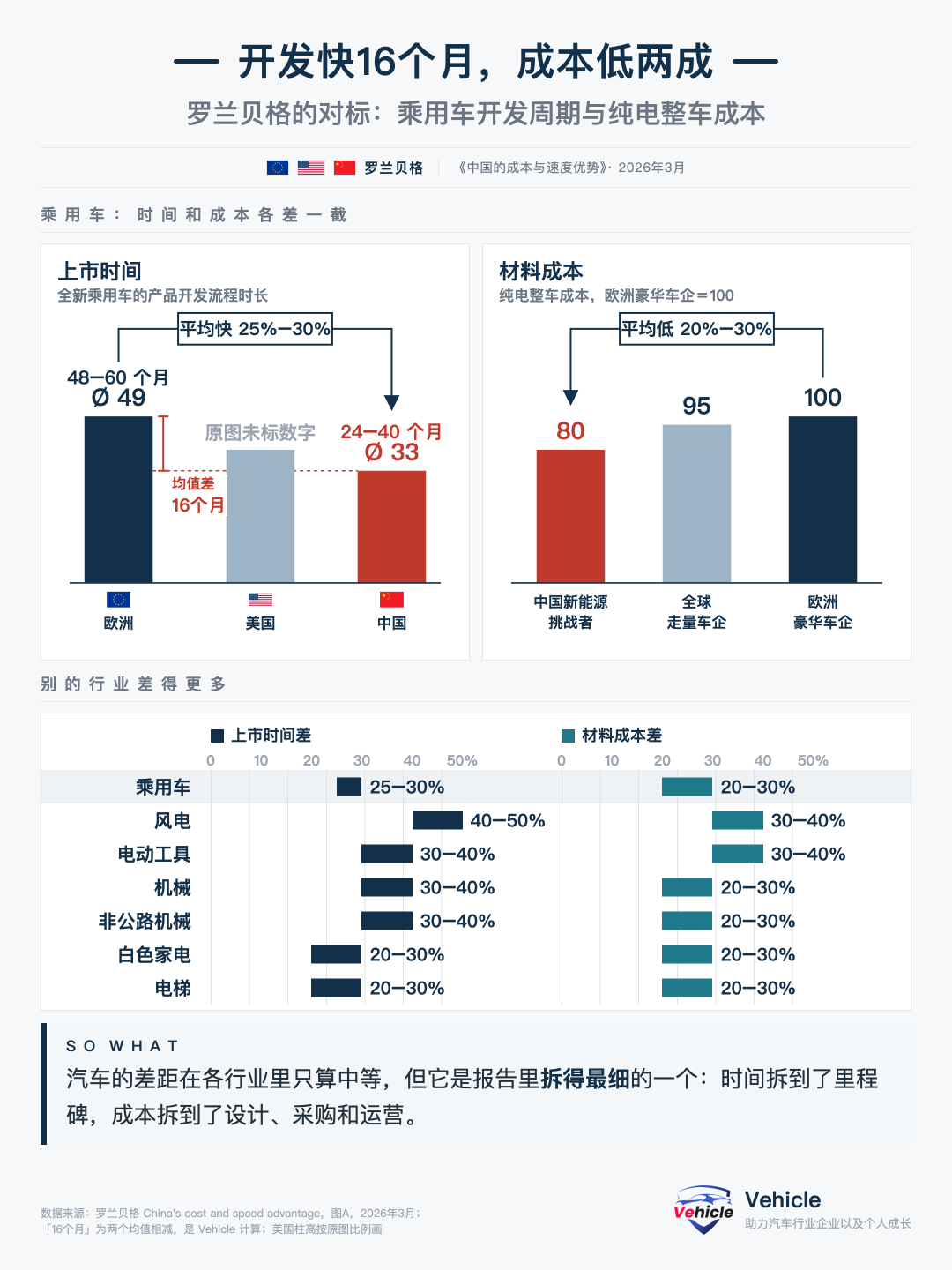
Redrawn according to Figure A in the Roland Berger report (March 2026). The 16 months is the subtraction of the two averages and is calculated in this article; the U.S. column had no numbers in the original chart.
How much faster: 16 months less than Europe on average, but it depends on whom you compare with.
According to Roland Berger's research, Europe's product development process is 48 to 60 months, 49 months on average; China's is 24 to 40 months, 33 months on average; the United States sits in between, so there is no need to calculate the time—after all, the United States is now closed to us. China is on average 16 months faster than European automakers, that is, 25% to 30% faster. In terms of cost, taking the pure-electric vehicle cost of European luxury automakers as 100, global volume automakers are at 95, and Chinese new-energy challengers are at 80—that is, 20% cheaper.
Among the industries compared in the report, the gap in automobiles is actually not the largest. The time-to-market gap is 40% to 50% for wind power, 30% to 40% for machinery, power tools, and off-highway machinery, and automobiles are roughly in the same tier as white goods and elevators. The report's overall statement is that the speed and cost gaps in other industries can reach as high as 40%.
More informative is the chart of seven anonymous automakers, which breaks the development of an all-new model into three stages: strategy, concept, and execution. Adding up the months of the three stages, the two German companies are at 65 months and 60 to 62 months, one Japanese company at 64 months, one British company at 51 months, one Korean company at 52 months, and the two Chinese companies at 42 months and 38 months. The two Chinese companies are about 23 months less than the average of the three German and Japanese companies, and only a little more than 11 months less than the British and Korean companies.
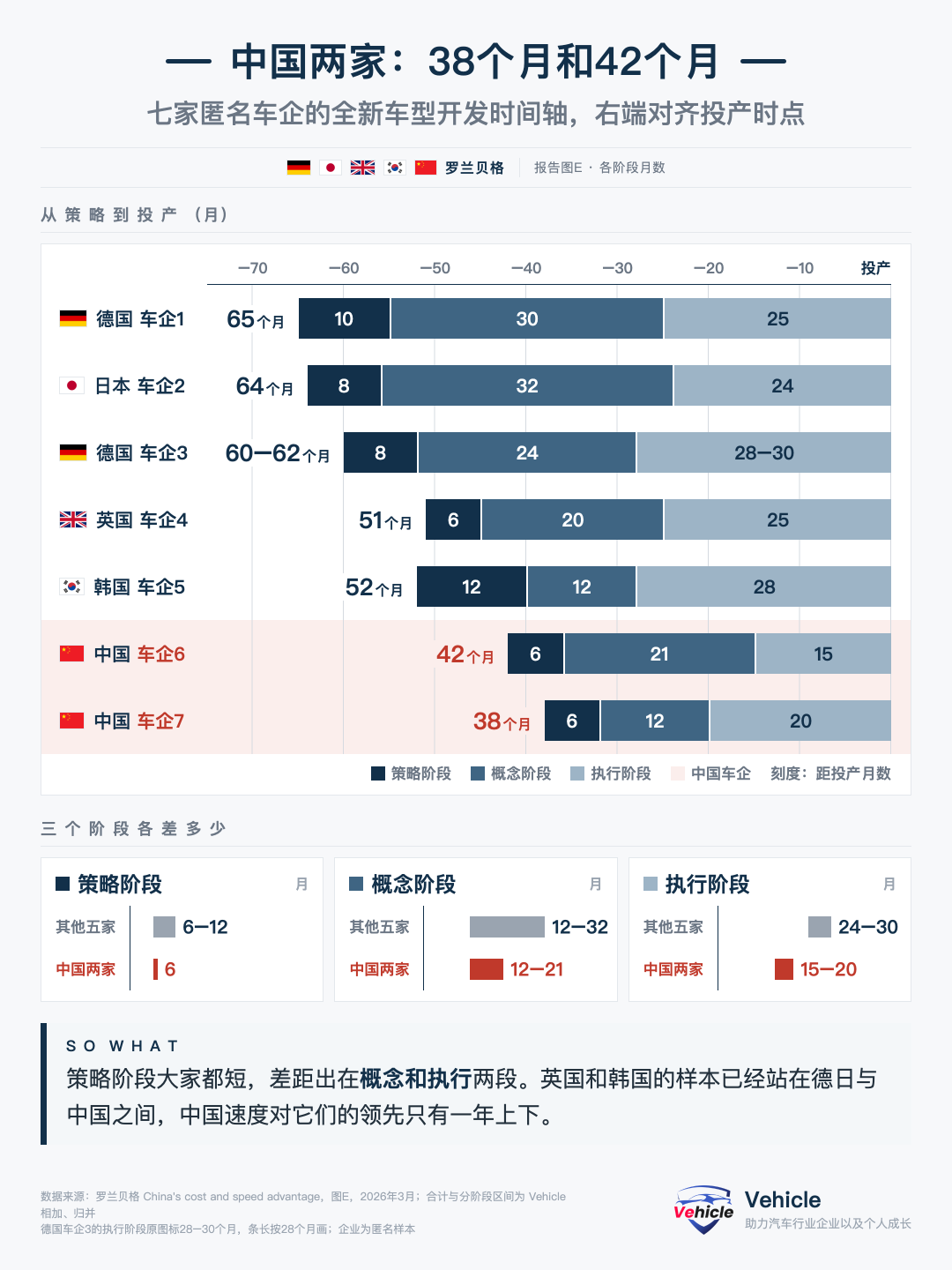
By stage, the product strategy stage is not long for anyone: the two Chinese companies each take 6 months, the British company also 6 months, and the longest, the Korean company, 12 months. The gap is concentrated in the latter two stages: in the concept stage, Germany and Japan need 24 to 32 months, while China is at 12 months and 21 months; in the execution stage, the other five companies are all between 24 and 30 months, while China is at 15 months and 20 months. The Korean company's concept stage is only 12 months, the same as the faster Chinese automaker, and its time is spent on strategy and execution.
In fact, the commonly seen "24 months" and "18 months" in the media often count from styling or concept freeze to start of production and do not include the product strategy stage in the vehicle development process. This is actually not contradictory to the 33 months mentioned in our article and these statements.
The extent of China's speed lead can be broken down by country for comparison: about two years for the long-cycle automakers in Germany and Japan, and about one year for those in the United Kingdom and South Korea.
Where the speed comes from: 8 of the 14 months are saved before design freeze.
The report gives a case of a leading Chinese passenger car company. The traditional automotive industry generally takes 52 months from project approval to start of production; this company takes 38 months, 14 months less. In the figure below, we correspond the milestones of the two timelines one by one for easy reference.
From project approval to design freeze, Europe needs 19 months, while this company uses 11 months, saving 8 months.
From design freeze to launch approval, Europe needs 16 months, while it takes 12 months, saving 4 months.
From launch approval to start of production—that is, the pre-mass-production and trial production stage—Europe needs 17 months, while it takes 15 months, saving only 2 months.
The bulk of the time is saved before the plan is fixed; the closer to start of production, the less compression there is.
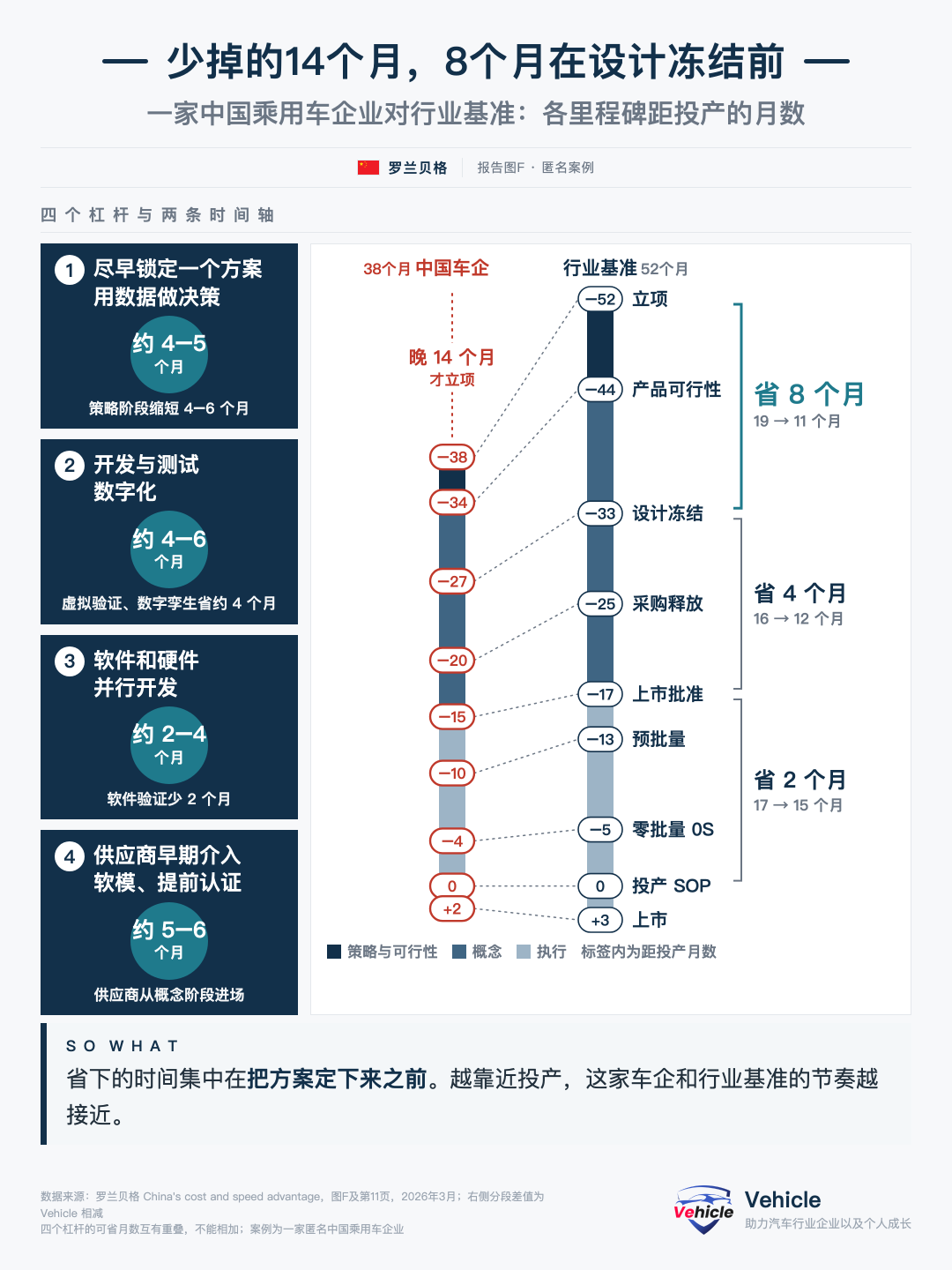
Roland Berger groups the methods behind China speed into four levers, each marked with roughly how many months can be saved.
Decide the plan as early as possible and use data for decisions, locking in a design as early as possible, saving about 4 to 5 months. Roland Berger says this company, relying on faster decisions and clear project priorities, shortened the strategy stage by 4 to 6 months.
Digital development and digital testing save about 4 to 6 months. Virtual validation and digital twins save about 4 months and also reduce expensive physical prototypes. Across the industry, Chinese automakers complete up to 80% of tests in a virtual simulation environment and also use AI tools to translate customer requirements directly into component specifications.
Software and hardware in parallel save about 2 to 4 months. Software and hardware are developed synchronously, and software functions are integrated at an early stage; this company's software validation time was therefore reduced by 2 months.
Suppliers entering earlier plus soft tooling and early certification save about 5 to 6 months. Suppliers participate from the concept stage and do not have to wait until the design is finalized.
More important than tools is what the report calls a pragmatic mindset. Western automakers often use customer data at specification review meetings to argue for adding another variant aimed at a niche market, while Chinese automakers set component parameters at a level that can satisfy most customers, resulting in shorter decision cycles.
Chinese cars also use more common parts and carryover parts. The same is true for suppliers. The report's example is a simple, invisible part such as a circuit board housing: Western automakers often even specify the details of mold design, while Chinese automakers accept a supplier's ready-made housing and only require a logo sticker to be attached.
The organization is adjusted accordingly as well. The report mentions an established commercial vehicle company whose sales structure changed in three years from 80% domestic to 60% international. It merged four independent development units—axles, transmissions, driveline, and powertrain engineering—into one powertrain platform, newly set up three departments for electrical and electronic, software-defined vehicles, and electronic control units, and separately set up a department that only does product planning for international markets.
In fact, in other words, European and American automakers focus on many extreme cases, while we think satisfying most users is enough. This actually reveals situations similar to the brake pedal snapping.
In addition, when the model changes, the original parts are directly carried over. This actually also has hidden risks: vehicle quality, center of gravity, and hard points change, and various durability and performance aspects are actually affected. Of course, if the architecture has taken this into account, then never mind.
Where the savings come from: 60% from design, labor and energy only 15%.
Roland Berger's report says the cost gap in the automotive industry is 20% to 30%, and up to 40% in other industries. The report emphasizes that this is not simply the result of lower wages and energy prices; the root lies in structural efficiency and management discipline across the entire value chain.
It provides a breakdown chart for a heavy truck, with data from an automotive client project. The cost difference between European and Chinese products is between 20% and 30%, of which about 60% comes from more economical product design; about 25% from a higher proportion of Chinese suppliers; and about 15% from lower operating costs in China—energy, labor, logistics, and financing are all included in this 15%, and the design item is four times that.
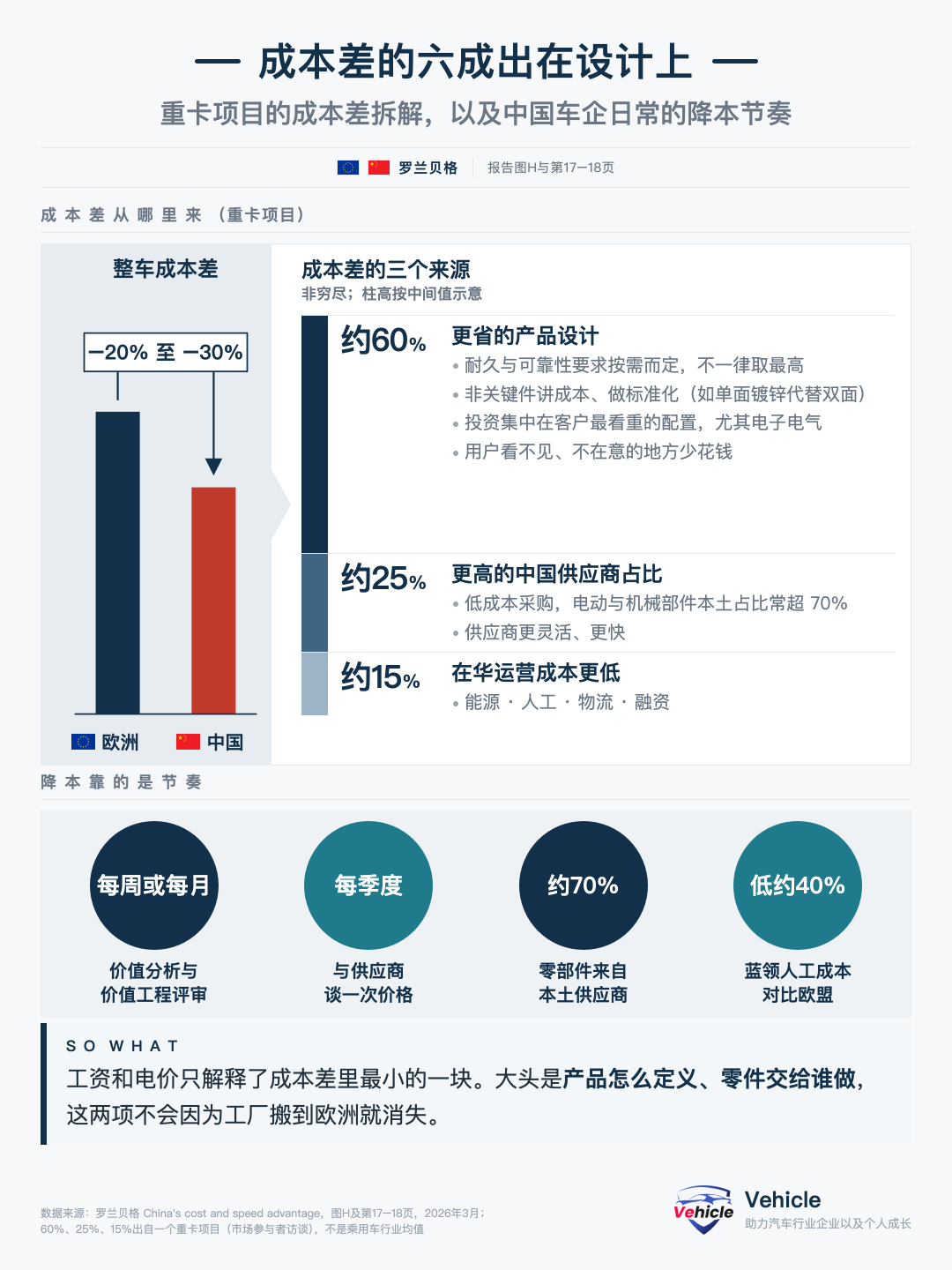
Design durability and reliability requirements are set according to actual needs rather than uniformly taking the highest. Material grades are lowered for non-critical parts; the report's example is using single-sided galvanized steel sheet instead of double-sided galvanized. Spend less where users cannot see or do not care, and direct the saved budget to the features customers value most, especially electrical and electronic.
The proportion of local suppliers for pure-electric and mechanical components often exceeds 70%, making the supply chain shorter and more flexible. Vehicle development is 20% to 30% faster than that of European peers, and suppliers must keep up with the same pace.
Operations: industrial energy prices are far lower than in the EU, blue-collar labor costs are about 40% lower, working hours are longer, logistics are cheaper due to infrastructure investment and scale effects, and there is policy support for energy and financing. The report mentions that even at a leading company like SAIC in Shanghai, engineers may work six days a week, from 9 a.m. to 11 p.m. or even midnight.
The rhythm of management is also different. Value analysis and value engineering meetings are held weekly or monthly, and material costs have hard annual reduction targets. Key partnerships such as batteries are maintained long term, but prices are negotiated quarterly. Many companies retain their own suppliers, who supply at zero to low profit, and there are selective subsidies for industries such as steel, energy, and battery materials.
The report depicts these practices as a pyramid:
At the top is controlling the complexity of the product portfolio, making only products that can cover about 80% of the market;
In the middle is making clear trade-offs in function, configuration, and performance, thinking clearly about where to be better and where it can be worse;
At the bottom is good enough, with specifications lowered to the appropriate level, tolerances set appropriately, and more carryover parts used.
On both sides are top-down decision-making and cross-departmental cost-reduction mechanisms, supported at the base by supplier management.
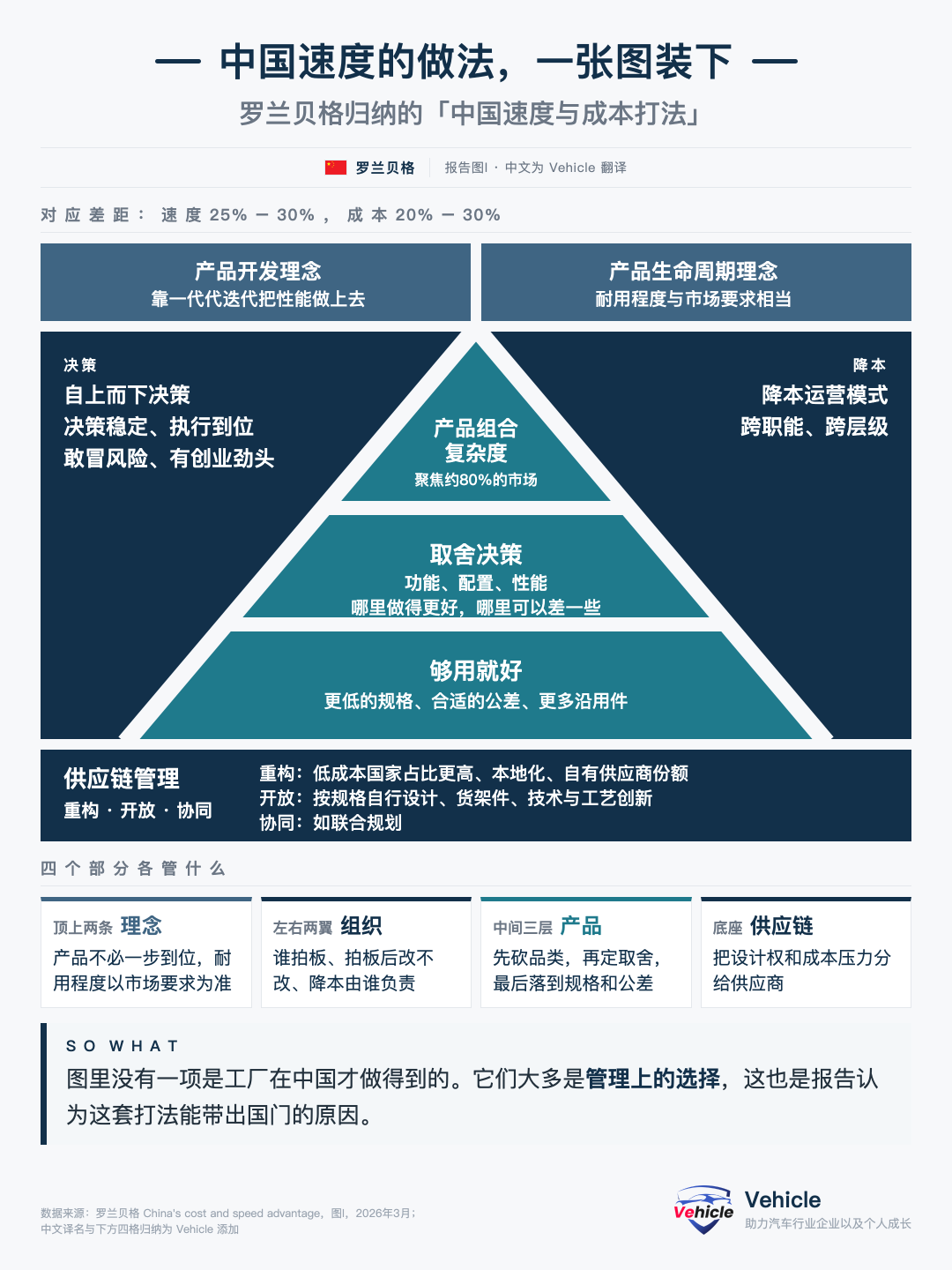
Speed and cost are two results of the same set of practices: fewer variants, more carryover parts, and greater supplier freedom make development faster and costs lower. In fact, wages and electricity prices account for only a small part of speed.
Can others learn it: ten levers, five easy to learn, four hard to learn.
In fact, this Roland Berger report is aimed at European and American automakers, prescribing medicine for them. Roland Berger calls it "China Speed Light." According to Oliver Knapp, a senior partner at Roland Berger, China speed is not a cultural phenomenon; it comes from clear decisions made in product design, product portfolio complexity, and the supplier base, so part of it can also be achieved in Europe.
One piece of evidence is that Chinese companies can take it with them. The report estimates that after Chinese companies move the value chain, especially R&D, to Europe, more than half of the advantages gained in China can be retained, some as high as 80%; even when producing in Western markets, the cost difference can be replicated at 50% to 80%. If the advantages of Chinese automakers mainly relied on local wages and electricity prices, then going overseas to build local plants would not bring domestic advantages with them.
Of course, this conclusion does not rule out that Roland Berger is trying to pitch consulting fees to European and American automakers.
The last chart in the report is a self-assessment table Roland Berger gives to European and American automakers, listing ten drivers of the gap and marking each with the complexity and investment required to address it. Reading along the five-level scale in the chart, five are easy to learn, four are hard to learn, and one is in the middle.
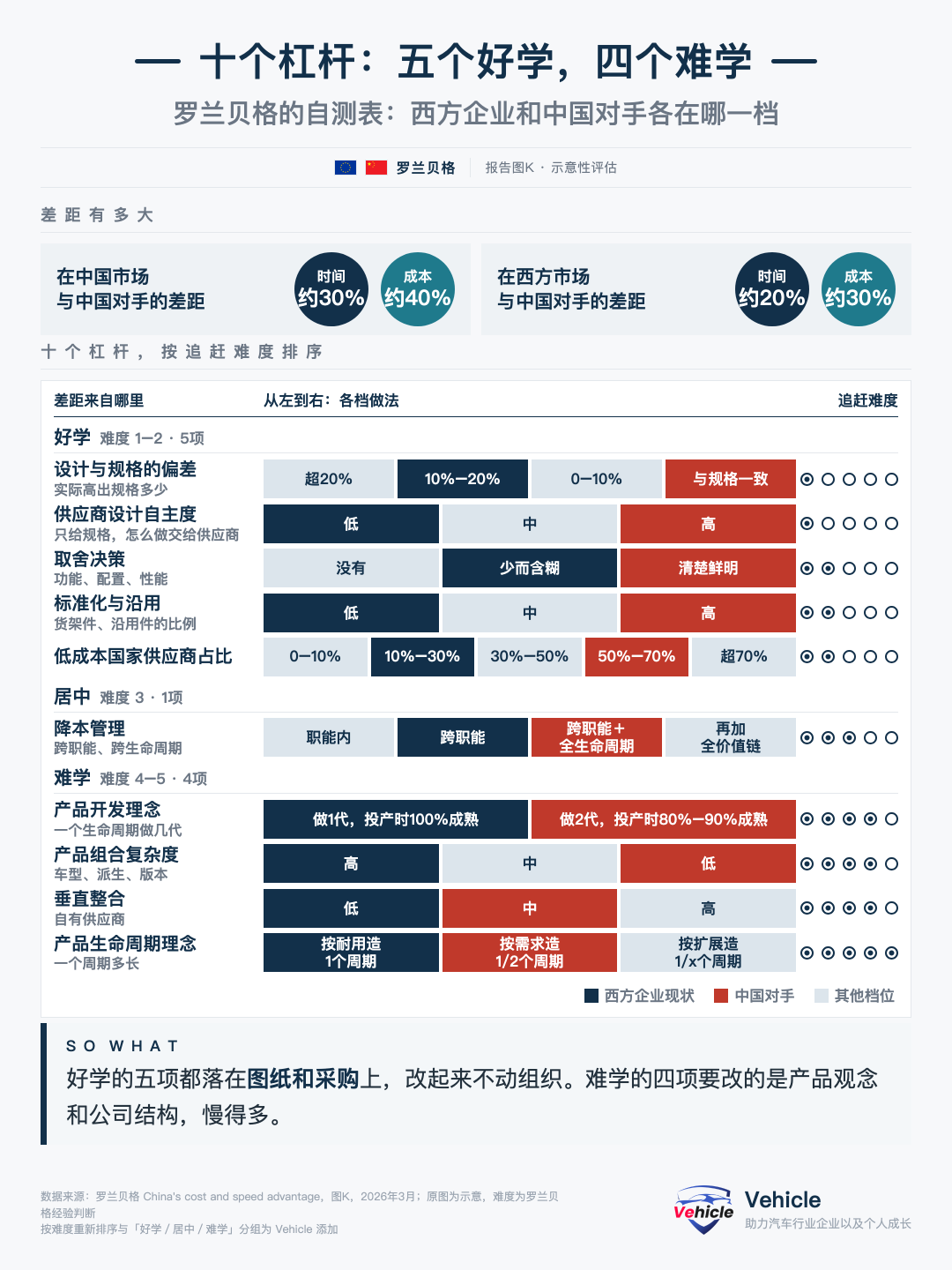
Of the five easy-to-learn items, designing to specification and letting suppliers manufacture to specification are the least difficult. Next come making clear trade-offs in function and performance, increasing standardization and the proportion of carryover parts, and raising the share of suppliers in low-cost countries. In the diagram, Western companies' actual designs often run 10% to 20% above specification, whereas Chinese competitors achieve consistency with specification.
Of the four hard-to-learn items, the hardest is the product lifecycle philosophy: Western companies build for durability, while Chinese competitors build as needed, with a product generation cycle only half as long. Next is the product development philosophy: Chinese competitors launch two generations within one lifecycle and go to market at 80% to 90% maturity at start of production. Product portfolio complexity and vertical integration also fall into the difficult tier, while cross-departmental cost-reduction management sits in the middle.
In fact, European automakers are already on the move.
Renault says the Twingo E-Tech electric version went from concept freeze to public debut in less than two years, relying on AI and digital twins, partnerships with suppliers, and modular off-the-shelf technology modules.
Volkswagen's three models put into production within 24 months came from its local R&D center in China—Volkswagen's only complete vehicle R&D center outside Germany.
According to Bloomberg, the Twingo model was also developed in China. Both of the fastest examples happened in China, so Vehicle's observation is this: so far, the fastest way for Western automakers to learn China speed is to do the project in China.
The report also lists the parts that cannot be learned. The supply system that vertically integrates batteries, semiconductors, and steel, the scale and purchasing power brought by the huge domestic market, and lower energy and financing costs all remain in China. The top-down decision-making style—decide first, then execute—is also difficult to replicate in Western companies accustomed to advancing through consensus.
The first thing European automakers learned was to define solutions early, go digital, and bring suppliers in ahead of time—that is, the eight months in the case. Concepts like "one cycle for two generations of products, launch when 80–90% mature" are actually hard for Europe and the US to learn in the short term, and they may not be willing to learn them.
Can this speed be sustained? The methods can be retained, but the lead will narrow.
The Roland Berger report lists four problems with the China model:
Compressing test cycles sometimes brings reliability issues, but as capabilities mature, such problems are decreasing.
Depth of innovation remains the West's advantage. Chinese companies excel at rapid adaptation and commercialization, while disruptive breakthroughs come more from research systems in Europe and the US.
Hierarchical decision-making is difficult to transplant to other cultures.
As trade restrictions increase, Chinese companies are also more vulnerable to external shocks.
These four problems are indeed quite fair.
But when going overseas, the advantages of Chinese cars may tell a different story; the variable is the difference between home ground and away ground. The report scores four combinations with dots: Chinese companies in the Chinese market get full marks on time to market, material cost, and fit with customer needs; in European and American markets, the first two remain full marks, but fit with customer needs drops by one.
European and American companies on their home ground get two dots each for time and cost, and three dots for fit with customers; in the Chinese market, all three drop to only one dot. The report calls Western companies' understanding of local customers a temporary protective shield, and how long it can hold depends on how quickly Chinese companies come to understand local customers.
However, some practitioners now believe that in the automotive and photovoltaic industries, the reaction time left for the West has already passed, and the latest Chinese models in Europe have already met or even exceeded local expectations, with young drivers especially recognizing Chinese cars.
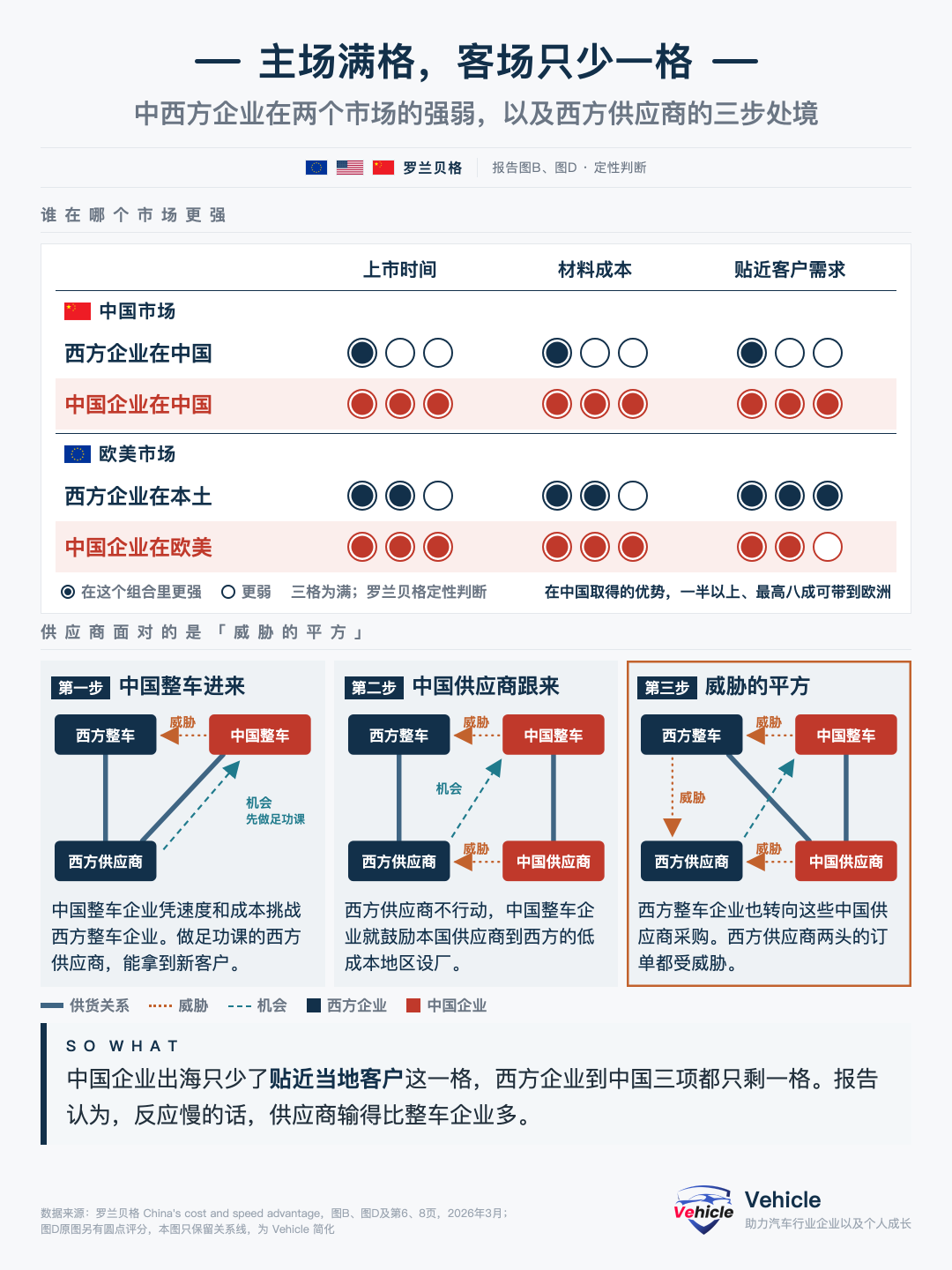
For suppliers, the report's judgment is even more serious. If Western suppliers cannot keep up, Chinese automakers will encourage domestic suppliers to set up plants in low-cost regions in the West, and then Western automakers may also turn to these suppliers for procurement. The report calls this "the square of the threat": if European and American suppliers respond slowly, they will lose more than the automakers.
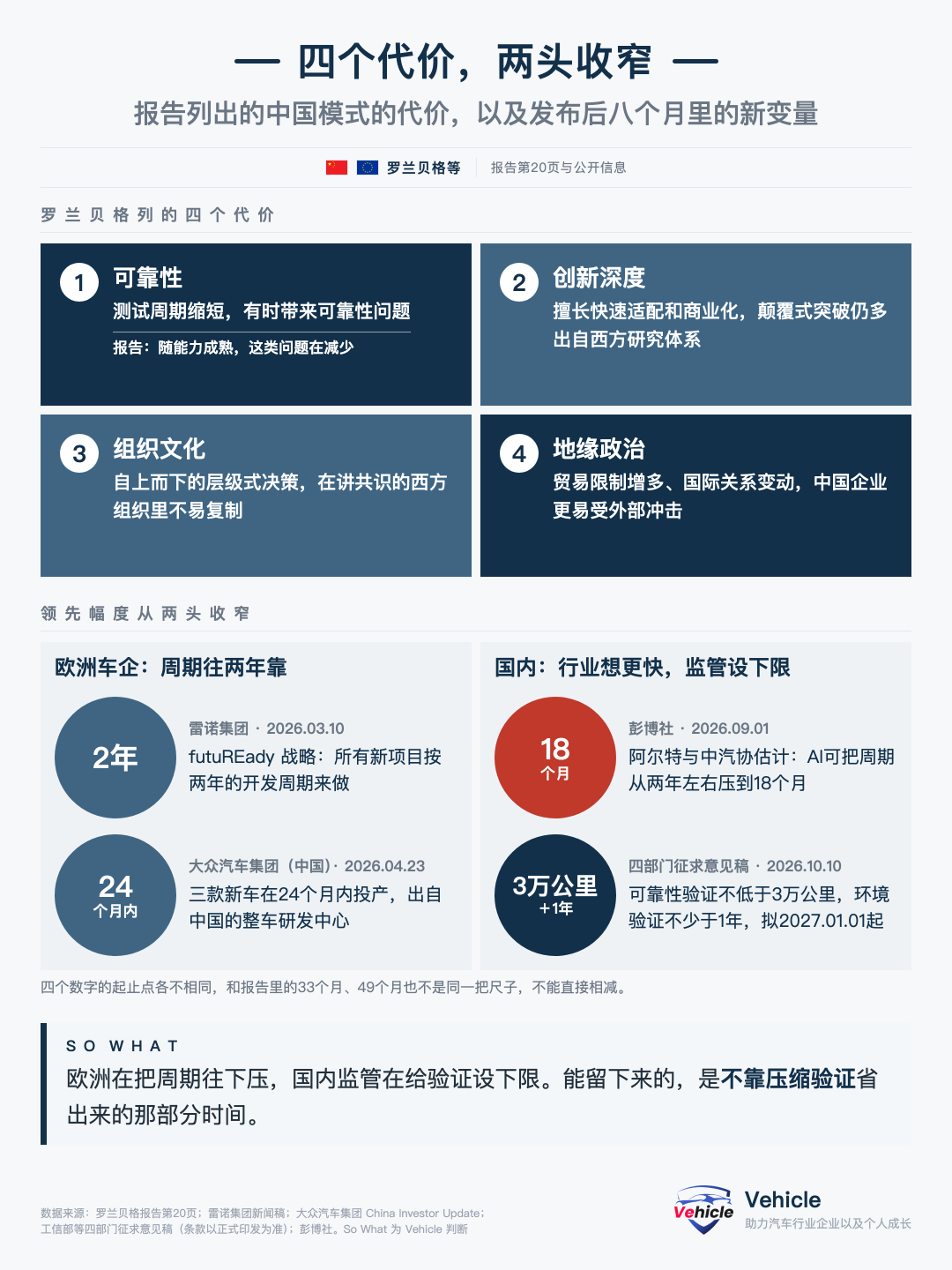
In summary, Vehicle's judgment is this: what can be sustained in Chinese speed is the methods, but the margin of lead will gradually shrink.
Defining solutions early, making fewer variants, and bringing suppliers in ahead of time depend neither on overtime nor on cutting tests; this is benign innovation. However, the part gained by compressing validation and extending working hours will first hit the regulatory floor domestically, and then encounter the local labor environment after going overseas.
At the same time, European automakers are pushing their own cycles toward two years, and the China-Europe gap will narrow. The cost gap is supported by supply chains and scale, and should last longer than the speed gap; this is a tier that European and American automakers find hard to learn.
What it means for Chinese companies
After automakers localize overseas, the report estimates that time and cost advantages can still retain 50% to 80%, but understanding local customers requires making up ground. In addition, European and American rivals have changed from European peers averaging 49 months to Renault and Volkswagen, which have set targets of 24 months.
For component companies, looking at it from another direction reveals opportunities. Chinese suppliers that follow automakers to low-cost regions in Europe may find customers beyond Chinese automakers. In addition, the domestic model of quarterly price negotiations and zero-profit supply from captive suppliers cannot be taken abroad; what can be taken abroad is the ability to participate from the concept stage and independently design according to specifications.
For foreign and joint-venture companies in China, the solution offered by Volkswagen and Renault is to place R&D and release authority in China, use local teams and local suppliers to develop products, and then bring the methods back to headquarters. For China's engineering services and R&D outsourcing companies, this is a growing demand.
Final thoughts
This Roland Berger report was written for Western companies, but we can treat it as a mirror. In others' eyes, Chinese speed is first about making decisions early, making fewer variants, designing as needed, and letting suppliers bear more; working hours and energy are the last stubbornness. The practices at the front can be taken away and learned. So what we truly need to think about is this: what exactly will our core competitiveness be in the future?
References and images
China's cost and speed advantages pdf - Roland Berger
*Unauthorized reproduction and excerpting are strictly prohibited-
-
![]()
What Is Leapmotor Really After? Q3 Revenue of 31.7 Billion Yuan, Yet Only 40 Million Yuan in Profit!
-
![]()
Himile Technology: Tire Mold Leader with Steady Revenue Growth and Over 2 Billion Yuan in Cumulative R&D Investment Over Five Years
-
![]()
WeRide's Q3 2026: Revenue up nearly 90%, gross margin 43%—Is Spring Finally Coming for L4 Companies?
-
![]()
From 89.6% Digitalization to AI Empowerment: Unveiling the "Nerve Center" of the Modern Industrial System
-
The AI Hardware Bull Market Is Over
-
![]()
Guangdong Leads by a Landslide, Shanghai Dominates Finance, Beijing's Giants Set the Pace
-
![]()
Breaking: Huawei Unveils First HarmonyOS AI Phone — Netizens Say They Guessed Wrong as Price Exceeds Expectations
-
![]()
Anthropic Prospectus Insights: How Compute Power, Jobs, and Organizations Will Change