Leqi II's Answer Sheet: How Many of the Four Optical Hurdles Has It Cleared?
 10/29 2026
 537
Abstract: Against the four optical thresholds proposed in our previous analysis, this article dissects Leqi II's launch event deliverables. Grating invisibility, rainbow pattern suppression, thinner form factor, and anti-reflection are evaluated individually. The strategic path is clear: single-green mass production first, full-color delayed for future Layout (Chinese pun retained as 'layout' in translation).
Some time ago, we published 'Leqi Second Generation Preview: Four Optical Hurdles for Pretending to Be Ordinary Glasses' ( Leqi's second-generation foresight : I want to disguise myself as regular glasses , Four optical obstacles cannot be bypassed ).
Our initial assessment was blunt: AI capabilities can be OTA-updated, but waveguide optics offer no post-design remediation. The success of Generation II hinges not on flashy specs but on how cleanly it clears these four challenges.
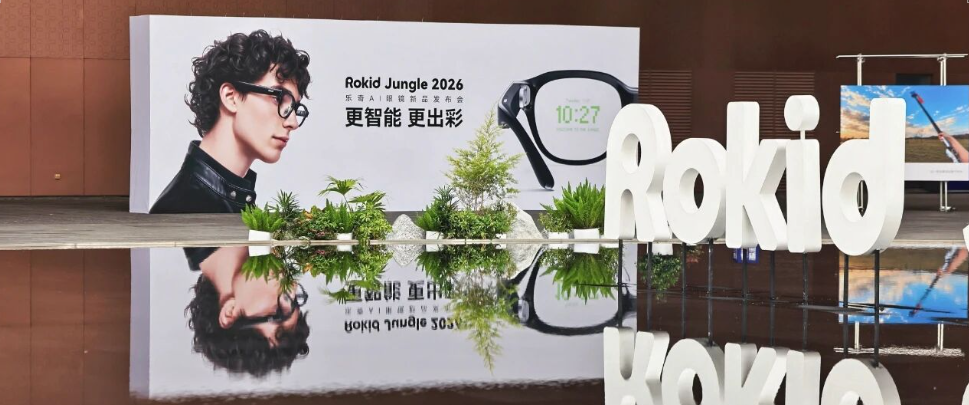
On October 27 at Jungle 2026, the answer sheet was formally submitted—not a perfect score in single categories, but a balanced systems approach.
Grating Invisibility: From 'Green-Eyed' Gen I to Face-to-Face Stealth 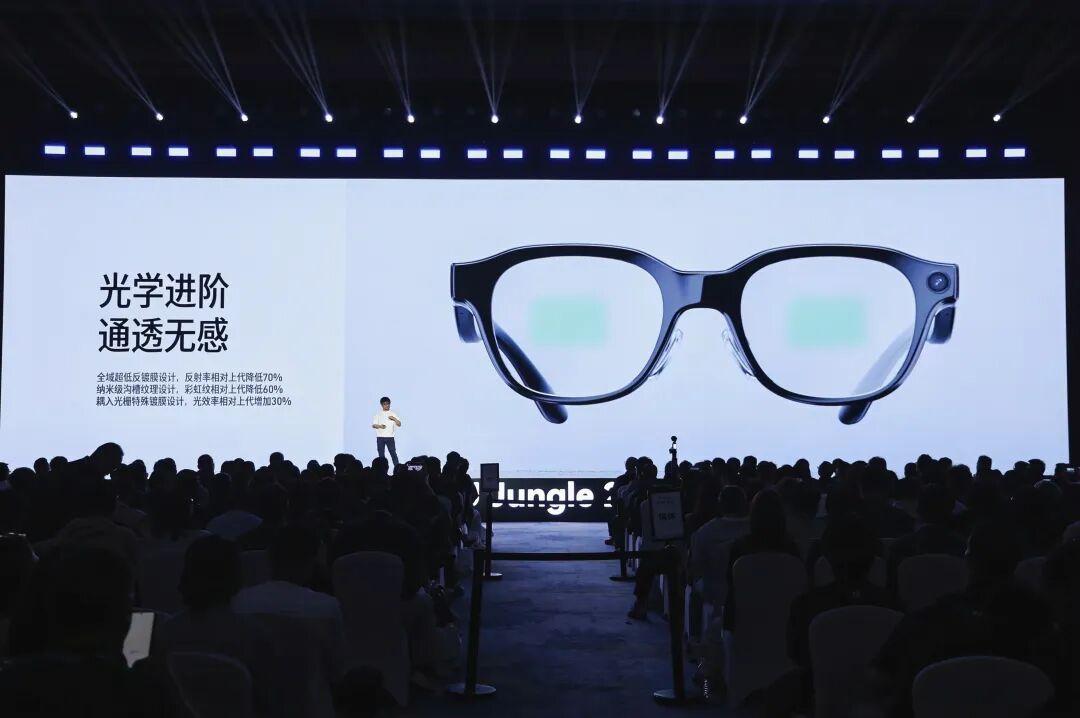
Industry-first implementation of ultra-low-reflection coating across both grating and non-grating zones. The coupling grating uses bespoke film stacks tailored to nanoscale groove topography, while non-grating areas receive synchronized low-reflection treatment, achieving uniform anti-reflective performance across the entire lens.
Many mistakenly assume anti-reflection films are just standard eyeglass coatings applied to waveguides.
This fails for grating waveguides: The periodic grooves alter equivalent refractive index, phase, and coupling efficiency when coated—akin to applying transparent film on textured metal, where improper application causes light deviation.
Leqi's solution employs grating-film co-design (films grow with grooves, not just pasted on), matching film thickness, materials, and deposition uniformity to groove structures rather than flat-coating.
At social distances, this 'disguise' holds; but 'invisibility' is angle-dependent, not full-spectrum optical disappearance.
Rainbow Patterns: Suppressible but Physically Ineradicable
Rainbow artifacts stem from environmental light dispersion by grating periodic structures—an inherent physical trait of diffractive waveguides that can only be suppressed, not eliminated at this stage.
Gen II claims 60% reduction in rainbow intensity versus Gen I.
The solution reconfigures nanoscale grooves—adjusting period, depth, and tilt—to redirect non-target diffracted light outside human eye reception ranges.
Simply put: stray colored light is diverted away from your eyes, not annihilated.
Clarification: Rainbow patterns are not imaging light but stray light from environmental sources being 'color-split' by gratings.
Gen II shifts most stray light diffraction angles beyond human eye sensitivity, though residual artifacts may still appear under complex strong light (sunlight, spotlights, car headlights).
Rainbow patterns represent the physical limits of diffractive waveguides—suppressible but not erasable—a cost consumer AR must accept.
Consistent with our prior analysis: physical boundaries remain, stray light is just pushed to peripheral vision. Most daily lighting hides it, though extreme oblique angles may still reveal traces.
Thinning & Wearability: Not Just Glass Grinding but Whole Process Chain Synergy 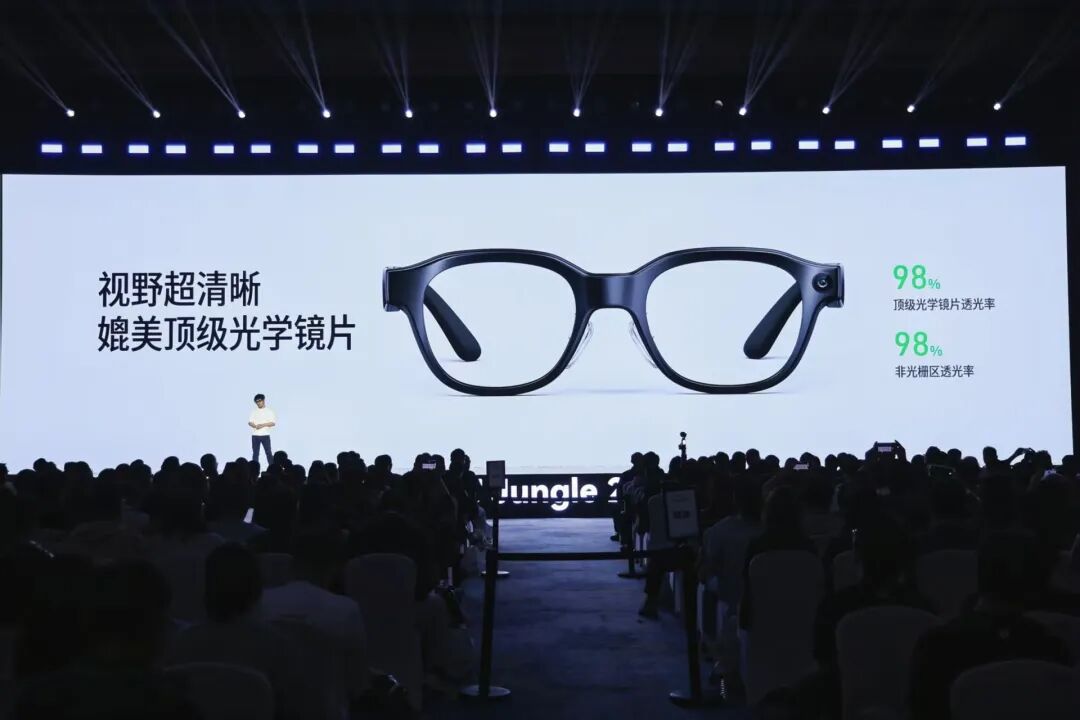
Optical engine volume reduced by 30%, total length shortened by 1mm; temple spread angle increased by 22% with enlarged liquid silicone nose pads; overall transparency improved by 40%, with 98% light transmission in non-grating zones and 93% in grating zones—approaching ordinary optical lens clarity.
Thinness is never an isolated metric.
Achieving 0.4mm-class waveguide mass production while maintaining coupling efficiency requires synchronized control of low-stress coating, surface flatness, imprinting consistency, and mounting clamping stress.
Gen II integrates these constraints into whole-device structural tuning, transforming 'thin lenses' into 'comfortable for hours' wearability.
Instead of hyping '0.x mm substrates,' it uses optical engine miniaturization + surface process + ergonomic design to achieve 'hours of comfortable wear.' This wearability engineering scores 85/100.
Anti-Reflection with Brightness Preservation: The Toughest Challenge—Clean Exterior, Uncompromised Interior
70% reflection reduction, 30% higher coupling efficiency in input gratings versus Gen I, maintaining single-green Micro-LED brightness at 1500nits.
This represents the most technically demanding challenge among the four. Simply reducing reflection is easy; the difficulty lies in simultaneously boosting coupling efficiency.
Underlying logic: This film stack doesn't just absorb ambient light but differentially processes environmental reflections versus imaging light. Leveraging input-zone-specific film stacks + groove co-simulation, it suppresses external reflections while preserving imaging light.
Anti-reflection ≠ light absorption—this is the core innovation.
This challenge scores 90/100, the most stable among the four.
Full-Color: The Bonus Question Leqi Is Now Tackling 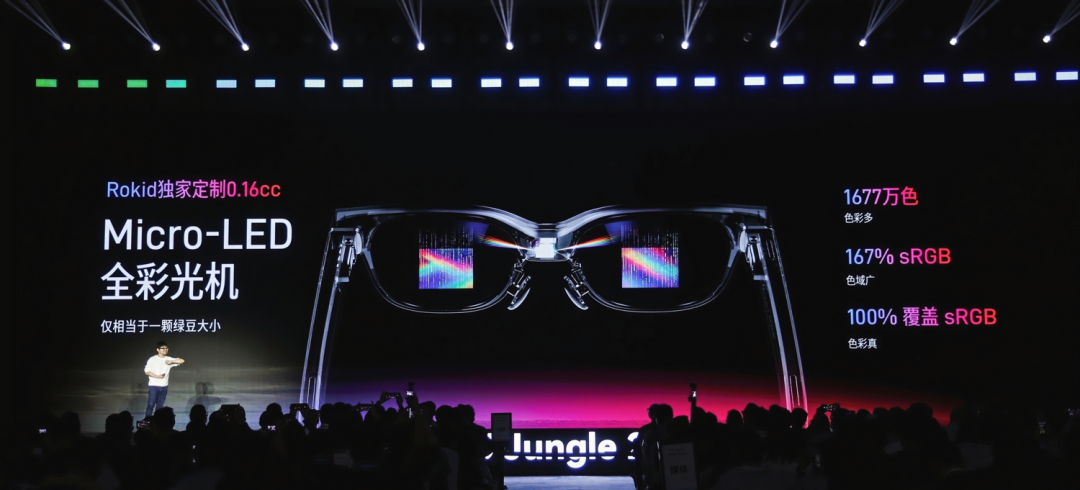
Beyond the four optical hurdles, full-color represents the true bonus question—the solving process has begun, though answers won't arrive until later.
Glasses 2 retains single-green with 480×380 resolution and 25° FOV. The full-color lineup debuts with Rokid Color: 0.16cc Micro-LED full-color optical engine, 55g device weight (excluding nose pads), priced from ¥4,999 with April 2027 delivery.
Pricing is sharply defined: Black version ¥3,699 (¥3,199 after subsidies), tortoiseshell ¥3,849 (¥3,349 after subsidies).
Rather than aggressively pursuing full-color, Leqi prioritizes solidifying foundational experiences of 'wearability, photographability, and usability.'
Its industry significance lies beyond specs
The true value of Leqi II is shifting diffractive waveguide evaluation from lab metrics to daily wearability for ordinary users.
Grating invisibility eliminates social awkwardness; controllable rainbow patterns enable outdoor use; anti-reflection without brightness loss ensures display quality; thinning with maintained yield enables mass production.
Past industry hyper-competition focused on FOV, nit brightness, and full-color timelines.
Leqi II offers an alternative: The first phase of consumer AR prioritizes 'looking like ordinary glasses.'
The path is clear: Monochrome for volume production to refine processes, full-color as next-gen technological benchmark, released in layers.
Conclusion
As we stated in our preview: 'Optics cannot be OTA-updated after finalization.'
Leqi II's approach is pragmatic: No single-category perfection, but solid progress across all four thresholds. Gratings fade, rainbow patterns diminish, lens transparency improves, and brightness is preserved.
Full-color awaits the next stage. For now, Leqi has pushed consumer-grade single-green AR to daily wearability.
Interactive Topic: Which hurdle matters most to you—grating invisibility, rainbow patterns, thinning, or anti-reflection with brightness? How would you score Leqi's answer sheet?
[Risk Disclosure] This article compiles data from Rokid Jungle 2026 (2026-10-27) public disclosures and official materials. Transmittance figures (98%/93%) derive from event PPTs, Rokid official site, and Qualcomm China releases. Reflection (-70%), coupling efficiency (+30% vs Gen I), and rainbow pattern (-60%) reductions represent official Gen II vs Gen I comparisons. Single-green display, FOV, and battery life are subject to mass-production verification. Inherent diffractive waveguide traits (light leakage, rainbow patterns) can only be suppressed, not eliminated. —— AR Andy | Focusing on waveguide and AR microdisplay sectors, dissecting optical industry fundamentals. Previous Coverage: 'Leqi Second Generation AI Glasses Preview: Four Optical Hurdles for Pretending to Be Ordinary Glasses'
-
![]()
Fuyao Glass Reports 14.97% Drop in Net Profit to 6.006 Billion Yuan for First Three Quarters, While Dimming Glass Yield Soars from 10% to 90%
-
![]()
GPS is Vulnerable to Interference, This Startup Aims to Provide a Centimeter-Level Alternative with 258 Satellites
-
![]()
Desay SV’s Q3 Revenue Hits 9.519 Billion Yuan, Up 23.75%; Overseas Gross Margin at 31.34%, Domestic at 17.58%
-
![]()
Automotive Parts Behemoth Huayu Reports 45.5 Billion Yuan in Q3 Revenue, Net Profit Dips 6.4% to 1.687 Billion Yuan, Yet Stays Robust
-
![]()
Li Auto Shifts Focus: Can Chips, Batteries, and L4 Tech Drive the Next Phase of Competition?
-
Suzhou: Not Just Aiming for Daily Access to Driverless Cars, but Transforming the Entire City into a 'Testing Ground' for Embodied AI
-
![]()
Who Benefits More from the Split of FAW-Audi and SAIC-Audi?
-
40-Year Reversal in Technology Flow: Why Did Volkswagen Transform China from a Factory into a Global Development Hub?