A Loss of 2 Billion Yuan in Three Years: XREAL's IPO Is a High-Stakes Gamble
 04/07 2026
 689
689
Introduction: Xu Chi Has Finally Awaited His Technological Amplifier
Three months ago, at the CES2026 Wutong Night Talk session, guest speaker Xu Chi stated that the biggest obstacle to the next iPhone moment is capital.
Then, on April 1st, smart glasses company XREAL submitted its prospectus to the Hong Kong Stock Exchange. As the first smart glasses company in China, and even globally, to sprint for a Hong Kong Stock Exchange IPO, if everything goes smoothly, XREAL could become the "first smart glasses stock."

Xu Chi is confident. He believes that XREAL can solve technological problems and that capital is a technological amplifier. It is precisely this aspiration for capital that has propelled XREAL to the starting line, launching its charge towards becoming the first smart glasses stock.
I. XREAL's Vision Requires More Ammunition
Judging from his resume, XREAL's founder, Xu Chi, is a quintessential "tech geek."
A graduate of Zhejiang University, he pursued a Ph.D. in Electrical and Computer Engineering at the University of Minnesota in the United States. He later worked at NVIDIA and Magic Leap before returning to China in 2017 to found XREAL, focusing on AR glasses R&D.
And according to the prospectus, XREAL has achieved remarkable results.
From 2023 to 2025, XREAL continuous (this word means 'consecutively' and is kept for context, though not translated directly) ranked first in the global AR glasses market. During the same period, XREAL achieved revenues of 390 million yuan, 394 million yuan, and 516 million yuan, respectively, with a year-on-year revenue growth of approximately 30.8% in 2025.
Logically speaking, such a highly skilled talent with such outstanding achievements should not so bluntly express his aspiration for capital assistance in public interviews.
The reason lies in the prospectus. Accompanying XREAL's impressive revenue performance is a certain funding gap.
From 2022 to 2025, XREAL's annual losses were 882 million yuan, 709 million yuan, and 456 million yuan, respectively, with cumulative losses exceeding 2.047 billion yuan over three years.
What requires even more vigilance is the cash flow.
Over the past three years, XREAL's net cash outflows from operating activities were 472 million yuan in 2023, 174 million yuan in 2024, and 203 million yuan in 2025. These outflows remained negative for three consecutive years, and even increased in 2025.
More critically, as of the end of 2025, cash and cash equivalents were only approximately 63.63 million yuan.
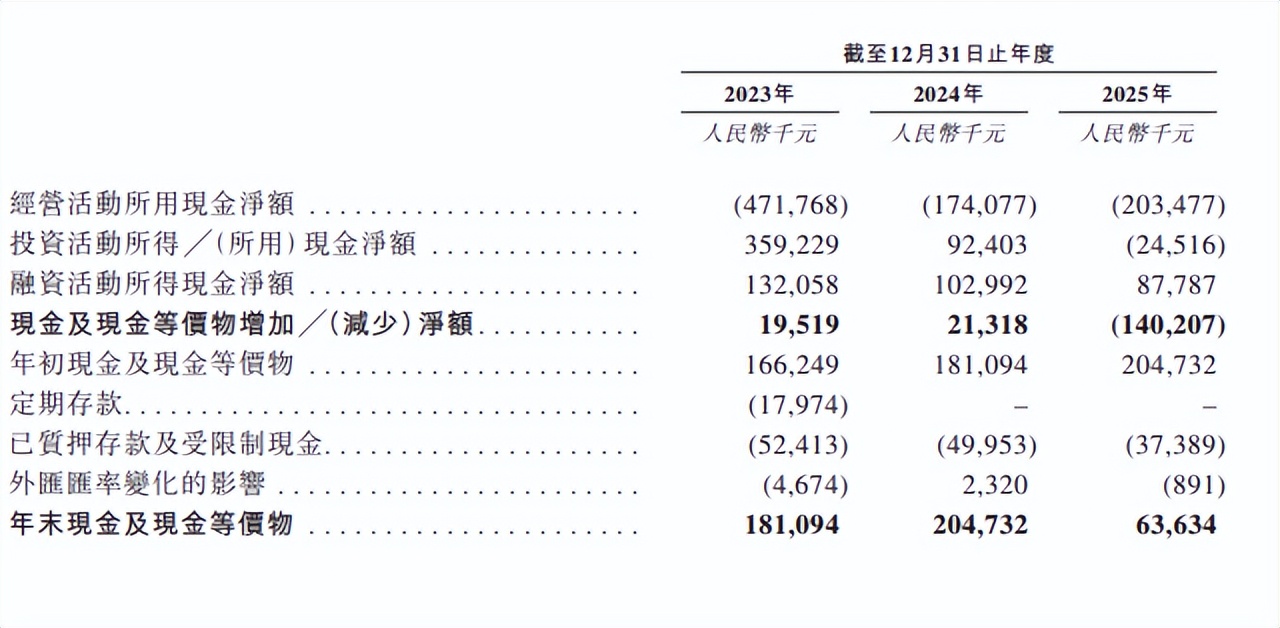
XREAL's sprint (this word means 'sprint' in the context of going public and is kept for context) for an IPO may also stem from the fact that its on-hand cash flow is not overly abundant, and given its current revenue situation, it is indeed difficult to sustain the company's expenditures.
XREAL is currently the "top brand in the global AR glasses market" and is indeed at the forefront. However, the current issue is that this track (this word means 'sector' and is kept for context) is still too small.
In 2025, XREAL's annual revenue was 516 million yuan. While this figure towers over its peers, it is not outstanding within the entire consumer electronics industry.
To a certain extent, this is a limitation of the current smart glasses sector, not a problem with XREAL. Therefore, this "global first" is more like a medal for a pioneer rather than a throne for a ruler.
Thus, Xu Chi's aspiration for capital as an amplifier is not only because XREAL needs more financial support but also because the entire smart glasses industry requires more investment and exposure.
Over the past few years, XREAL has been gradually changing this status quo.
In recent years, XREAL's flagship products have gradually shifted from the entry-level Air series to the mid-to-high-end One series, indicating an improvement in brand premium capability and a growing market demand for higher-end smart glasses products.
Relying on this, XREAL's gross profit margin has improved. Prospectus data shows that XREAL's gross profit margin climbed from 18.8% in 2023 to 35.2% in 2025, nearly doubling.
However, it is worth noting that the prospectus shows that sales and distribution expenses decreased from 214 million yuan in 2023 to 131 million yuan in 2025, while R&D expenses contracted from 216 million yuan to 183 million yuan.
This also means that part of the reason for the narrowing losses is due to reduced expenses, not solely driven by business growth. For a hardware company that emphasizes being "technology-driven," a decrease rather than an increase in R&D investment is not a particularly healthy sign.
After all, in the internet technology industry, short-term losses have never been a major issue.
NIO has incurred losses for 11 consecutive years since its establishment in 2014, with cumulative losses exceeding 130 billion yuan. JD.com also operated at a loss for 12 consecutive years from its entry into the e-commerce sector in 2004 until 2016.
Investors in internet technology have never solely focused on current development. Smart glasses are, after all, a new business format highly valued in the current market and are considered by many to be the next gateway to replace smartphones in the AI era.
Therefore, a large number of tech investors remain very bullish on XREAL.
According to the Tianyancha app, XREAL's shareholder lineup reads like a "who's who" of the tech circle, including well-known institutions such as Alibaba, Kuaishou Technology, NIO Capital, Shunwei Capital, and Sequoia China.
II. The Hundred-Regiment Battle for Smart Glasses
As Xu Chi had hoped, smart glasses ushered in (this word means 'have ushered in' and is kept for context) a wave of enthusiasm in 2026. In the first quarter of 2026 alone, 6 billion yuan in financing was secured, with significant support for various smart glasses players, including XREAL and Thunderbird Innovation.
Even newcomer Bit Fantasy secured 40 million yuan in financing shortly after its establishment.
IDC predicts that global smart glasses shipments are expected to exceed 23 million units in 2026, with AI glasses surpassing 10 million units. China's market is expected to reach 4.508 million units in shipments in 2026, a year-on-year increase of 77.7%.
More critically, the state has included smart glasses in the 2026 consumer goods trade-in subsidy program. The injection of policy dividends is like stepping on the accelerator for this sector.
At the same time, various tech giants are also making cross-border moves. Products like Xiaodu AI Glasses and Xiaomi AI Glasses have made their debuts, and even Li Auto, a car manufacturer, has announced its entry into the AI glasses sector.
The entry logics of these giants vary, but each one makes startups feel uneasy.
Although AI glasses and AR glasses are still somewhat distinguished at present—the former emphasizing AI-oriented capabilities and voice interaction, and the latter emphasizing optical display—the future development path will inevitably involve the fusion of AI and AR, and everyone will eventually converge in front of users' eyes.
Even these giants listed on XREAL's shareholder roster have their own layouts.
For example, Alibaba, whether with its previous Quark Glasses or this year's heavily promoted Qianwen AI Glasses, demonstrates its determination to deep cultivation (this word means 'deeply cultivate' and is kept for context) the smart glasses sector.
The giants will undoubtedly not abandon AI glasses as one of the potential "gateways."
If smart glasses truly become the gateway to the AI era, they will represent a traffic gateway no less significant than Baidu Search or Alipay, and will inevitably become part of the giants' strategic planning in the AI era.
Just like the smart speaker craze back in the day, when everyone felt that smart speakers might be the gateway to future smart homes. The battles among Baidu, Xiaomi, and Alibaba for smart speakers are still fresh in our memories, with various unicorn companies struggling to survive, and the three giants occupying nearly 97% of the market share.
Will this lead to new concerns among investors?
After all, the giants can afford to lose money on AI glasses because their goal is to seize the gateway.
But startups cannot, especially after going public, when every yuan of loss will face soul-searching from investors. In the mobile internet era, when BAT entered the market, entrepreneurs faced an unknown market. However, in the AI glasses era, the giants' ecological barriers are higher than ever before.
When your shareholders are also potential competitors in the sector, the delicacy of this relationship is akin to hiring a tiger as a bodyguard—both safe and dangerous.
Of course, as the current leader, XREAL still has its unique advantages.
Its overseas revenue is particularly notable.
In 2025, over 70% of XREAL's revenue came from overseas markets, with the United States, Japan, and Europe contributing 36.9%, 14.6%, and 13.8%, respectively. Its sales network covers 40 countries and regions.
This is indeed rare among consumer electronics startups. While most Chinese hardware brands are still struggling to go overseas, XREAL has already established a solid foothold in developed markets.
However, overseas markets are not without risks. Meta plans to double its AI glasses production capacity to 20 million units in 2026, and Google and Apple's AR product roadmaps have also emerged.
During the window period when the giants are still warming up and no killer smart glasses product has emerged, being the first to list on the capital market means securing more abundant financial reserves and higher brand exposure than competitors.
But this window period is closing rapidly.
As the giants' production capacity expansion and channel deployment progress at an exponential rate, the time left for startups is visibly dwindling.
However, for XREAL, there is another approach besides direct competition.
XREAL, with investments from multiple giants, is a high-quality cooperation choice for these giants.
For example, Google currently has a good cooperative relationship with XREAL. XREAL provides optical and chip technology, while Google injects its operating system and Gemini large model. The two players, on the same chessboard, are both teammates and opponents.
From B2C to B2B, XREAL can better leverage its technological and supply chain advantages. In the future, beyond its own product lines, XREAL may even become a direct "supplier" for the giants.
Even this point could give rise to new competition.
For example, Rokid Glasses by Rokid is equipped with Alibaba's Tongyi Qianwen large model. The giants are not limited to cooperating with just one party, and there may be a new round of competition among agents and suppliers in the future.
Obviously, XREAL is aware of this.
The prospectus shows that XREAL plans to use part of the IPO proceeds to build approximately 10 autonomous production lines for X-Prism optical engine manufacturing, expected to be completed and put into operation before 2031, with an annual production capacity of approximately 810,000 units.
Only by strengthening its R&D and production capabilities can XREAL maintain its advantageous position amid future possibilities.
In summary, XREAL's IPO represents the capital support that Xu Chi has long desired and is also an inevitable choice for XREAL after eight years of accumulation.
Currently, XREAL still maintains strong market competitiveness. The combination of self-developed optical engines and self-developed chips, along with over 70% of revenue coming from overseas markets, all prove the brand's global competitiveness.
However, how long these advantages can be maintained in the face of the giants' ecosystems and channels remains a huge question mark.
At the same time, for secondary market investors, XREAL's IPO is also a multiple-choice question filled with potential gains and risks. The final pricing of this IPO will also be a vote by the market on the future of smart glasses.
Disclaimer: This article is based on the company's statutory disclosures and publicly available information and provides commentary. However, the author does not guarantee the completeness or timeliness of this information.
Additionally: The stock market involves risks, and caution is advised when entering. This article does not constitute investment advice, and the decision to invest or not must be made through one's own discernment.
-
![]()
Registered Capital Slashed to 372 Million Yuan! Yutong Optical Finalizes Industrial and Commercial Change Registration
-
![]()
Zhuque-3 Successfully Lands, and 'Time Traveler' Secures Another ¥100 Million in Funding: China's Commercial Space Industry Experiences a 'Dynamic August'
-
![]()
Autohome Faces a Shrinking Window of Opportunity
-
![]()
Even a Titan Like Musk Has Faced Setbacks in Fulfilling Promises
-
![]()
AI Office: The End of the Racing Era, Context Becomes the Key to Success
-
![]()
Domestic Vehicle Chassis Revolution ②: The Steering Wheel Remains, But Mechanical Connections in the Steering System Are Decreasing
-
![]()
Exploring MiniMax Design: Can Video Editing Be as Simple as Speaking?
-
![]()
Why Can SenseTime Achieve Profitability While CloudWalk Still Faces Challenges, Despite Both Adopting Large Models?