Alibaba Cloud and Volcano Engine Compete in Automotive Cloud Market
 10/26 2026
 418
Alibaba Cloud and Volcano Engine have each secured a 'top spot.'
Before this year’s Spring Festival, the two companies had already competed in airport advertisements: Alibaba emphasized its revenue share in full-stack AI cloud, while Volcano highlighted the call volume of its public cloud large models.
Now, in the segmented automotive cloud rankings, the two sides have begun a second round of competition.
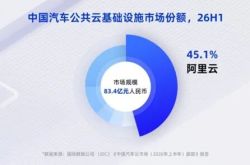
According to IDC data for the first half of 2026, Alibaba accounted for 45.1% of the automotive public cloud infrastructure market, while Volcano captured 45% of the AI cockpit solution market. The two figures are close, but the market sizes behind them are 8.34 billion yuan and 710 million yuan, respectively.
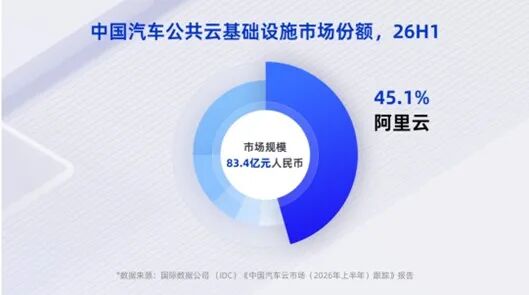
China's automotive public cloud infrastructure market in the first half of 2026.
Alibaba leads in providing computing, storage, and network resources to the automotive industry. Automakers rent GPUs to train intelligent driving models and store and process vehicle data. Volcano leads in software and services that enable in-car AI assistants, including model licensing, application development, deployment management, and post-launch updates and maintenance. These can run in the cloud, on the vehicle side, or through a combination of both.
In fact, both types of business are related to AI: Training models utilizes public cloud infrastructure, while the cockpit rankings tally software, models, and application services.
More noteworthy changes have occurred over time: In the public cloud infrastructure market, Volcano has risen to second place, with Alibaba and Volcano together accounting for over 60%. In the cockpit solution market, the order is reversed, with Volcano first and Alibaba second.
Alibaba continues to expand its share in the larger revenue market, while Volcano has entered the top tier. The two companies’ products now directly compete in the cockpit market.
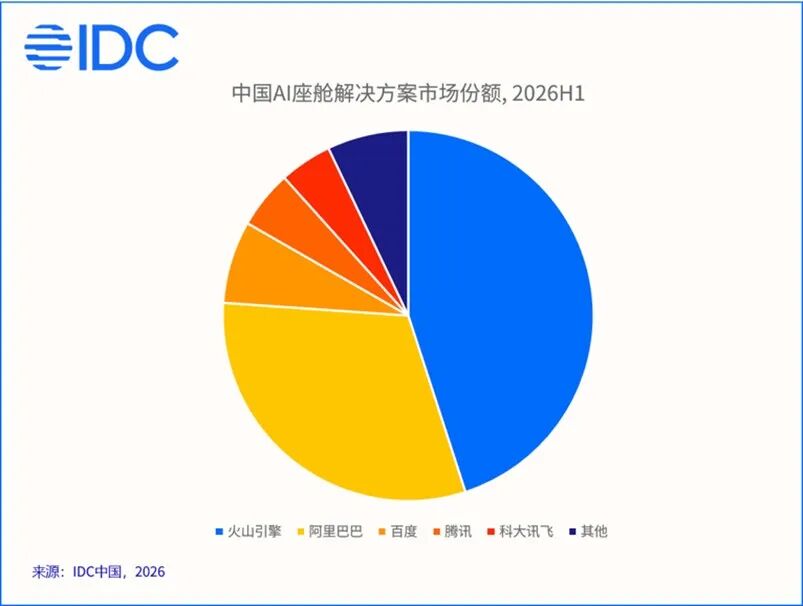
China's AI cockpit solution market share in the first half of 2026.
01 Alibaba’s Share Rises, Volcano Enters the Top Tier
In March this year, a procurement announcement from VOYAH encapsulated the competitive landscape of the automotive cloud market.
In the project for “leasing public cloud services for vehicle-cloud big data,” Alibaba quoted approximately 11.9 million yuan and ranked first among bid candidates, with Tencent and Huawei placing second and third, respectively. Volcano also participated in the bidding, and its comprehensive score was listed in the announcement.
While Alibaba and Volcano each claimed to be “number one” in advertisements, when participating in VOYAH’s procurement of resources and services, they still had to compete alongside Tencent and Huawei and submit project-specific quotes.
This type of public cloud resource procurement is currently the largest and most concentrated area of competition in the automotive cloud market, in terms of both deal size and growth. In the first half of 2026, revenue from public cloud infrastructure increased by 88.1% year-on-year. Based on the disclosed scale and growth rate, this represents an increase of approximately 3.9 billion yuan compared to the same period last year; this single revenue increase alone is about 5.5 times the size of the entire AI cockpit solution market during the same period.
Despite its long-standing dominance, Alibaba Cloud’s growth in this period was still faster than the industry average. In the first half of 2026, its revenue in the same market increased by 111% year-on-year. A rough calculation shows that Alibaba added approximately 2 billion yuan in revenue during this period, roughly capturing about half of the industry’s growth.
The remaining vendors collectively added about 1.9 billion yuan in revenue. The market is growing rapidly, allowing multiple companies to expand, but the distribution of new revenue is uneven. Alibaba’s faster growth has reduced the combined share available to other vendors. This change is first reflected in revenue distribution, while the number of clients each company has secured requires order details to calculate accurately.
Volcano’s upward trajectory has also been rapid. In the first half of 2024, the top five automotive public cloud providers included Alibaba, Huawei, Tencent, Baidu, and AWS, with Volcano not yet on the list; by the second half of that year, Volcano entered the top five; and in the first half of 2026, it ranked second.
Alibaba’s share also increased during the same period: from 35.7% in the second half of 2024 to 42% in the second half of 2025, rising to 45.1% in the first half of 2026. Volcano’s rise in ranking coincided with Alibaba’s share growth.
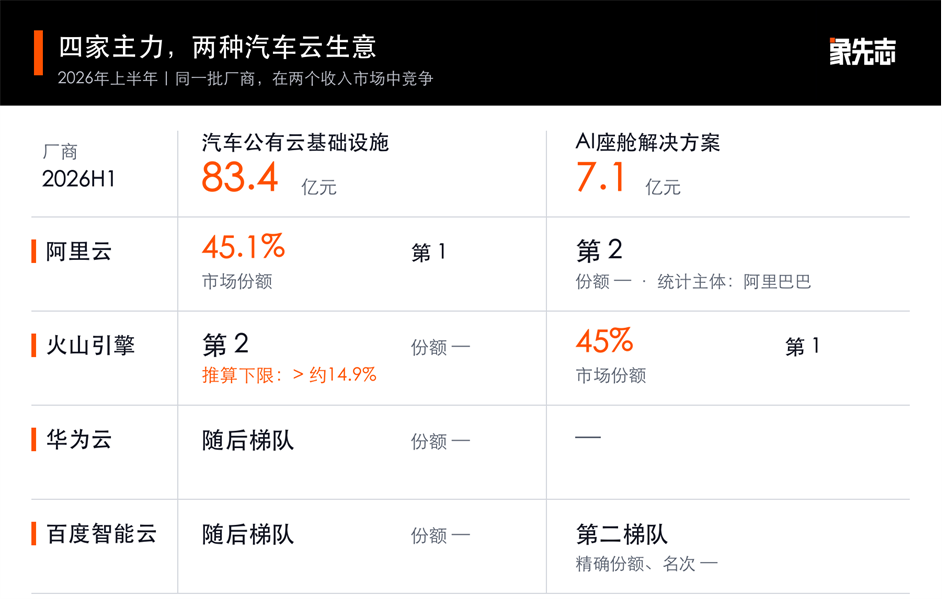
IDC’s latest analysis describes Huawei, Baidu, and Tencent as having similar market shares, with a clear gap between them and Alibaba and Volcano.
Automakers’ continued investment in intelligent driving R&D supports market expansion. IDC mentioned that as visual-language-action models and world models enter large-scale production validation, demand for autonomous driving computing power persists. Meanwhile, rental prices for compliant AI computing chips have risen, and high-performance storage prices have increased by 20-30% year-on-year.
The revenue increase thus includes both new investments and price hikes. For automakers, budgets must cover both model iteration and resource costs, while procurement and R&D teams must also consider whether rented resources can be fully utilized.
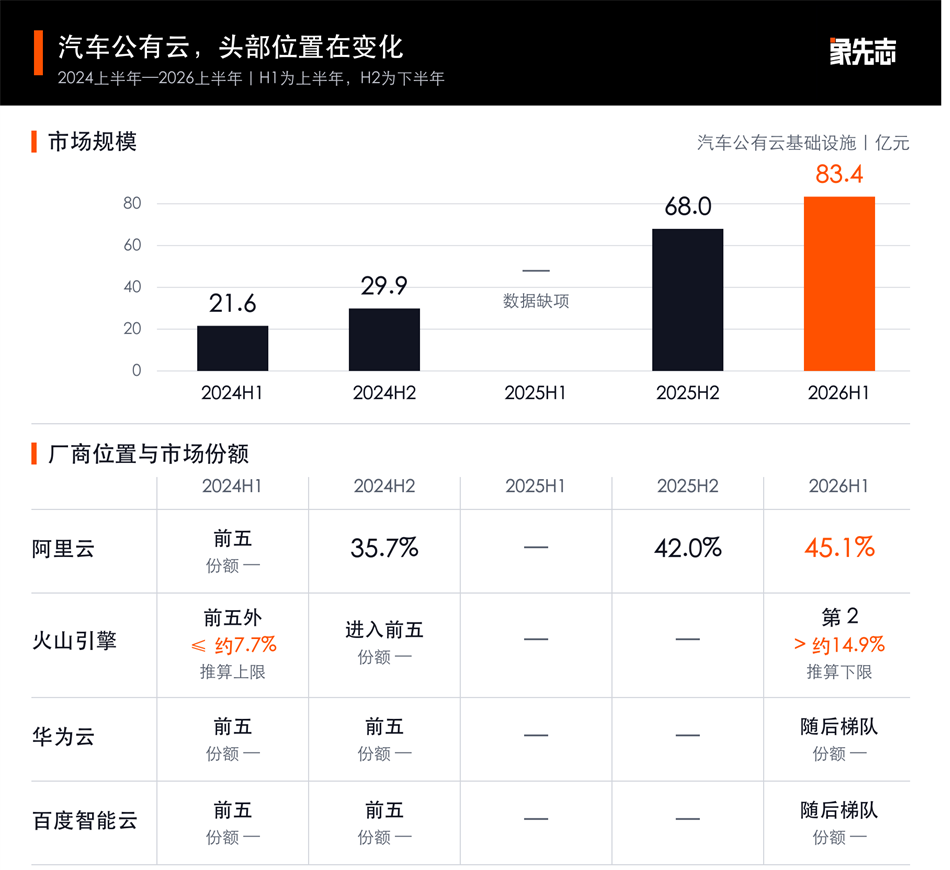
Changes in the scale of the automotive public cloud market and the positions of the four major players.
02 Former Leaders Overtaken, New Landscape Emerges
Alibaba’s expanding share and Volcano’s rise to second place have squeezed the positions of several former major suppliers. Huawei, Tencent, and Baidu have been overtaken by Volcano, while AWS dropped out of the top five in the second half of 2024; now, Alibaba and Volcano together account for over 60% of revenue, with the remaining vendors sharing the rest of the market.
As early as 2024, IDC predicted that automakers were consolidating their multi-cloud strategies to two or three suppliers, and the market landscape was gradually solidifying.
Volcano’s growth can be roughly estimated from public figures.
In the first half of 2024, Alibaba, Huawei, Tencent, Baidu, and AWS collectively held 92.3% of the market, leaving only 7.7% for other vendors, including Volcano. By the first half of 2026, Alibaba held 45.1%, and the two companies together accounted for over 60%, implying that Volcano’s share had exceeded approximately 14.9%. Based on these public figures, Volcano’s share grew from no more than approximately 7.7% to over approximately 14.9%.
Alibaba’s share also rose during this reshuffling. While public data does not yet provide consecutive share figures for Huawei, Tencent, Baidu, and AWS, the fact that they have been overtaken is beyond dispute.
According to previous reports by Lei Feng Network, Li Auto previously primarily used Baidu’s cloud services, with limited use of AWS. After launching a new intelligent computing project bid in 2022, Li Auto chose to procure public cloud services from Volcano, which provided over 300 NVIDIA server computing units, with delivery planned for 2023. The report cited Volcano’s lower pricing as one factor in winning the project.
Li Auto’s increased training investment also prompted a new round of bidding for existing suppliers. Volcano entered the cooperation list through this procurement. By July 2024, when 36Kr reported that Li Auto was reorganizing its R&D for end-to-end systems and continuing to expand training computing power, its partners still included Volcano, Alibaba, and Baidu.
Li Auto continues to cooperate with Baidu while assigning new training tasks to additional suppliers. Automakers can continue using existing services and procure separately for new models and expanded training scales, giving new suppliers opportunities to generate revenue.
Revenue growth and share decline can occur simultaneously. In the first half of 2026, Alibaba captured about half of the industry’s revenue increase, while the combined revenue of other vendors still grew, their combined share declined.
Former market leaders also have a basis for continuing to compete for orders. In its research for the second half of 2024, IDC ranked Baidu first in autonomous driving R&D solutions, with Huawei leading in vehicle IoT solutions; Tencent has also disclosed cases of providing intelligent driving data storage products for NIO.
However, collaborations on R&D tools, vehicle connectivity, or storage projects have not allowed a single cloud provider to secure all of an automaker’s subsequent procurement. Alibaba and Volcano have already altered the ranking of public cloud revenue, and the resources needed for the next round of model training will bring several suppliers back into competition.
03 The Biggest Clash: Public Cloud Expansion
In terms of market size and revenue growth, the most significant direct competition between Alibaba and Volcano lies in public cloud procurement driven by demand for intelligent driving training.
In VOYAH’s public cloud tender in March, Alibaba and Volcano both participated, with Tencent and Huawei also competing. Alibaba ranked first among candidates, while Volcano vied for the procurement.
Alibaba’s existing engineering collaborations condition its pursuit of new orders. In 2022, when XPENG launched its “Fuyao” intelligent computing center, the two companies jointly optimized GPU scheduling, communication, storage, and training platforms. By August 2026, an XPENG executive responsible for autonomous driving and intelligent cockpit products disclosed via a certified account that the collaboration had extended to adopting Zhenwu AI chips and full-link engineering optimization for model training.
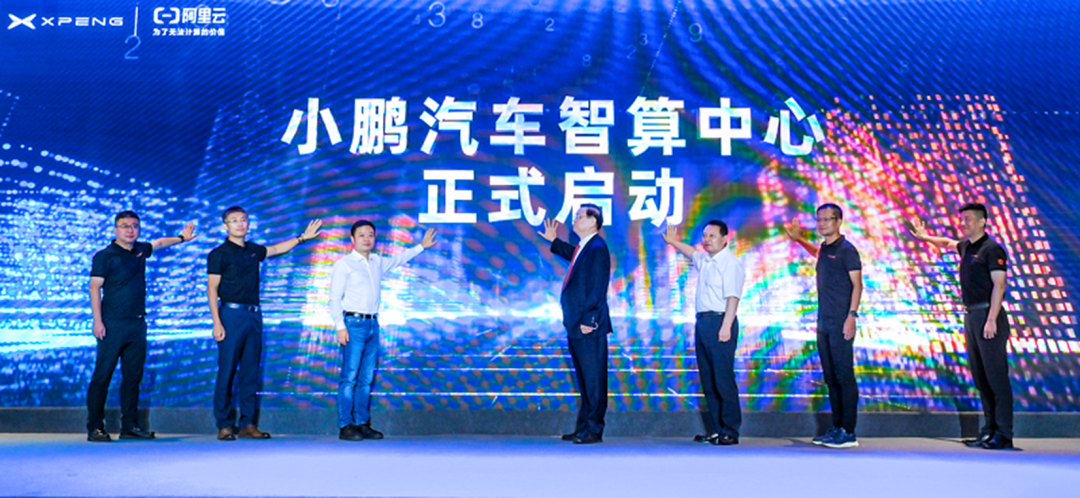
XPENG’s “Fuyao” intelligent computing center launched in 2022.
As both chips and models evolve, the previous joint work between the two companies connects to a new round of tasks. For Alibaba, maintaining its lead in automotive public cloud requires continuing to secure procurement from existing clients after capacity expansion and technological updates. It must sustain existing projects and participate in new tenders like VOYAH’s.
Volcano’s opportunities arise when automakers select new suppliers for additional tasks. Li Auto’s historical procurement shows that new computing power projects can allow latecomers to enter; to continue winning business, Volcano must also address training issues after machine rental.
In Haomo’s “Snow Lake Oasis” private cloud project, Ai Rui, the technical vice president, explained that when autonomous driving data shifted from single-frame images to video clips, reading and communication slowed training, and GPUs might wait for data. Haomo developed its own file system, while Volcano optimized underlying computing, communication, and training frameworks.
Both Alibaba and Volcano are already involved in such engineering work, and their competition extends from project quoting to the total cost of completing training. GPU wait times for data can slow training, and new resources must integrate with existing systems; model iteration must also maintain training efficiency. Rising chip rental and high-performance storage costs make utilization rates a critical procurement consideration for automakers.
Alibaba, with its larger public cloud revenue scale, must ensure existing clients continue ordering during expansion. Volcano, expanding its supply scope, must secure new clients through procurement for additional tasks. Automakers will compare existing collaborations with new quotes and delivery plans.
Volcano’s lead in the cockpit market gives it a stronger position in another type of procurement. It accounts for 45% of AI cockpit solution revenue, with Alibaba second. In September 2026, SAIC disclosed that its Roewe Jiayue 07 co-created the Doubao cockpit assistant with Volcano, integrating over 2,000 vehicle service interfaces; Alibaba had also previously announced plans with BMW to develop next-generation vehicle AI engines based on Qianwen and Banma Yuanshen AI.
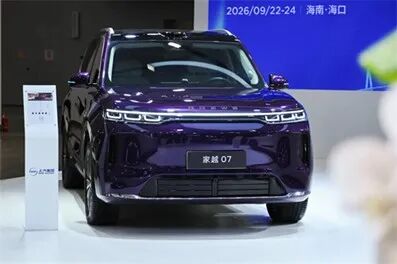
The Roewe Jiayue 07 debuted at the 2026 World New Energy Vehicle Congress.
Alibaba competes for both training resource orders and model/application projects for mass-produced vehicle models. Volcano now participates in both types of business: chasing Alibaba in public cloud and maintaining its lead in cockpit solutions.
Automakers continue to place orders with other suppliers.
In VOYAH’s public cloud project in March, Alibaba ranked first among candidates; by September, another “intelligent computing resource pool construction project” was awarded to Tencent Cloud, Hubei Telecom, Mobile, and Unicom, with a total contract value of approximately 82.51 million yuan.
Based on revenue in the first half of 2026, Alibaba and Volcano are now the top two in automotive public cloud. When automakers initiate subsequent procurement, they will still re-evaluate suppliers. To defend or expand their shares, both companies must continue winning orders. Undoubtedly, the two-strong pattern (landscape) in automotive cloud has largely taken shape.
-
![]()
Alibaba Cloud and Volcano Engine Compete in Automotive Cloud Market
-
![]()
“After Testing K3.1 Pro Overnight, It Seems Kimi Is Truly Advancing Towards Embodied AI”, “K3.1 Pro, Speed, Task Execution, Allowance, Embodied AI”
-
![]()
BYD Registers Decline in Six Models, Xiaomi Undergoes Leadership Shuffle! Comprehensive Review of BEV Sales Rankings from January to September
-
![]()
DeepSeek’s Product Department Entrusted to a Quantitative Trader
-
![]()
After Two Decades of Anticipation, Wuhan and YMTC Face a Cooling A-Share Market
-
![]()
Why Are Automakers Pivoting to Battery Swapping Amid Rapid Advances in Ultra-Fast Charging?
-
![]()
From Lucent to NVIDIA: When History Echoes
-
![]()
Thermal Effects on Femtosecond Filamentation and Supercontinuum Generation in YAG Crystals: Insights from Ultrafast Nonlinear Optics Study No. 105