From Lucent to NVIDIA: When History Echoes
 10/26 2026
 520
History may not repeat itself verbatim, but it often echoes with striking similarities.
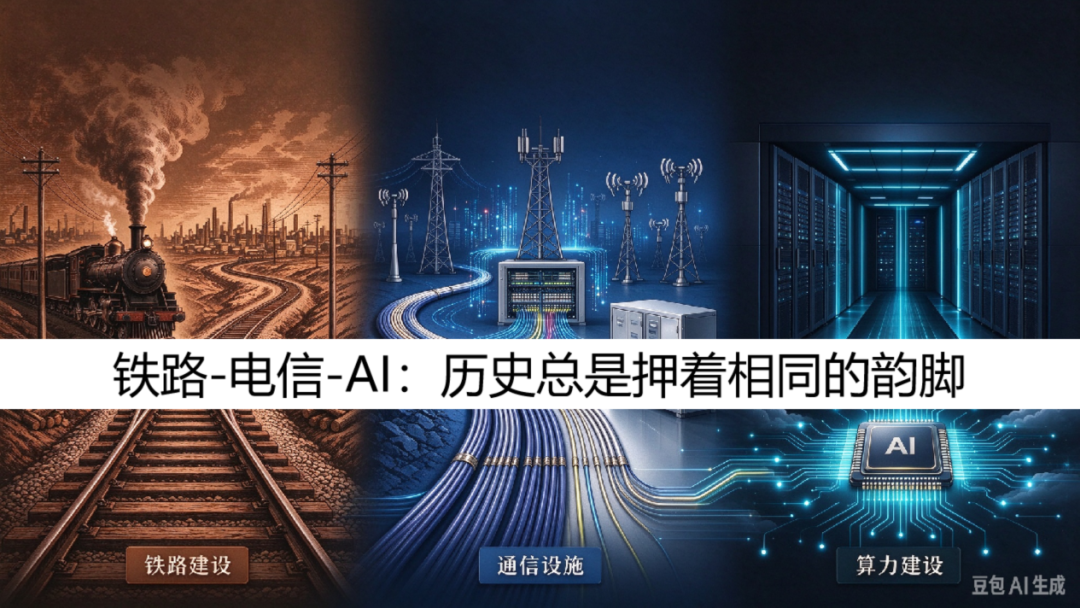
Today, the meteoric rise of AI computing power has captivated many, yet it obscures a time-honored cycle: the playbook of artificial demand has unfolded twice before, during the railway and telecom booms. From the railway era of the 19th century, through the telecom revolution at the dawn of the 21st century, and now into the AI age, the same rhythm persists, repeating across different eras and contexts.
I. Railway Era: Giants Fabricated Demand by Creating Their Own Clients
In 19th-century America, the nation placed a monumental bet on railways. Federal subsidies flowed generously, capital surged into the market, and a national consensus emerged: railways were the key to endless growth.
Union Pacific (UP), the industry leader, was the darling of the era.
However, railway infrastructure is inherently a one-time investment: once tracks are laid, they require no replacement for decades. The actual growth in passenger and freight demand proved sluggish, unable to sustain UP's soaring financial ambitions.
So, in 1864, UP executives established a puppet company, Crédit Mobilier, transforming it into a fully controlled 'exclusive client.' UP awarded railway contracts to this shell entity at inflated prices, effectively signing contracts with one hand and collecting payments with the other. This scheme generated large orders and recognized revenue out of thin air. The financials looked impressive, and Wall Street applauded, but behind the scenes, not a single inch of genuine new traffic volume materialized to meet this artificial demand.
Eight years later, in 1872, the media exposed the scandal, sparking public outrage. In 1873, a financial panic ensued, capital fled rapidly, and 89 railway companies across the U.S. collapsed in succession. The railway bubble burst spectacularly.
UP survived by sheer luck, but its growth myth was shattered. After several restructurings and changes in ownership, it could no longer justify its once-frenzied valuation.
II. Telecom Era: Giants Propped Up Orders by Lending to Clients
A century later, the communications revolution swept the globe. Fiber optics and programmable switches became the era's core assets, and the communications equipment sector reaped epic-scale profits.
In 1996, Lucent Technologies, armed with the legendary Bell Labs and cutting-edge communications technology, spun off from AT&T and stood at the forefront of the telecom boom.
However, switches and fiber optics are also long-cycle durable goods. Once deployed, they remain in use for years, creating a natural shortage of sustained new demand. The high-growth narrative proved unsustainable.
Lucent's solution? Supplier credit: lending money to clients, who would then use the credit to purchase Lucent's equipment. When clients lacked funds, Lucent directly provided financing, with payments and equipment deliveries counted as revenue in the current period. At its peak, Lucent's financing commitments to clients reached $7.1 billion. But after operators received the equipment, they struggled to generate enough traffic revenue to repay the loans, leading to a steady accumulation of bad debt.
Then, in 2001, the telecom bubble burst. Lucent wrote off $3.5 billion in bad debt over two years, its stock price nearly wiped out, and in 2006, it was acquired by Alcatel, marking the quiet end of a once-great giant.
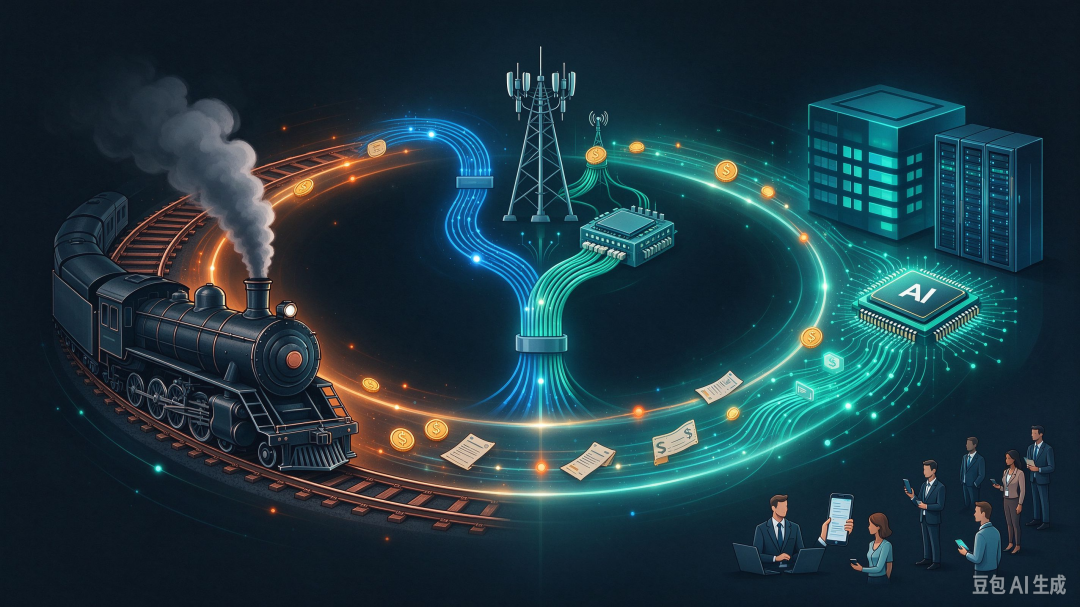
III. AI Era: Giants Sustain a Closed-Loop by Investing in Clients
Three decades later, artificial intelligence has become the world's hottest super-sector, with computing power serving as the era's infrastructure, much like railways and telecom facilities once did.
NVIDIA, wielding its GPU dominance, takes center stage as one of the new era's core players.
However, AI computing power and large-model infrastructure inherently feature over-construction. With limited current use cases, weak corporate willingness to pay, and slow commercialization, real end-user demand falls far short of the massive GPU clusters and supercomputing centers being deployed. Short-term real revenue cannot sustain NVIDIA's growth rate, let alone justify its trillion-dollar market cap.
So, NVIDIA teamed up with tech giants like Microsoft and Google, along with model companies like OpenAI and Anthropic, to orchestrate a more sophisticated high-stakes game: using equity investments to bind procurement obligations, artificially propping up computing demand.
- NVIDIA → OpenAI: In September 2025, NVIDIA committed up to $100 billion, on condition that OpenAI used the funds to deploy at least 10GW of NVIDIA computing systems (millions of GPUs), with investment disbursements tied to each 1GW milestone.
- NVIDIA + Microsoft → Anthropic: In November 2025, NVIDIA invested up to $10 billion, Microsoft up to $5 billion, requiring Anthropic to purchase up to 1GW of NVIDIA computing power and $30 billion worth of Azure cloud services.
- Google → Anthropic: In April 2026, Google committed up to $40 billion (with $10 billion upfront and the remaining $30 billion tied to performance milestones), agreeing to deliver 5GW of TPU computing power to Anthropic via Google Cloud over five years.
- NVIDIA → OpenAI (additional): Of OpenAI's total financing of approximately $110 billion, NVIDIA, as both 'shareholder and core supplier,' contributed an additional ~$30 billion, providing 3GW of inference computing power and 2GW of training computing power.
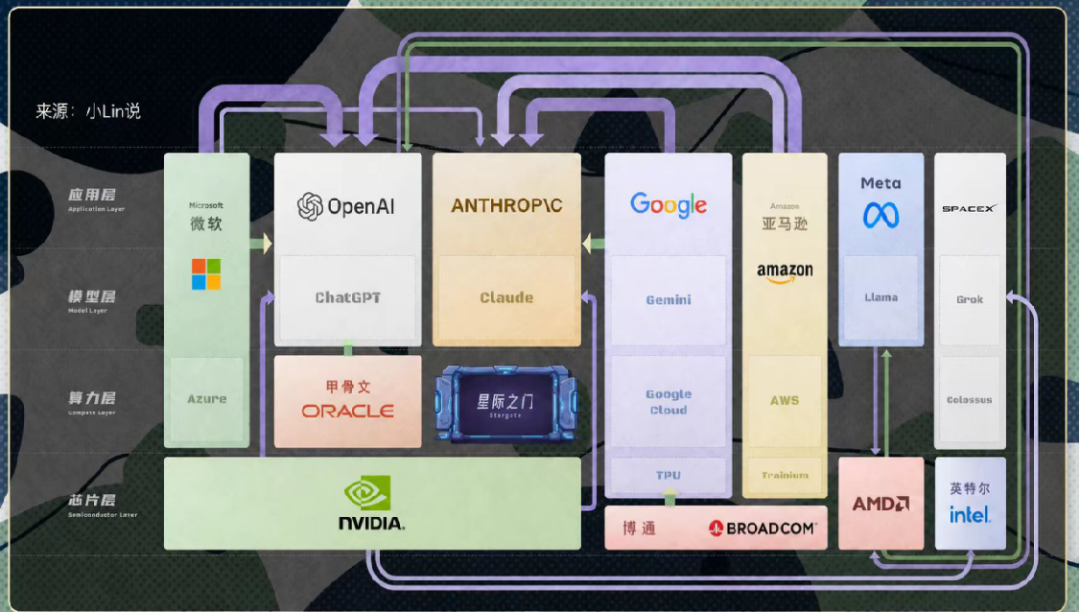
The logic is clear: NVIDIA, Microsoft, and Google invest → OpenAI and Anthropic use the funds to inflate valuations → the funds flow back to purchase GPUs, cloud services, and TPU computing power → procurement amounts boost the giants' revenue, strengthening financials and driving up stock prices → the giants then reinvest profits into the next round. Capital circulates within this closed loop, with each round of financial data looking more impressive than the last, yet detached from real end-user payments.
So, what happens next?
Epilogue
In the railway era, giants built their own clients to fabricate demand.
In the telecom era, giants lent to clients to prop up orders.
In the AI era, giants invest in clients to sustain a closed-loop.
The times change, the players rotate, the narratives grow grander, and the transaction designs become more intricate, but the underlying core remains unchanged for a century.
Of course, these giants are essentially placing a massive gamble: betting on whether real end-user demand will explode first or if the bubble will burst sooner. Theoretically, there is a possibility: before the bubble collapses, large-scale, high-paying use cases emerge, absorbing the mountain of computing power, and filling this empty loop with real end-user revenue.
But history's lessons remain starkly visible. Bubbles never burst amid skepticism—they always shatter at their most frenzied, crowded moment.
So, when do you think this bubble will burst?
-
![]()
Alibaba Cloud and Volcano Engine Compete in Automotive Cloud Market
-
![]()
“After Testing K3.1 Pro Overnight, It Seems Kimi Is Truly Advancing Towards Embodied AI”, “K3.1 Pro, Speed, Task Execution, Allowance, Embodied AI”
-
![]()
BYD Registers Decline in Six Models, Xiaomi Undergoes Leadership Shuffle! Comprehensive Review of BEV Sales Rankings from January to September
-
![]()
DeepSeek’s Product Department Entrusted to a Quantitative Trader
-
![]()
After Two Decades of Anticipation, Wuhan and YMTC Face a Cooling A-Share Market
-
![]()
Why Are Automakers Pivoting to Battery Swapping Amid Rapid Advances in Ultra-Fast Charging?
-
![]()
From Lucent to NVIDIA: When History Echoes
-
![]()
Thermal Effects on Femtosecond Filamentation and Supercontinuum Generation in YAG Crystals: Insights from Ultrafast Nonlinear Optics Study No. 105