BYD Registers Decline in Six Models, Xiaomi Undergoes Leadership Shuffle! Comprehensive Review of BEV Sales Rankings from January to September
 10/26 2026
 375
Authored by | Auto Observer
Recently, China Auto Data Research unveiled the BEV model sales rankings for the period spanning January to September 2026. Drawing on the previous rankings for the first eight months, as meticulously analyzed by Auto Observer, we delve into the latest shifts in the market landscape (refer to the article's conclusion for the rankings of the initial eight months).
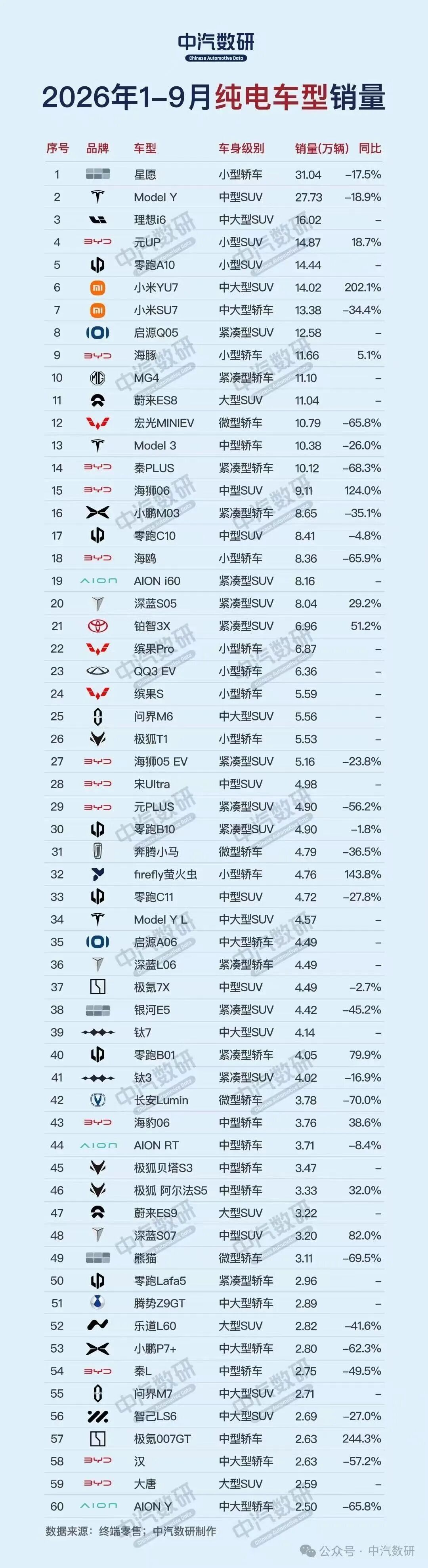
Throughout the first nine months, Geely Starwish maintained its lead with 310,400 units sold, preserving the momentum established in the first eight months. It was closely trailed by the Model Y, which recorded 277,300 units in sales.
Traditionally, the fourth quarter marks Tesla's year-end sales surge. Should Starwish continue its downward trajectory this year, a shift in the annual BEV sales champion is not beyond the realm of possibility.
From Auto Observer's vantage point, on one hand, there is a domestic compact car with a starting price exceeding 60,000 units, and on the other, a global automotive giant relying on a single model. This 'clash of titans' essentially pits two distinct business models against each other.
Among the emerging players, Xiaomi has finalized its leadership transition: YU7 outperformed SU7 with 140,200 units sold and a remarkable year-over-year growth rate of 202.1%, in contrast to SU7's 133,800 units (which experienced a year-over-year decline of 34.4%).
The transition from sedans to SUVs underscores that Xiaomi's brand momentum remains robust, with its product portfolio shifting from 'sports sedans' to family-oriented SUVs. However, SU7's decline serves as a cautionary tale: while novelty attracts initial interest, it does not guarantee repeat purchases.
NIO's journey has been a rollercoaster: the all-new ES8 dropped from 7th place in the January-August rankings to 11th place in the January-September rankings; the L60 witnessed a 41.6% year-over-year decline, and the ET5 fell out of the top 60.
Although Li Auto's i6 held steady in third place, its growth trajectory noticeably flattened, increasing from 152,700 units in the first eight months to 160,200 units in the first nine months.
The fate of emerging forces remains consistent: without a continuous influx of new models, sustained sales are unattainable.
In stark contrast, the AITO M6 soared from 46th place in the first eight months to 25th place in the first nine months.
Leapmotor emulated BYD's strategy of inundating the market with a diverse range of models, this time with a keen focus on 'cost-effectiveness.' Six models—A10 (144,400 units), C10, B10, C11, B01, and Lafa5—made the list, spanning a comprehensive range from the 70,000-unit tier to the 200,000-unit tier. 
Furthermore, Auto Observer observed two sets of 'generational shifts' occurring discreetly. GAC Aion's AION i60 surged to 19th place with 81,600 units sold, while the veteran AION Y experienced a significant 65.8% year-over-year decline, leaving only 25,000 units sold. By replacing an aging model with a new one, Aion demonstrated decisive renewal, but the risk associated with relying on a single hit model shifted from the 'old guard' to the 'newcomer.'
The Chang'an ecosystem thrived across the board: Qiduan Q05 entered the top eight with 125,800 units sold, Deepal S05 exhibited steady growth with 80,400 units, and Qiduan A06 and Deepal L06 each contributed 44,900 units. Chang'an is capitalizing on its dual strategy of 'Qiduan for volume, Deepal for intelligence' to translate the resource advantages of a central state-owned enterprise into tangible sales figures.
The MG4 secured 10th place with 111,000 units sold, underscoring that a dual emphasis on exports and domestic sales provides the most compelling narrative for 'Chinese compact cars going global.'
Conversely, the A00-class segment continued its downward spiral. In the first nine months, the Hongguang MINIEV witnessed a 65.8% year-over-year decline, the Chang'an Lumin a 70.0% decline, and the Geely Panda a 69.5% decline. It is not that compact cars are no longer in demand; rather, the 'old trio' of 'lack of intelligence, slow charging, and inadequate safety redundancy' has been rendered obsolete by the times.
Downgrading consumption is a fallacy; upgrading consumption is the prevailing trend. The popularity of the Yuan UP and Leapmotor A10 attests to this.
Within the joint venture阵营 (camp), Toyota's bZ3X distinguished itself with a notable 51.2% year-over-year increase. This underscores that by adopting a humble approach, leveraging the Chinese supply chain, and setting a more modest price point, the formula for joint venture BEV self-rescue has long been evident. 
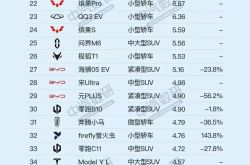
Finally, let's turn our attention to the kingpin, BYD. On the surface, BYD emerges as the biggest winner on the list: 12 models, including the Yuan UP, Dolphin, Qin PLUS, Sealion 06, Seagull, and Han, made the list, totaling over 800,000 units and solidifying its position as the largest BEV player.
However, a closer examination of the growth figures reveals a more nuanced picture. The Qin PLUS experienced a 68.3% decline, the Seagull a 65.9% decline, the Yuan PLUS a 56.2% decline, the Han a 57.2% decline, and the Qin L a 49.5% decline.
Half of its models are experiencing a sharp decline, with only the Yuan UP (+18.7%), Sealion 06 (+124.0%), Seal 06 (+38.6%), and Dolphin (+5.1%) exhibiting growth.
This encapsulates BYD's 'dominance-with-decline' scenario: its scale remains colossal, but its momentum continues to wane.
With one quarter remaining in 2026, the question lingers: what will unfold next? Time will tell.
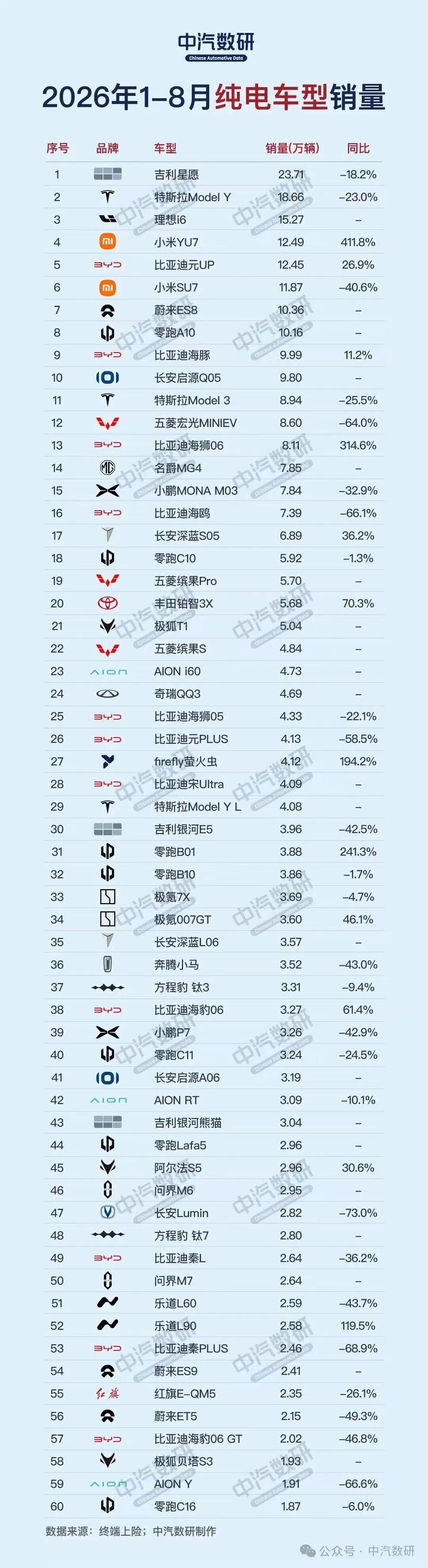
All charts featured in this article, unless otherwise specified, are sourced from publicly disclosed information across various channels. We hereby acknowledge and express our gratitude! The views expressed in this article are for reference purposes only and do not constitute investment advice.
This article represents original content from Leverage Auto Observer and is strictly prohibited from being reproduced without prior authorization. To reproduce, please obtain the necessary authorization. Additionally, when reproducing with authorization, kindly indicate the source and author at the outset of the article. Thank you!
-
![]()
Alibaba Cloud and Volcano Engine Compete in Automotive Cloud Market
-
![]()
“After Testing K3.1 Pro Overnight, It Seems Kimi Is Truly Advancing Towards Embodied AI”, “K3.1 Pro, Speed, Task Execution, Allowance, Embodied AI”
-
![]()
BYD Registers Decline in Six Models, Xiaomi Undergoes Leadership Shuffle! Comprehensive Review of BEV Sales Rankings from January to September
-
![]()
DeepSeek’s Product Department Entrusted to a Quantitative Trader
-
![]()
After Two Decades of Anticipation, Wuhan and YMTC Face a Cooling A-Share Market
-
![]()
Why Are Automakers Pivoting to Battery Swapping Amid Rapid Advances in Ultra-Fast Charging?
-
![]()
From Lucent to NVIDIA: When History Echoes
-
![]()
Thermal Effects on Femtosecond Filamentation and Supercontinuum Generation in YAG Crystals: Insights from Ultrafast Nonlinear Optics Study No. 105