Thermal Effects on Femtosecond Filamentation and Supercontinuum Generation in YAG Crystals: Insights from Ultrafast Nonlinear Optics Study No. 105
 10/26 2026
 441
When a femtosecond laser beam travels through a transparent medium, the dynamic interplay between Kerr self-focusing and defocusing effects—induced by free-electron plasma—leads to the formation of elongated, high-intensity filaments. During this filamentation process, the laser pulses undergo spatiotemporal reshaping, with spectral broadening occurring on both sides of the pump wavelength, ultimately resulting in supercontinuum generation. At high repetition rates, the heat generated by nonlinear absorption accumulates within the material, significantly altering the propagation characteristics of subsequent pulses. This study delves into the experimental and numerical analysis of how convergent and divergent pump incidence conditions influence supercontinuum generation and thermal accumulation in YAG crystals, with repetition rates ranging from 200 kHz to 2 MHz [1].
Figure 1 presents the experimental setup. The pump source is a Yb:KGW laser, characterized by a central wavelength of 1030 nm, a pulse width of 210 fs, a beam diameter of 4.1 mm, and a fixed single-pulse energy of 1.28 μJ. The pump beam is directed into a 10 mm-thick YAG crystal through a lens with a 125 mm focal length. The output is collimated for spectral and power measurements, while a CCD camera records the filament emission trajectory on the lateral surface of the crystal. By adjusting the focusing lens, the offset Δz of the beam waist relative to the crystal's incident surface can be modified: when Δz < 0, the beam waist is positioned outside the incident surface, resulting in divergent incidence; conversely, when Δz > 0, the beam converges. It is important to note that the beam waist position is defined based on focusing conditions in air and may differ from the actual nonlinear focal position within the crystal.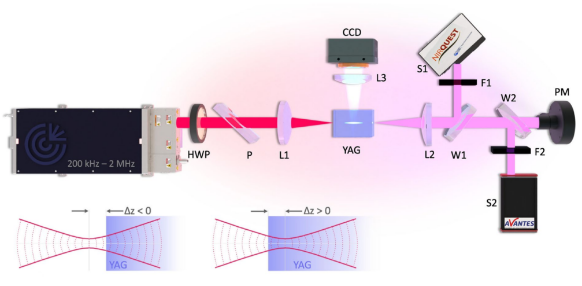 Figure 1. Schematic representation of the experimental setup, showcasing both convergent and divergent incidence conditions [1].
Figure 2 illustrates the variation in the nonlinear focal position and filament emission trajectory as a function of Δz at a 200 kHz repetition rate. The nonlinear focus is identified as the first intensity maximum within the emission trajectory. At Δz = 1 mm, a divergent beam produces a shorter, smoother trajectory, whereas a convergent beam generates a longer trajectory with more pronounced brightness fluctuations. Additionally, re-focusing phenomena are observed near Δz = +3 mm and +4 mm.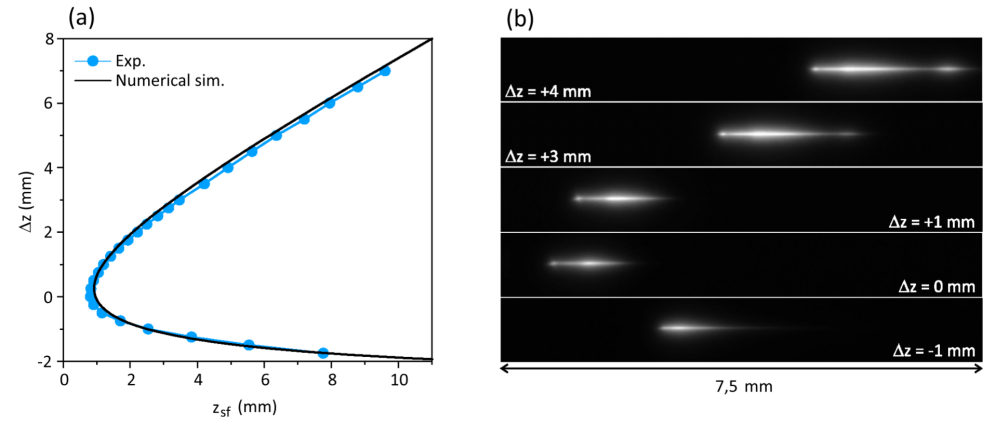 Figure 2. (a) The relationship between the nonlinear focal position and the beam waist offset; (b) Filament emission trajectories at various offsets [1].
Figure 3 compares the changes in crystal transmittance and supercontinuum generation with respect to the beam waist position. YAG crystals exhibit relatively high transparency to low-intensity 1030 nm light. However, the high intensity during filamentation triggers multiphoton absorption and free-carrier absorption, leading to a reduction in transmittance. Near Δz = +1 mm, nonlinear loss reaches its peak, accompanied by weak long-wavelength broadening and more pronounced short-wavelength broadening. Significant red-shifting is observed in the divergent incidence range from Δz = 1.5 to 0.5 mm. Further focusing into the crystal partially restores long-wavelength broadening, but spectral modulation becomes evident, which the authors attribute to the re-focusing of the filament.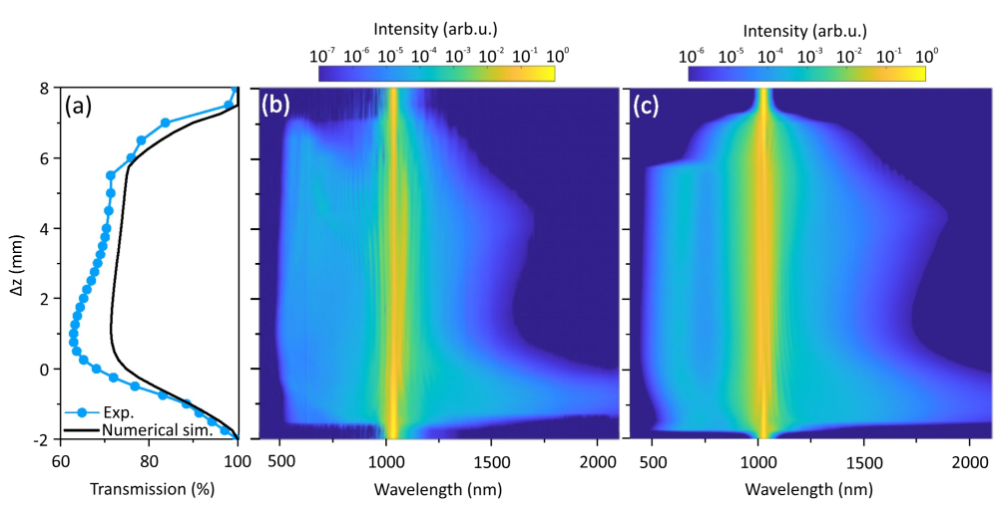 Figure 3. Variations in (a) crystal transmittance and (b) experimentally measured and (c) simulated supercontinua as a function of beam waist offset [1].
Figure 4 selects Δz = 1 mm and +1 mm as representative conditions to compare the supercontinua generated under these two incidence scenarios. Divergent incidence extends the long-wavelength output beyond 2 μm, while convergent incidence results in more pronounced short-wavelength broadening. Both experimental and simulated results demonstrate good agreement.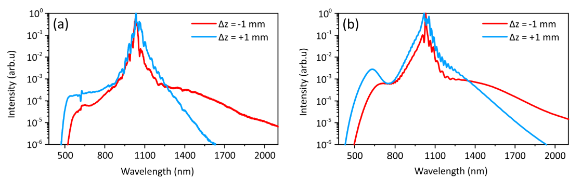 Figure 4. Supercontinua generated under two distinct incidence conditions: (a) experimental findings and (b) simulated outcomes [1].
Figure 5 presents the simulated results of the filament propagation process. Near the first nonlinear focus, plasma generation at the pulse front causes defocusing of the pulse rear, shifting the on-axis intensity peak forward and forming a self-compressed leading pulse in the time domain. This is accompanied by red-shifting broadening. As the pulse continues to propagate through the crystal, the declining plasma density weakens the defocusing effect, allowing the pulse rear to intensify and form a stronger trailing sub-pulse near the second focus. This trailing sub-pulse drives blue-shifting broadening. In the case of divergent incidence, lower nonlinear absorption and plasma density enable the leading pulse to maintain high intensity over longer distances, resulting in more pronounced red-shifting. Conversely, convergent incidence leads to stronger nonlinear loss, faster intensity decay of the leading pulse, and a stronger trailing pulse, favoring blue-shifting.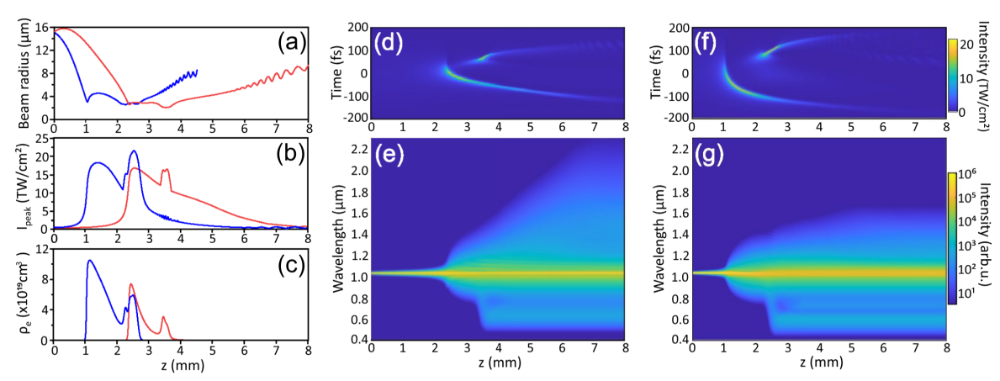 Figure 5. Simulated evolution of beam radius, peak intensity, plasma density, and pulse temporal and spectral profiles [1].
Figure 6 displays the spectra obtained when the repetition rate is increased from 200 kHz to 2 MHz while maintaining a constant single-pulse energy. For convergent incidence, the long-wavelength boundary of the spectrum contracts as the repetition rate increases, nearly disappearing at 2 MHz. In contrast, for divergent incidence, the spectral width remains largely unchanged, with only a slight decrease in intensity near the long-wavelength end.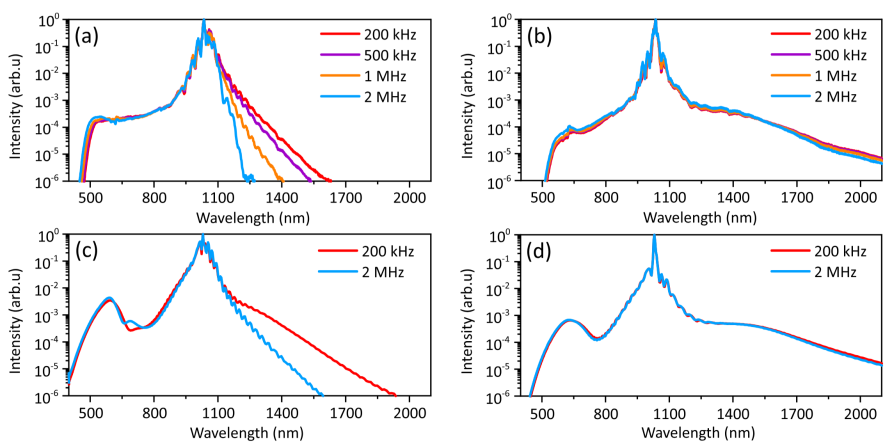 Figure 6. Supercontinua generated at different repetition rates: (a), (b) experimental data; (c), (d) simulated results [1].
This observed difference is attributed to thermal accumulation effects. The study employs the thermal diffusion length L_diff = √(D/f) to characterize the distance over which heat diffuses between adjacent pulses. Given the room-temperature thermal diffusivity of YAG (D = 3.8 mm²/s), this length is approximately 4.4 μm at 200 kHz, closely matching the ~5 μm filament diameter at the focus. At 2 MHz, however, it shortens to ~1.4 μm, facilitating easier local heat accumulation. Meanwhile, experimental measurements reveal that nonlinear absorption is approximately 12% for divergent incidence and 36% for convergent incidence, with more heat accumulating under convergent conditions.
Figure 7(a) presents temperature simulations conducted at 2 MHz. Assuming that all deposited energy is converted into local heat, the temperature rise near the optical axis is approximately 42 °C for convergent incidence and no more than 15 °C for divergent incidence. The positive thermo-optic coefficient of YAG induces additional focusing, known as a thermal lens, due to local temperature increases. A stronger thermal lens alters the propagation of the leading pulse, causing its intensity to decline more rapidly and suppressing long-wavelength broadening. Figure 7(b) illustrates the spectral intensity within the 1500–1700 nm wavelength range as pulses arrive individually. For convergent incidence, the spectral intensity drops to nearly zero after approximately ten pulses. In contrast, for divergent incidence, it decreases by no more than 30% before stabilizing. It is important to clarify that the disappearing components are specific wavelengths within the selected band, while the entire supercontinuum still persists. After cooling the crystal and reducing the repetition rate back to 200 kHz, the spectral width fully recovers, with no evidence of permanent damage observed.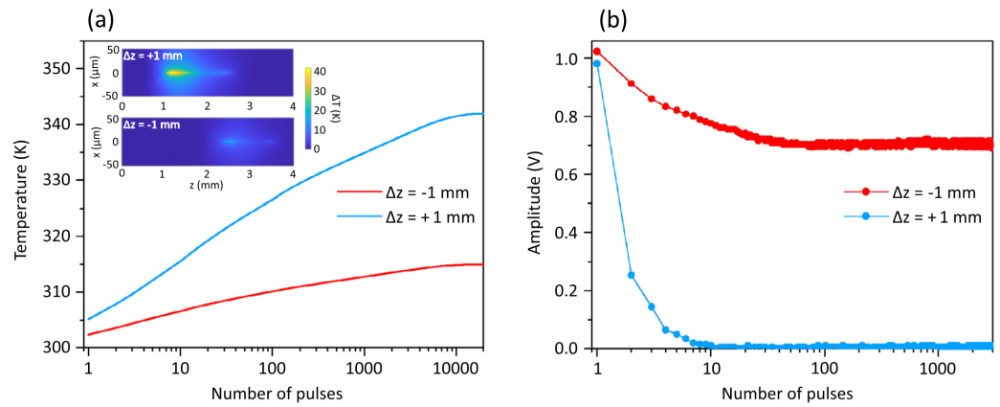 Figure 7. (a) Simulated local temperature changes as a function of pulse number; (b) Normalized detection signals within the 1500–1700 nm band [1].
In conclusion, under the experimental conditions of this study, slightly divergent incidence reduces nonlinear loss and thermal lensing effects during filamentation in YAG crystals, thereby more effectively maintaining broadband long-wavelength output at high repetition rates. For practical adjustments, the beam waist position can be scanned while measuring transmittance and target-band spectra. However, the specific operating point still necessitates re-optimization based on factors such as focal length, beam diameter, pulse energy, and crystal length.
References [1] V. Jukna, M. utovas, V. Mariulionyt, et al. The impact of thermal effects on filamentation and supercontinuum generation in bulk materials at MHz pulse repetition rates[J]. Scientific Reports, 16: 18529 (2026). DOI: 10.1038/s41598-026-51931-y.
-
![]()
Alibaba Cloud and Volcano Engine Compete in Automotive Cloud Market
-
![]()
“After Testing K3.1 Pro Overnight, It Seems Kimi Is Truly Advancing Towards Embodied AI”, “K3.1 Pro, Speed, Task Execution, Allowance, Embodied AI”
-
![]()
BYD Registers Decline in Six Models, Xiaomi Undergoes Leadership Shuffle! Comprehensive Review of BEV Sales Rankings from January to September
-
![]()
DeepSeek’s Product Department Entrusted to a Quantitative Trader
-
![]()
After Two Decades of Anticipation, Wuhan and YMTC Face a Cooling A-Share Market
-
![]()
Why Are Automakers Pivoting to Battery Swapping Amid Rapid Advances in Ultra-Fast Charging?
-
![]()
From Lucent to NVIDIA: When History Echoes
-
![]()
Thermal Effects on Femtosecond Filamentation and Supercontinuum Generation in YAG Crystals: Insights from Ultrafast Nonlinear Optics Study No. 105