Chery’s Globalization 3.0: What Exactly Does It Entail?
 10/09 2026
 510
510
On the afternoon of October 7th, before the National Day holiday ended, Chery released an 'Announcement on Deepening Executive Role Adjustments for the Globalization 3.0 Strategy.' The announcement was brief, yet the implications were profound.
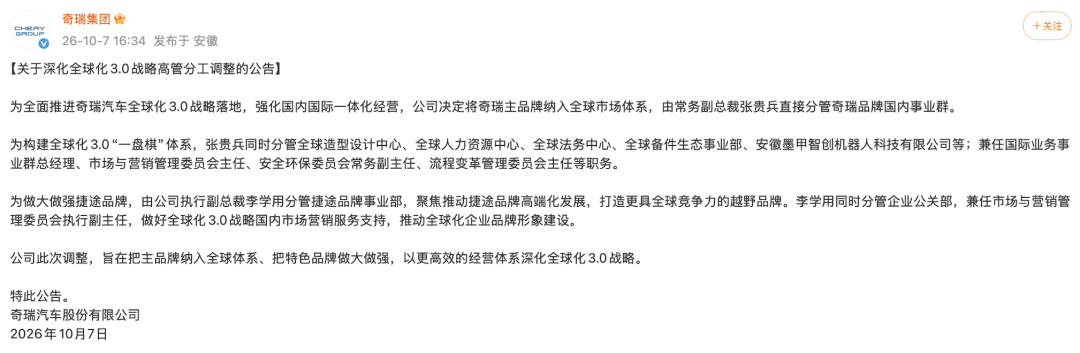
Many are asking: What precisely is Chery’s Globalization 3.0?
Most online analyses emphasize its aggressive overseas expansion and continuous export record-breaking.
However, after comparing this announcement with the personnel changes on September 23rd, the semi-annual report, and the September production and sales bulletin, my perspective differs significantly.
While Globalization 3.0 pertains to global expansion, the most pressing issues addressed in these two rounds of adjustments are actually domestic.
This article will not delve into the success of Chery’s overseas expansion. Instead, it will focus on three key points: what Chery’s Globalization 3.0 entails, why it is happening now, and which metrics to monitor next.
Let’s dive in.
01 First, Clarify What 3.0 Means
No Official Blueprint Exists—It’s Interpreted as ‘Becoming a Local Enterprise’
Let’s start with a frequently overlooked fact: Chery has never officially released a document titled ‘Globalization 3.0 Blueprint.’
This term is synthesized from various occasions.
At the 2025 Global Innovation Conference, Yin Tongyue proposed the concept of ‘In somewhere, For somewhere, Be somewhere’—akin to Volkswagen’s upgraded approach in China.
At the 2026 Kantar BrandZ Summit, Zhang Guibing stated that Chinese auto exports have entered a ‘3.0 era of deep localization and brand value transformation.’
The personnel announcements on September 23rd and October 7th directly referenced the ‘Globalization 3.0 Strategy.’
The commonly cited generational divisions are: 1.0—selling products, 2.0—building factories, and 3.0—creating ecosystems.
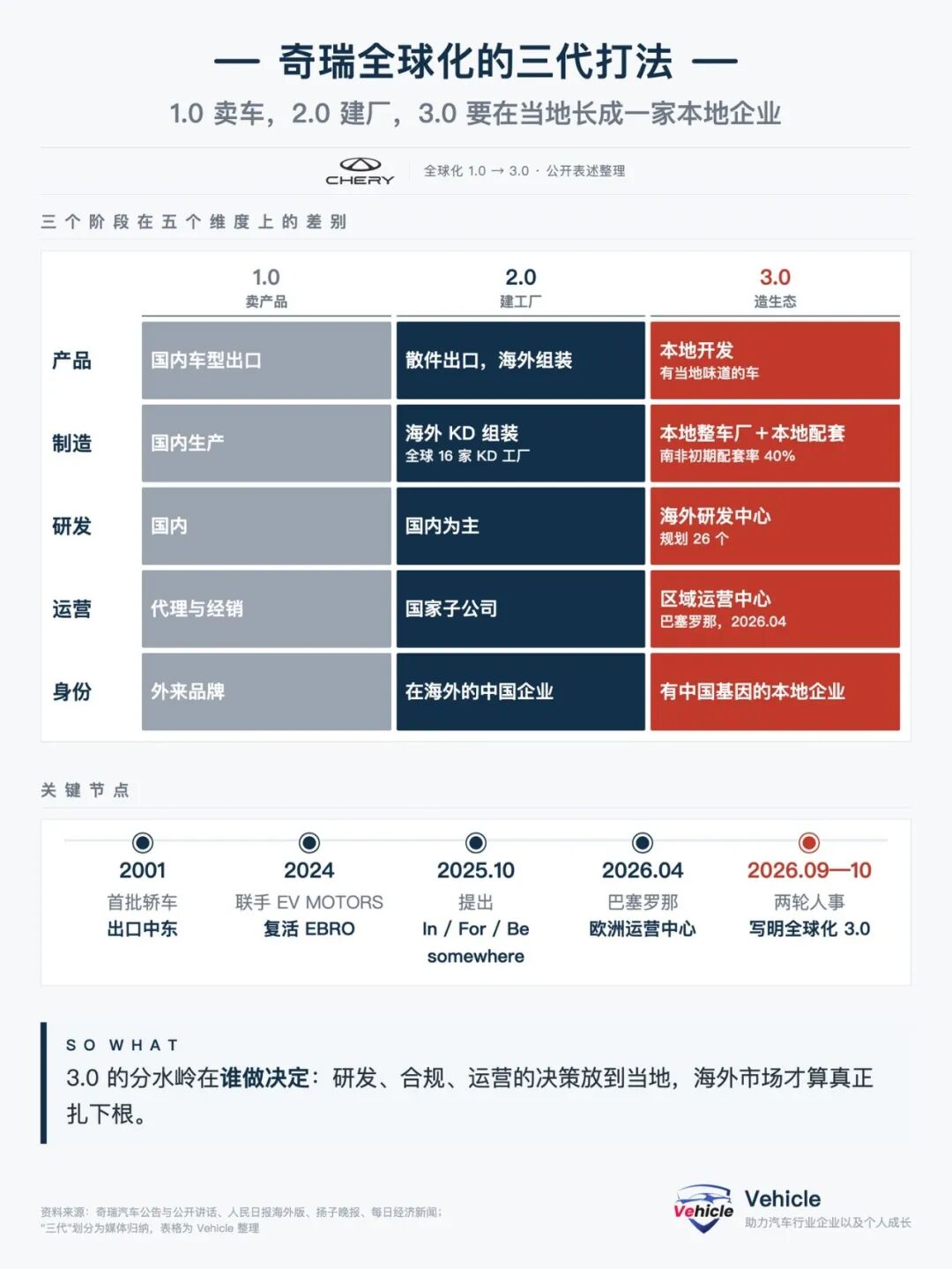
Simply put, 1.0 and 2.0 address ‘how to get cars to the local market,’ while 3.0 focuses on ‘where decisions are made.’
R&D, compliance, operations, and after-sales decisions are all made locally. In Zhang Guibing’s words, it’s about becoming a local enterprise with Chinese DNA.
Note: The ‘three generations’ classification originates from summaries by Vehicle and other self-media outlets. Chery’s official expression is ‘integrate and take root.’
02 70% Exports, 40% Domestic Decline
Weak Domestic Performance Reflected in Reports
Let’s examine some figures.
In the first three quarters of 2026, Chery Group sold 2.207 million vehicles, with 1.551 million exported, up 65.6% year-on-year, already surpassing total exports for 2025.
Exports accounted for 70.3% of group sales—for every 10 cars sold, 7 went overseas.
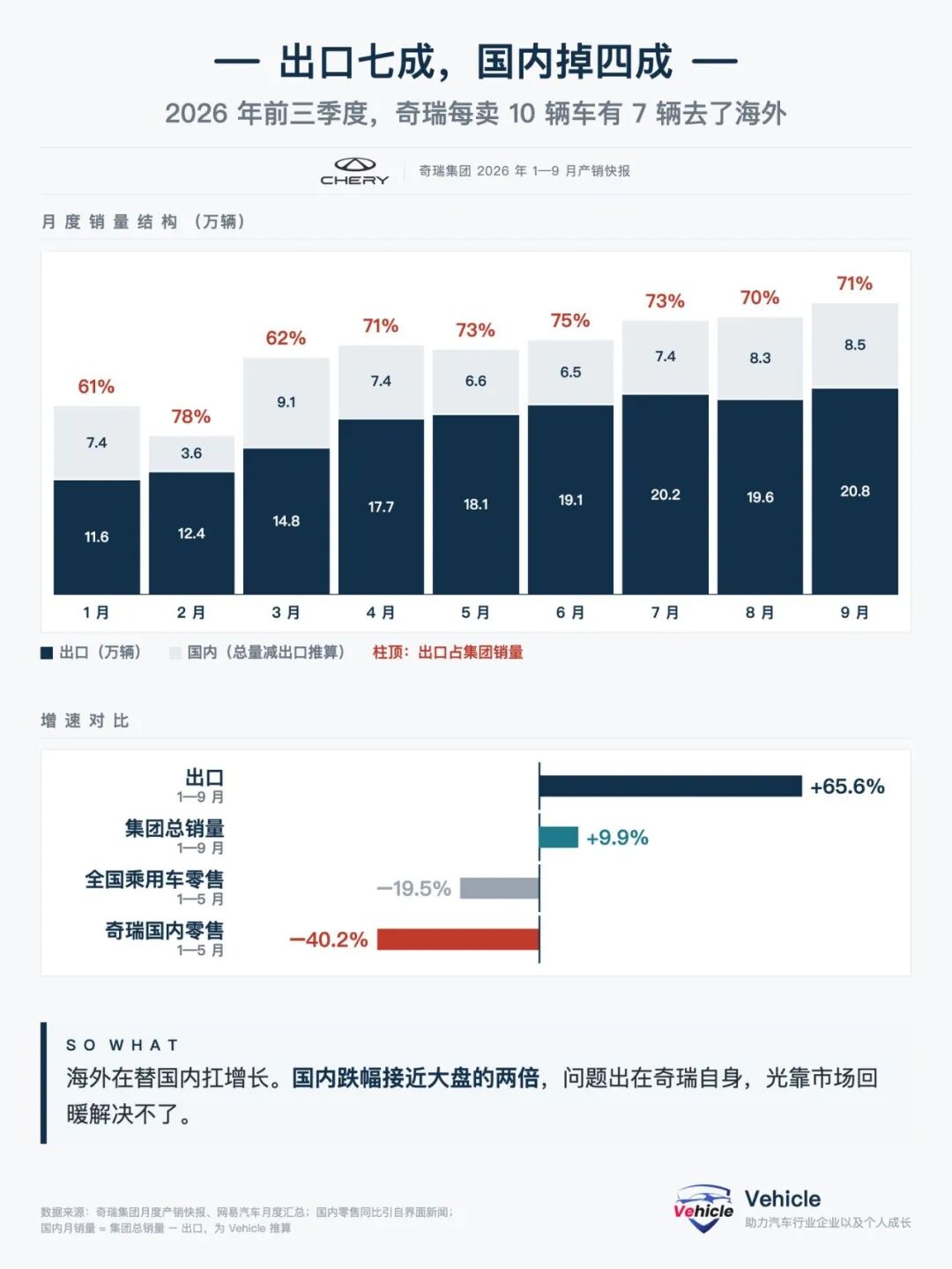
The domestic side paints a bleaker picture.
In our previous monthly analysis of Chinese auto sales, ‘Detailed Analysis of August Auto Market: Exports Exceeded Last Year’s Total in the First Eight Months, While Domestic Sales Fell by 3.67 Million,’ we noted that nationwide passenger vehicle retail sales were down 20% year-on-year. However, Chery Holdings’ domestic retail sales fell 40.24% year-on-year—nearly double the overall market decline.
My assessment is that while the weak market explains part of the domestic decline, the bigger issues lie within Chery’s own branding and distribution channels.
03 Profits Come from Overseas
Revenue Barely Grew, but Profit Structure Changed Completely
In our previous article on Chery’s semi-annual report, ‘Chery’s First Half of 2026: ‘No. 1 in Volume’ Across 130 Countries Overseas, But Profits ‘Down 11.7%’, we highlighted a particularly noteworthy set of numbers.
First-half revenue was 143.28 billion yuan, up just 1.2% year-on-year. However, overseas revenue was 98.97 billion yuan, up 51%, while domestic revenue was 44.31 billion yuan, down 41.7%.
One increase, one decrease—overseas revenue’s share jumped from about 46% to 69%.
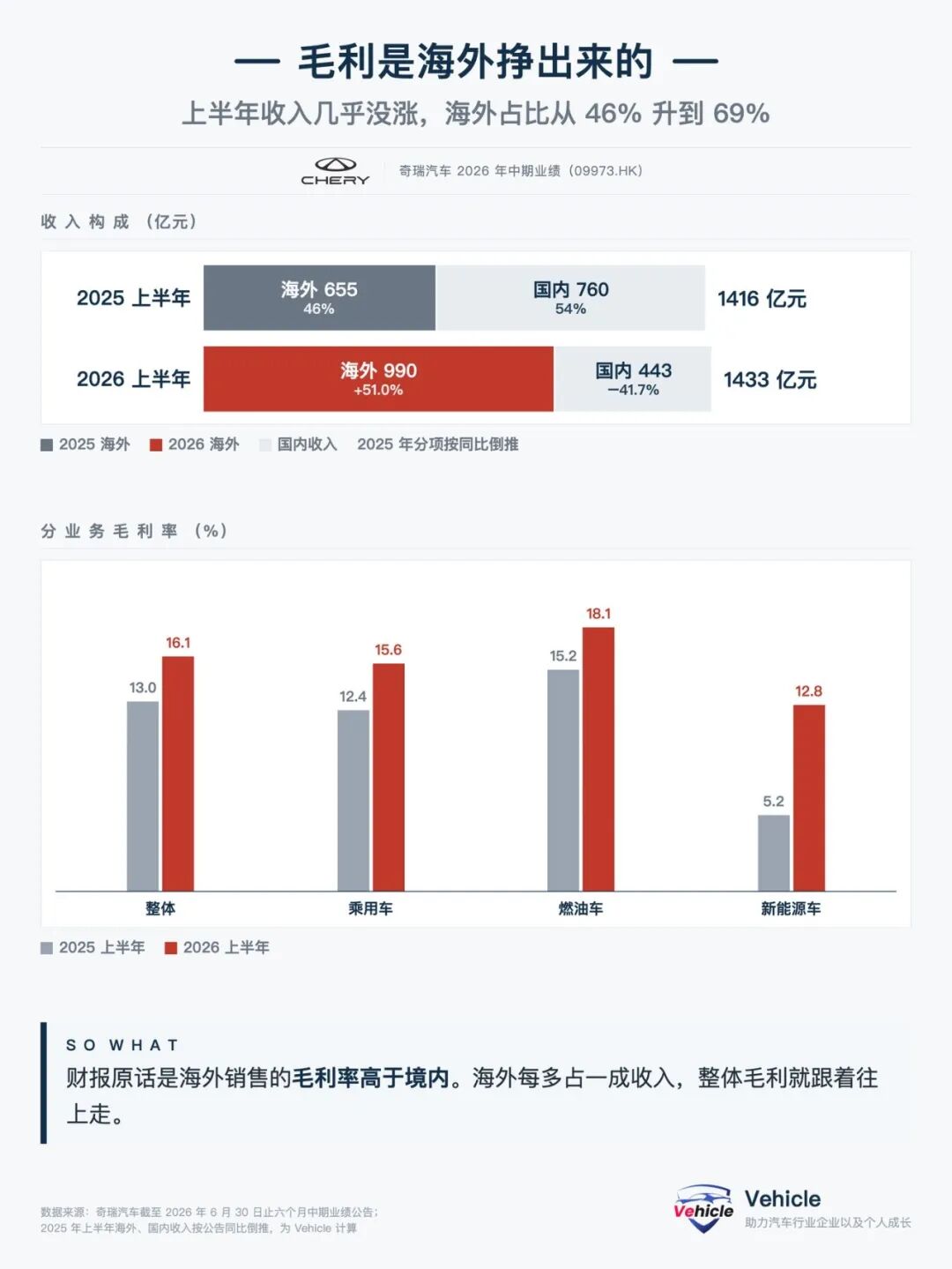
Gross margin rose from 13.0% to 16.1%. The financial report bluntly stated: overseas sales have a higher gross margin than domestic sales.
New energy vehicle gross margin surged from 5.2% to 12.8%, the biggest increase.
Simply put, Chery’s profits now primarily come from overseas, while the domestic market is more of a drain.
This explains Yin Tongyue’s statement about ‘no longer participating in internal competition’: overseas profits give Chery the confidence to sell fewer cars domestically and avoid price wars.
04 Two Rounds of Personnel Changes: Putting Domestic Operations in the Hands of Those Managing Overseas
In 14 Days, the Main Brand’s Domestic Business Changed Hands
Now, let’s examine the two rounds of personnel changes.
On September 23rd, Zhang Guozhong was appointed Executive Vice President of Chery Holdings, and Zhang Guibing took over as Executive Vice President of Chery Automobile.
Zhang Guozhong built Chery’s five-brand matrix: Chery, Exeed, Jetour, iCAR, and Luxeed. Zhang Guibing has led international operations since 2018 and oversaw Chery’s first overseas CKD project in 2004.
The October 7th announcement was more critical.
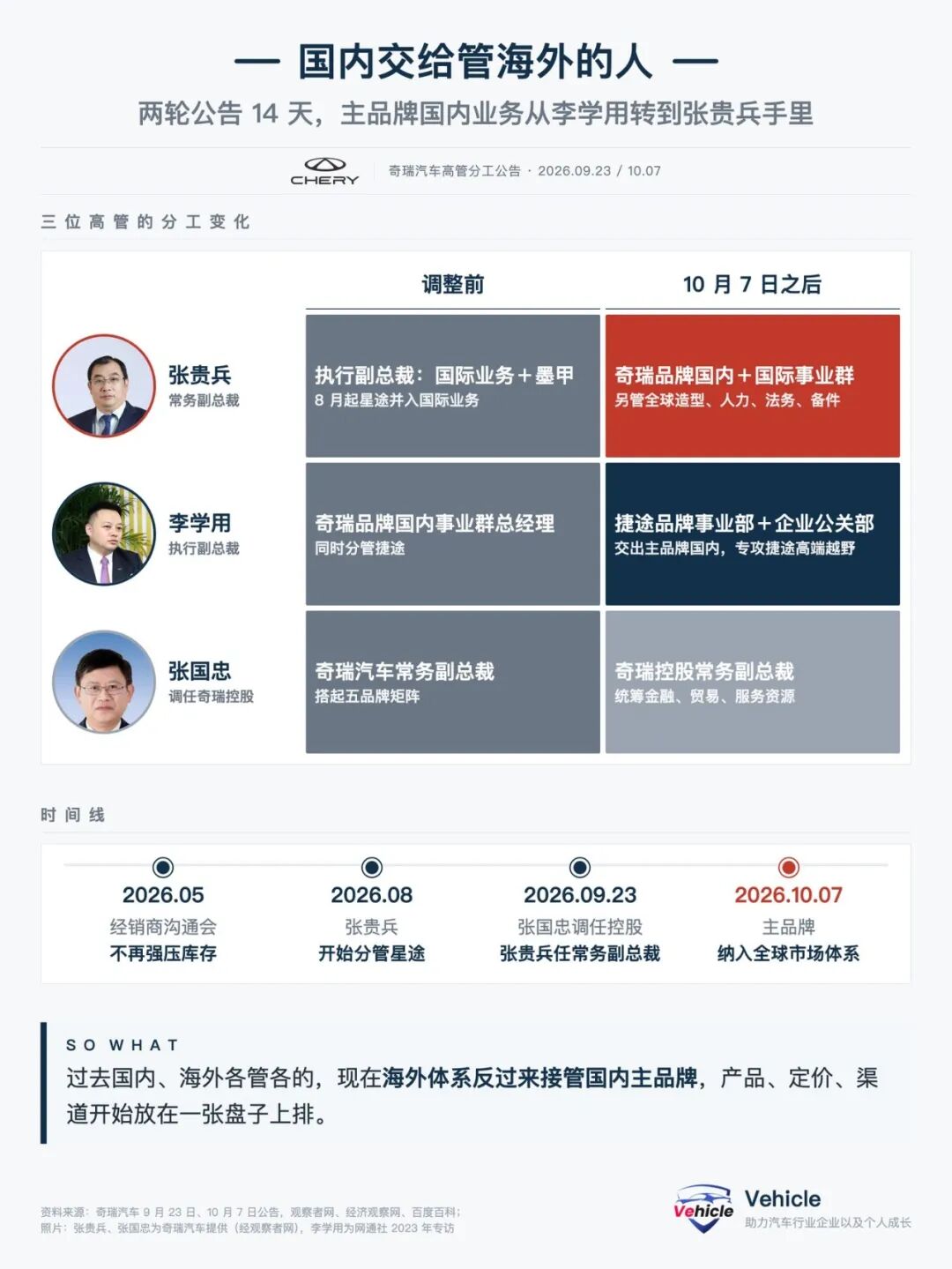
Here’s a detail many interpretations missed: according to public records, Li Xueyong has been General Manager of Chery’s domestic business unit since July 2025.
So this adjustment transferred the main brand’s domestic business from Li Xueyong to Zhang Guibing, who has always managed overseas operations. Li Xueyong shifted to focus on Jetour’s premiumization while overseeing corporate public relations.
Zhang Guibing now single-handedly manages both the main brand’s domestic and international business units, plus global styling, HR, legal, and spare parts.
My interpretation is that previously, domestic and overseas operations had separate strategies. Going forward, the main brand’s product, pricing, and distribution strategies will be aligned. This time, the overseas system is taking over domestic operations.
The timing is also strategic. Q4 is when automakers finalize next year’s budgets and product plans. Finalizing the organization now allows 3.0 requirements to be directly incorporated into the 2027 plan.
05 Jetour Moves Upmarket, but Where Are Exeed and Luxeed Headed?
The Announcement Mentioned Two Brands but Not the Other Three
Pulling September’s brand-specific numbers, the divergence is clear.
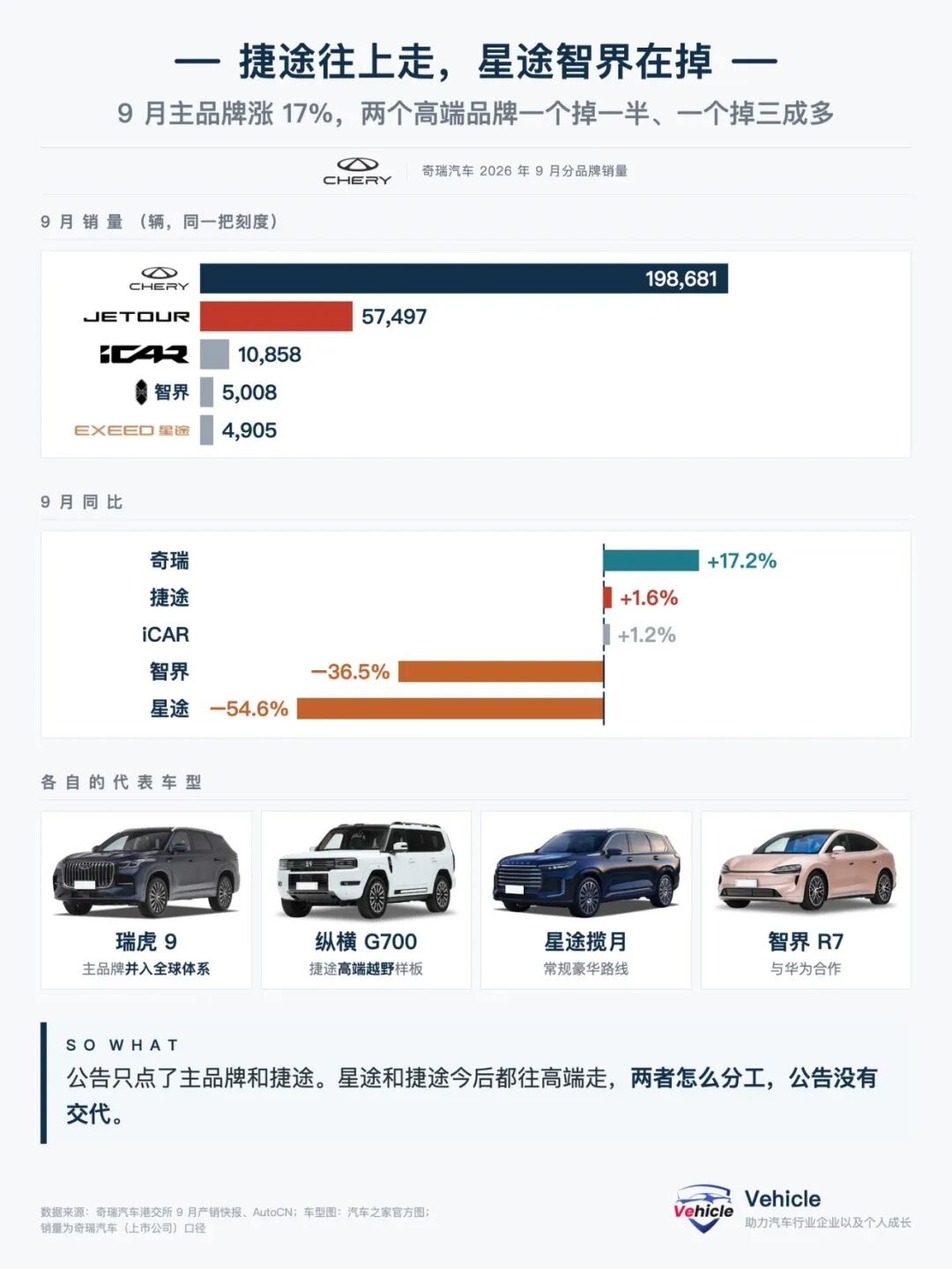
Brand September Sales (units) YoY Chery 198,681 +17.2% Jetour 57,497 +1.6% iCAR 10,858 +1.2% Luxeed 5,008 -36.5% Exeed 4,905 -54.6%
Jetour’s new positioning is ‘premium off-road.’ Hardcore off-road and boxy designs are globally hot segments, with models like the Traverse G700 (Zongheng G700) already available.
The issue is that Exeed has always been Chery’s premium brand, and now Jetour is also moving upmarket. The announcement didn’t mention how these two premium brands will coexist.
Exeed’s sales halved in September, and Luxeed dropped by over a third. Neither brand was even mentioned in the announcement. I suspect ‘streamlining’ in branding and distribution is likely, though this remains speculation for now.
06 How Deep Have the Roots Grown?
Europe Has All Three Pieces; South Africa Must Wait Until 2027
After discussing all these organizational adjustments, how much has 3.0 actually materialized overseas?
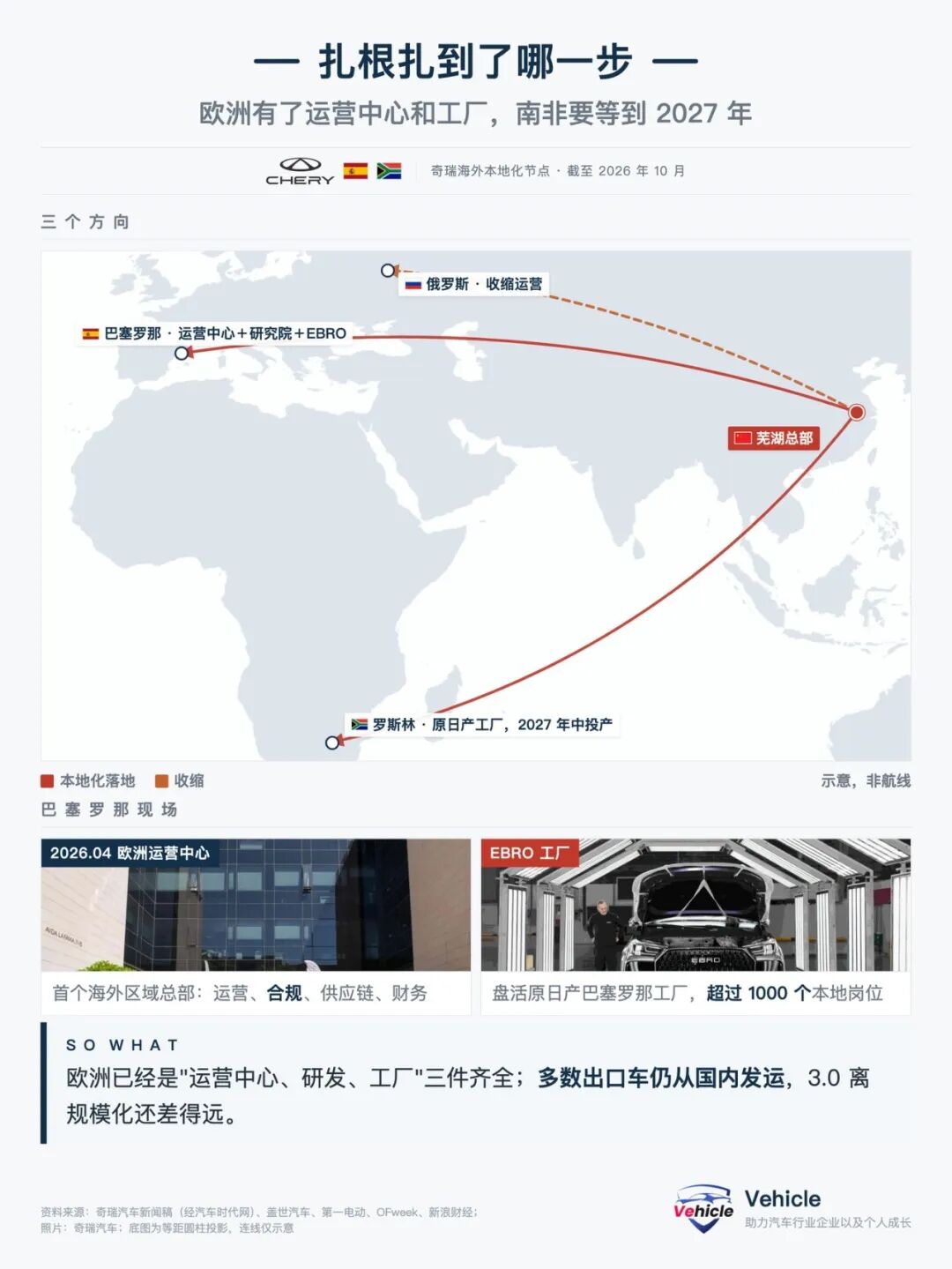
01 Europe: Operations Center, R&D, and Factory Are All in Place
In April 2026, Chery opened its European Operations Center in Barcelona, its first overseas regional headquarters, managing operations, compliance, supply chain, finance, and public affairs. The Spain Research Institute launched simultaneously.
Combined with its partnership with EV MOTORS to produce EBRO vehicles at the former Nissan Barcelona plant since 2024, this created over 1,000 local jobs.
02 South Africa: Taking Over Nissan’s Factory, Production Starts Mid-2027
In July 2026, Chery took over Nissan’s Rosslyn plant in South Africa, planning to start production in mid-2027 with an initial annual capacity of 15,000 units. The initial local component sourcing target is 40%, with a long-term goal of selling 100,000 units annually in South Africa.
But there’s another side to consider.
Sina Finance analysis noted that most of Chery’s exported vehicles still ship from China, with cross-border logistics and tariffs continuously pressuring profits.
So my view is that 3.0 is still mainly at the conceptual and organizational level—scaled local production hasn’t fully arrived yet.
07 Exchange Rates and Russia: Two Hurdles
Volume Without Local Roots Can Be Wiped Out by a Single Policy
Why must Chery take root? Its own financial reports provide the answer.
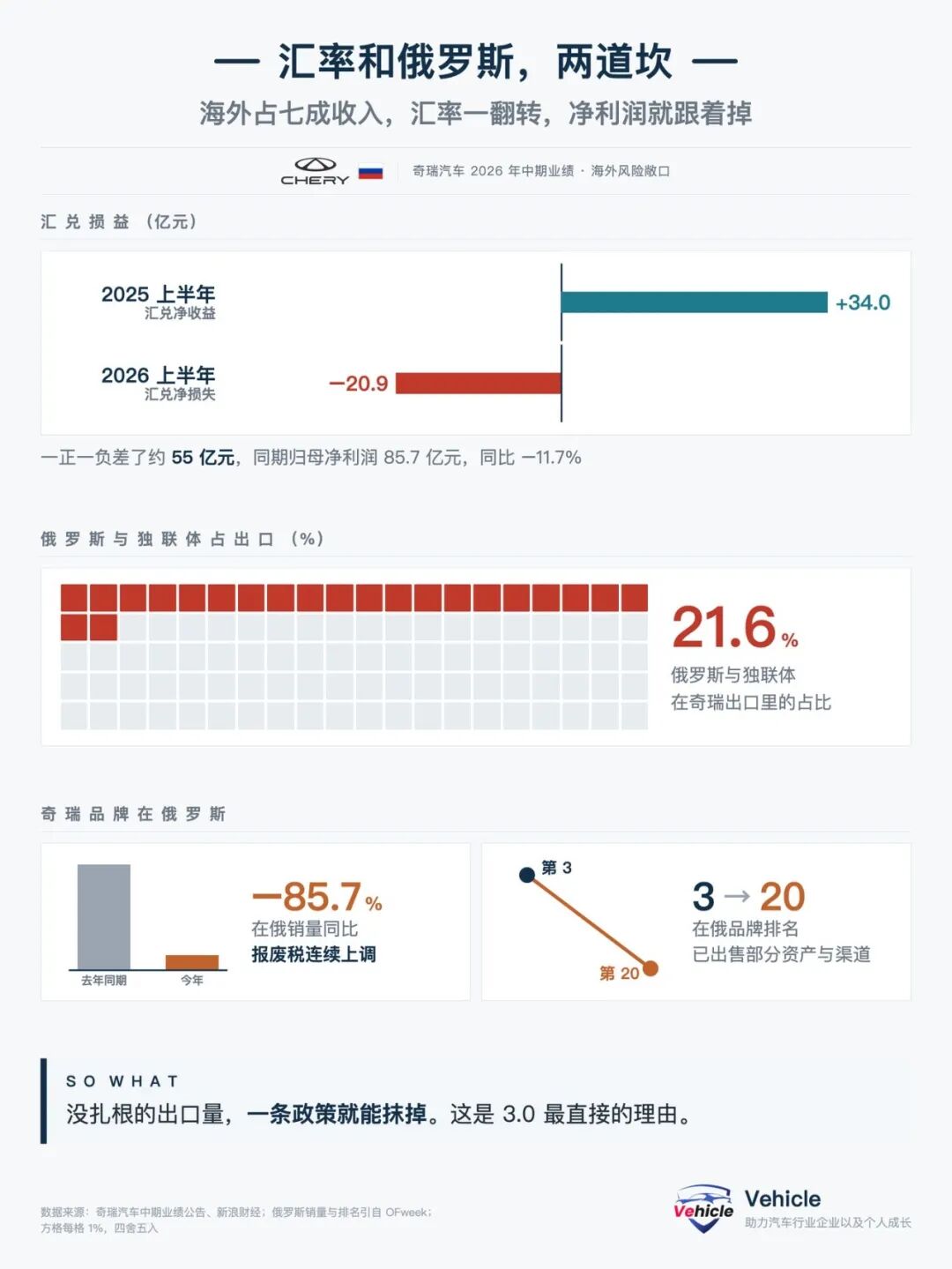
01 First Hurdle: Exchange Rates
In the first half of 2025, Chery reported 3.40 billion yuan in net exchange gains. By the first half of 2026, this became a 2.09 billion yuan net exchange loss—a difference of about 5.5 billion yuan.
This was the main reason for the 11.7% year-on-year drop in net profit. With 70% of revenue coming from overseas, when the RMB appreciates, the profit statement takes a direct hit.
02 Second Hurdle: Russia
Russia and the CIS account for 21.6% of Chery’s exports. After Russia repeatedly raised scrappage taxes, Chery’s local sales plummeted 85.7% year-on-year, dropping from 3rd to 20th place. Chery has begun adjusting its business, assets, and distribution channels in Russia through joint ventures with local companies.
This is the most direct reason for 3.0: Volume built solely on exports can be wiped out by a single policy.
08 Final Thoughts
Annual Targets Are Short-Term Tests; Halting Domestic Decline Is the Long-Term Challenge
After reviewing the two announcements and the semi-annual report, my strongest impression is that the direction of Globalization 3.0 is sound. Russia’s lessons and tariff barriers show that relying solely on export volume has hit a ceiling.
But the most urgent task for these two rounds of adjustments is to revitalize the domestic main brand using the overseas system while clarifying the positioning of multiple brands.
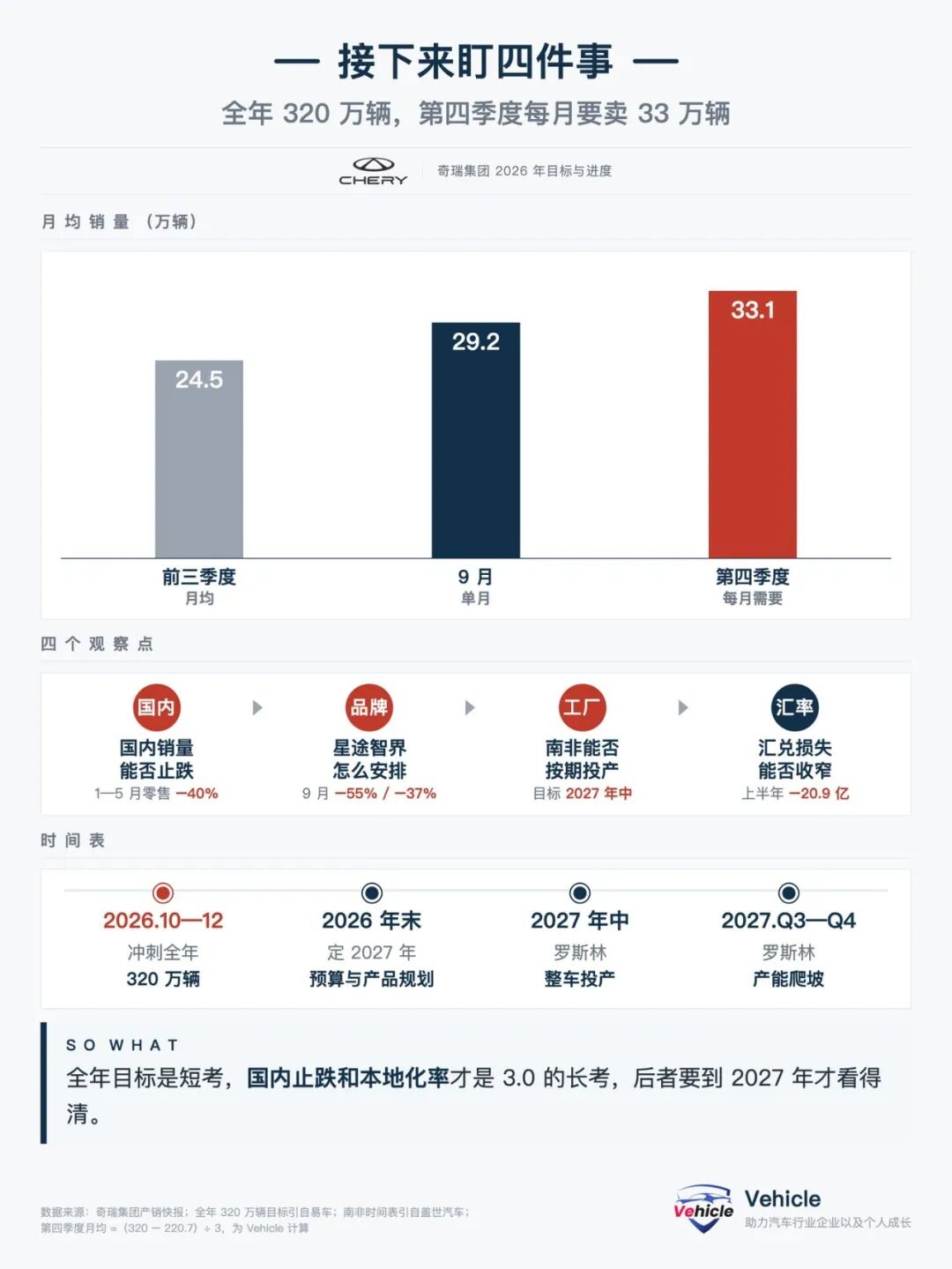
The annual target is 3.2 million vehicles. With 2.207 million sold in the first three quarters, Chery needs to sell about 331,000 vehicles per month in Q4—higher than September’s 292,000. So the pressure remains significant.
I’ve compiled an observation checklist to refer to when future data is released.
Chery Globalization 3.0 Observation Checklist
1. Domestic Sales: Can monthly domestic sales (total sales minus exports) stop declining? Watch year-on-year changes.
2. Brand Arrangements: Will there be new organizational adjustments or mergers for Exeed, Luxeed, and iCAR?
3. Localization: Can South Africa’s Rosslyn plant start production in mid-2027? Can EBRO scale up?
4. Exchange Rates: Can full-year 2026 exchange losses narrow compared to the first half?
5. Annual Target: Can Q4 monthly averages reach 330,000 units? Will the full-year target of 3.2 million be met?
Three final sentences that might be more suitable for observing Chery:
1. The core of 3.0 is ‘decision-making at the local level,’ not just selling more cars.
2. These two rounds of personnel changes show the overseas system taking over the domestic main brand.
3. Halting domestic decline and improving localization rates matter more than export records.
Next time you see Chery break an export record, first check its domestic sales.
That’s all for today’s share. If you found it useful, please like, share, and tap ‘Seen.’ Feel free to leave your thoughts in the comments.
*Una
-
![]()
Why Did Axisystems Only Earn 29.09 Million Yuan After Selling 420,000 Automotive Chips in Six Months?
-
![]()
Chery’s Globalization 3.0: What Exactly Does It Entail?
-
![]()
Why Does Apple Opt for Aluminum in Its Phone Cases? Beyond Lightness and Heat Dissipation
-
![]()
Why Is the Time Allotted for Driver Takeover More Critical When the Intelligent Driving System Disengages?
-
![]()
Capturing the Victoria Harbour Fireworks with iPhone 18 Pro Max: A Glimpse into Apple's New Imaging Philosophy
-
![]()
Final Ruling: Domestic Auto Market Fails to Capitalize on Traditional 'Golden September' as Sluggishness Persists
-
![]()
Globalization 3.0: Zhang Guibing Faces His Ultimate Challenge
-
![]()
ChatGPT Teaches Me Mahjong! OpenAI’s Smart UI Test: Revolutionizing AI Interaction