Why Did Axisystems Only Earn 29.09 Million Yuan After Selling 420,000 Automotive Chips in Six Months?
 10/09 2026
 515
515
Over 400 million yuan worth of chips sold in six months, yet 516 million yuan poured into R&D.
This star chip company, loudly promoting 'high-end intelligent driving' and 'large-model edge computing,' reveals a surprisingly fantastical reality.
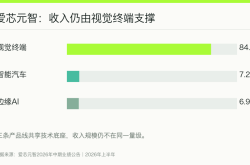
In the first half of 2026, Axisystems achieved 402 million yuan in revenue, soaring by 181.8% year-on-year. However, a closer look at its revenue breakdown exposes a harsh truth: 84.8% of total revenue still came from sales of traditional visual terminal chips (e.g., security cameras). The much-hyped intelligent vehicles and edge AI segments combined accounted for just one-seventh of the total.
Gross margin did improve from 20% to 29% year-on-year, but total losses still reached 688 million yuan during the same period. Even after adjusting for non-cash and listing-related items, losses expanded from 319 million yuan to 540 million yuan. While revenue grew rapidly, R&D expenditures surged even more aggressively.
Qiu Xiaoxin (founder of Axisystems) is playing an extremely risky game of 'tightrope walking': using hard-earned profits from camera chip sales to aggressively fund the bottomless pits of automotive intelligent driving and edge AI.
The question remains: Can the thin cash flow from visual terminals truly afford the two expensive tickets to the future?
Best-Selling Product: 'Seeing Clearly' 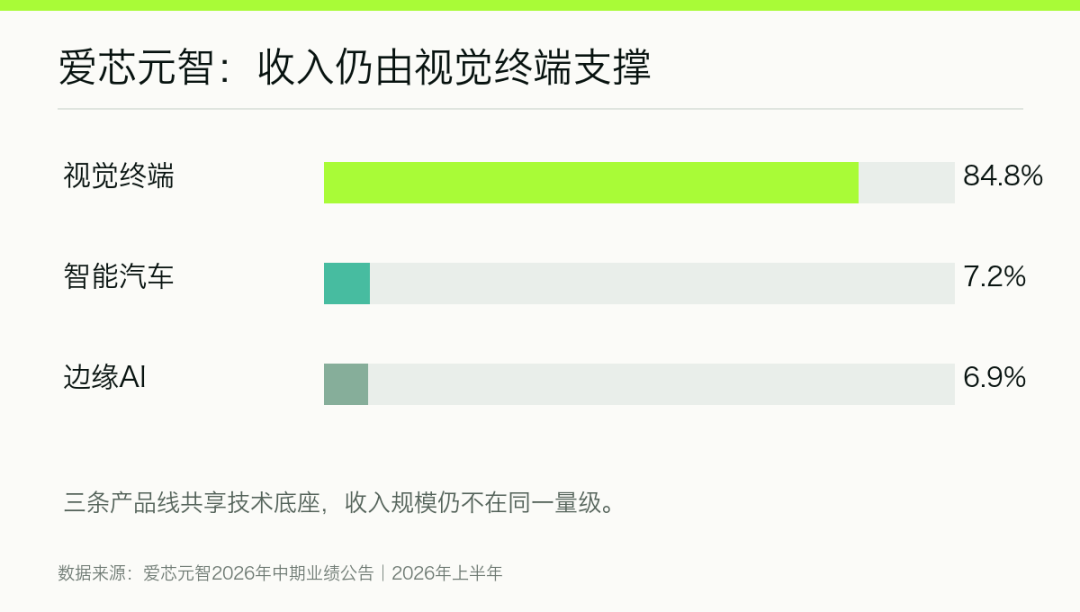
Original Data Graph | First-Half 2026 Revenue Breakdown; Source: Axisystems' HKEX Interim Results Announcement
Axisystems' revenue history is primarily a commercialization story of camera chips.
From a modest 50.23 million yuan in 2022 to 473 million yuan in 2024, visual terminals served as the absolute growth driver. In 2024, they contributed over 90% of revenue, while automotive product revenue stood at a mere 6.71 million yuan. This seemingly traditional business propelled Axisystems to its HKEX listing.
The company wisely avoided directly competing in the most expensive and challenging intelligent driving main control chip market at its inception. Instead, it targeted security and various visual terminal applications. By integrating AI-ISP for image processing with NPU for local computing, Axisystems solved 'visibility' and 'comprehensibility' issues for cameras under low-light and low-power conditions.
However, despite shipment volumes, this business remains far from achieving true 'financial freedom.'
From January to June, 402 million yuan in revenue minus 286 million yuan in cost of sales left 117 million yuan in gross profit. Yet R&D expenses alone consumed 516 million yuan, while selling and administrative costs exceeded 200 million yuan. The meager gross profit from existing businesses proved utterly insufficient against this massive expense structure.
The listing did buy Axisystems crucial survival time. As of end-June, cash and equivalents reached 1.971 billion yuan. However, inventory surged from 328 million yuan at year-end 2025 to 729 million yuan. While stockpiling supports deliveries, it also means significant capital remains trapped in warehouses. Should new chip adoption fall short of expectations, inventory will not automatically convert into cash.
A longer-term view reveals greater concerns. In 2025, total revenue reached 562 million yuan (+18.8% YoY), but annual losses hit 1.184 billion yuan. The sudden revenue acceleration in H1 2026 still relied on volume and price increases in visual terminals. For now, automotive and edge AI remain far from shouldering financial responsibility.
Qiu Xiaoxin's Platform Dream 
▲ Qiu Xiaoxin at industry event; Source: Axisystems official, June 2026
Qiu Xiaoxin's background explains the company's strategic path. As a former Broadcom technology executive and UNISOC CTO, she gained experience in large-scale chip R&D and mass production. Co-founder Liu Jianwei also brings chip design, verification, and entrepreneurship experience. The team initially avoided betting on cloud training chips. Facing markets dominated by giants like NVIDIA, they chose terminal vision chips—a fragmented but concrete market where technology could first mature in real-world devices.
In early interviews, Qiu recounted challenges after delivering their first chip, AX630A, to customers: notable strengths but also glaring weaknesses required iterative improvements. While chip companies often celebrate 'tape-out success,' customers pay for the subsequent unglamorous work—drivers, tools, image tuning, thermal management, and stable supply. Axisystems' entry into today's visual terminal market succeeded by addressing these operational shortcomings to achieve mass production.
Her ambitions run deeper. Edge devices, vehicles, and visual terminals all process sensor data requiring low-power local computing. If NPU, ISP, and development tools could be reused across products, a single R&D investment could serve multiple markets. Qiu has openly stated that fragmented edge markets cannot sustain a scaled chip company through any single niche.
Today, Axisystems is no longer Qiu's solo stage. During listing, she served as founder and chairman, with Sun Weifeng as CEO. Sun, previously responsible for sales, technical services, and customer engineering at HiSilicon, now oversees operations and business direction. Co-founder Liu Jianwei remains active in edge computing events, while Li Hao leads automotive business development. Chip architecture requires definition, mass production demands client servicing, and automotive projects need team validation—each function demands specialized personnel.
This staffing structure also exposes challenges. Teams skilled in general-purpose chips may not automatically understand automotive OEM procurement cycles; those experienced in vehicle projects cannot automatically resolve large model software stack adaptations. Qiu's recent admission of urgent need for AI chip and software architects reflects escalating complexity in chip area, heterogeneous computing, and toolchains.
This approach carries both logic and costs. Camera clients prioritize image quality, cost, and stable delivery; automakers demand functional safety, long-term supply, vehicle platform compatibility, and accident liability frameworks; edge large model clients emphasize model compatibility, memory bandwidth, operators, and software migration. While shared IP provides initial momentum, it cannot automatically secure orders across three distinct sales teams. The revenue gaps among the three business segments in financial reports underscore the gap between 'technical reusability' and 'commercial reusability.'
In July 2026, Axisystems established Axis Computing to specifically advance AI inference capabilities, while high-end automotive chip development proceeds through Chuangyuan Zhihang—a collaboration with OmniVision and NIO Shenji. Organizationally, the company acknowledges that managing three markets simultaneously with one team makes aligning technology, clients, and funding timelines extremely challenging.
Chuangyuan Zhihang represents more than just a partnership. Axisystems contributes computing chip expertise, OmniVision provides image sensor capabilities, and NIO Shenji brings automotive chip R&D and application scenarios. This collaboration distributes investment burdens and accelerates interface integration, but market acceptance remains to be proven for expanding beyond affiliated automakers. Securing shareholder support for a chip and establishing an industry-standard platform constitute two distinct business propositions.
Automotive Business: 420,000 Chips Installed, Flagship Chip Still Under Examination 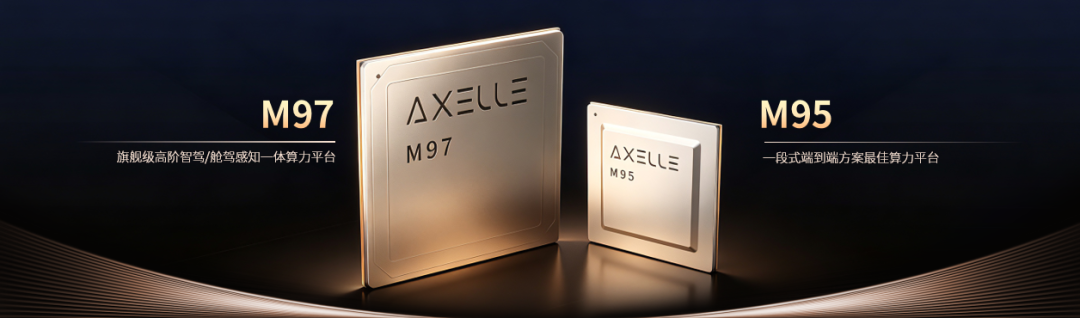
▲ Official product diagram of M9 series; Source: Axisystems, September 2026
In H1 2026, Axisystems disclosed shipments of approximately 420,000 intelligent vehicle SoCs, securing 24 new mass production model design wins and collaborating with 25 OEM brands. The M57, targeting basic ADAS functions, launched in its first mass production vehicle in March 2026. As a Tier 2 supplier, Axisystems partnered with algorithm firms like Nullmax to compete in price-sensitive markets.
However, this segment has become fiercely competitive.
The mandatory national standard 'Safety Requirements for Combined Driving Assistance Systems of Intelligent Connected Vehicles' takes effect on New Year's Day 2027, forcing automakers to recalculate system safety liability costs. If M57 can only secure low-end models through extreme price cuts, surging shipments may yield negligible profits. Moreover, formidable competitors loom. Horizon Robotics reported cumulative mass production of over 15 million Journey chips across 500 design wins. By comparison, Axisystems had shipped only 1.6 million intelligent driving chips as of August 2026. While statistical caliber (caliber) and starting times differ, the ecosystem gap remains substantial. Axisystems now positions its 720 TOPS-equivalent M97 and mainstream M95 (both 5nm chips) for high-end markets. The M97 emphasizes self-developed NPU, low-latency ISP, and image preprocessing, while the M95 targets mainstream high-end solutions. The company hopes automakers and Tier 1s will run their algorithms on these 'open chips' rather than purchasing pre-packaged intelligent driving systems—a position appealing to OEMs seeking software autonomy. Qiu Xiaoxin once admitted to misjudging market segmentation, expecting a 'mid-tier' between highway and urban ADAS functions before urban capabilities rapidly commoditized.
The company's M9 materials repeatedly emphasize memory bandwidth, image preprocessing, and model migration—engineering challenges more substantive than raw 720 TOPS claims. Urban ADAS systems ingest multi-camera and sensor data per second, requiring chips to first process images before feeding model-required data to compute units. Peak computing power means little if data bottlenecks occur during memory access and software adaptation. Different vendors calculate 'equivalent TOPS' using inconsistent model conditions.
Tape-out costs, once sunk, explain the urgency for high-end products to race against time. As of the interim report, the M97 had only returned silicon and delivered engineering samples, while the M95 taped out in July. Despite September's loud parameter announcements, no sufficient vehicle installation data yet validates their mass production competitiveness. The 420,000 low-end shipments in H1 hardly constitute victory for the M9 series.
Horizon Robotics has already advanced along a different path: supplying both Journey chips and software/system capabilities through supplier partnerships to more vehicle models. Volkswagen China's locally developed ADAS system integrates chips, algorithms, data, and vehicle software under one project. Axisystems' chip-and-toolchain-only approach avoids conflicts with OEM self-development teams but requires clarifying algorithm ownership and integration responsibilities during design win negotiations.
This places the automotive business in a delicate position: no longer 'PPT-stage,' but its true valuation and profit potential still hinge on pending high-end product validation. While basic chip shipments build delivery credentials, they cannot sustain high-end R&D costs if those chips fail to generate recurring mass production revenue.
Edge AI: Biggest Hype, Smallest Revenue 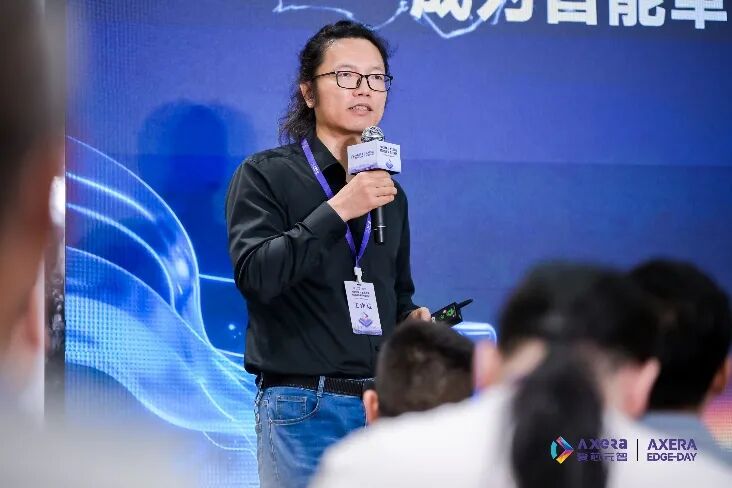
▲ Co-founder Liu Jianwei at edge computing event; Source: Axisystems official, June 2026
Edge AI revenue reached 27.69 million yuan in H1 2026. While this represents 251.9% YoY growth, it builds on an extremely low base of just 7.869 million yuan in H1 2025.
The narrative of large-model edge inference sounds compelling, but reality proves harsh. 'Requiring local computing' does not equate to 'automatically purchasing Axisystems' chips.' In this fragmented market, cloud GPUs, mature edge platforms, and even cheaper general-purpose SoCs all compete for the same customer budgets. Moreover, Axisystems' existing visual market faces intense competition. Consider StarSemi, which reported 2.972 billion yuan in 2025 revenue and 308 million yuan in net profit, also covering AI processors, ISPs, and intelligent vehicle applications. Axisystems confronts a pre-existing, highly profitable, and fiercely competitive ecosystem. According to prospectus data, Axisystems held 12.2% of China's edge AI inference chip market (3rd place) and 6.8% globally (5th place) in 2024. While these numbers appear respectable, HiSilicon dominated with 48.6% share. More cruelly, edge scenarios are highly non-standardized. In H1 2026, Axisystems generated just ~5.37 million yuan in technical service revenue—still earning hard money from hardware sales while sustainable paid software services remain negligible. 'Many clients' and 'concentrated revenue' can coexist 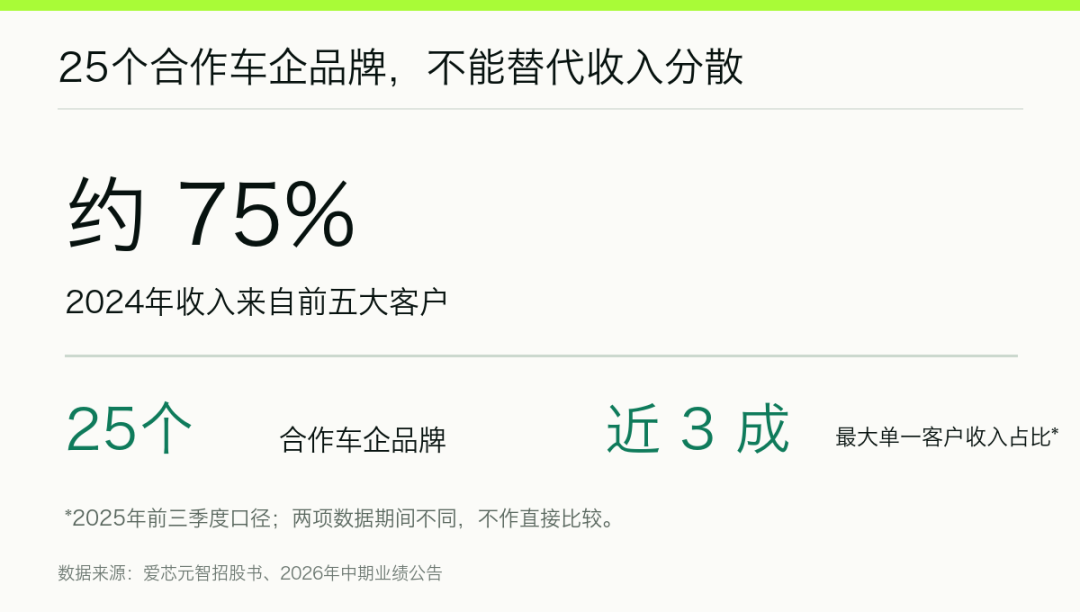
Original Data Graph | Client Count vs. Revenue Concentration; Source: Axisystems prospectus and 2026 interim results
Despite claiming collaborations with 25 OEM brands, Axisystems faces a critical financial risk: extreme customer concentration.
Prospectus data shows the top five clients accounted for ~75% of 2024 revenue, with the largest single client representing nearly 30% in Q1-Q3 2025. This reflects a channel disease common in visual chip markets: while endpoints appear numerous, supply chain lifelines remain controlled by a handful of integrators and distributors.
Shifting toward automotive doesn't immediately disperse (disperse) risks. Automotive chip design wins with one or two major clients may initially concentrate revenue even more during early mass production. High-end project R&D costs occur upfront, while client vehicle sales may only ramp years later. Should vehicle sales underperform, 'securing design wins' cannot recoup all investments. The prospectus admits R&D outcomes may only generate revenue years later—or never recover costs.
When explaining H1 losses, Qiu Xiaoxin attributed R&D growth to concentrated tape-outs of high-end automotive and high-computing chips alongside increased IP procurement costs. She expects these chips to gradually ramp in the next 1-2 years. If one or two OEMs lead in volume, early revenue will concentrate further. High-end R&D funds burn today, but vehicle mass production waits years. If whole vehicle sales falter, 'securing design wins' cannot resurrect lost cash flows.
What kind of company will AXERA ultimately be? 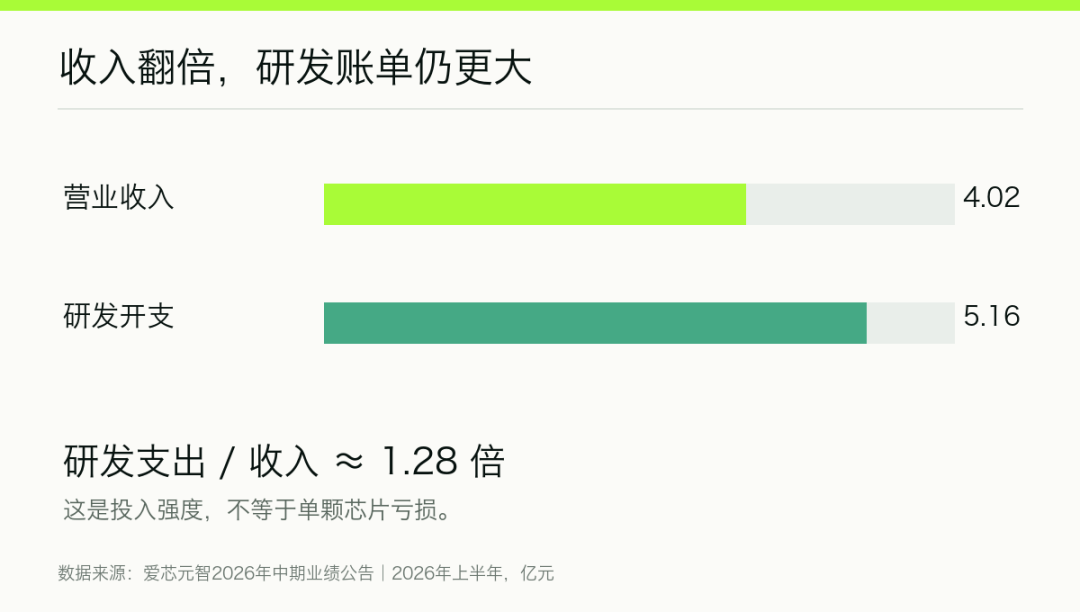
Original Data Chart | Comparison of Revenue and R&D in the First Half of 2026; Data Source: AXERA's Interim Results Announcement on the Hong Kong Stock Exchange
Qiu Xiaoxin once set an ambitious goal: Assuming there are 12 million vehicles in the high-end market, she hopes AXERA will secure at least 2 million of them.
But the capital market is extremely ruthless. Investors do not factor in next-generation vehicle shipments into this year's revenue in advance; they only look at your bloody ledger today: 181.8% growth and an adjusted loss of RMB 540 million.
AXERA's riskiest decision was to forcibly bring its visual processing expertise into the far more demanding arena of intelligent driving, which requires vehicle certification and software ecosystem standards a hundred times higher.
When evaluating AXERA next year, don't count how many product launches or 5nm chips it has released. Instead, focus on three indicators: Has the M9 entered stable mass production? Has there been repeat purchases for edge AI? Has customer concentration decreased?
If the majority of revenue still comes from 80% of visual terminal devices, would you classify AXERA as a platform company or as a company still relying on camera chips to support new businesses?
Smart Vehicle Galaxy • Firsthand Observations on the Intelligent Vehicle Industry
Follow Smart Vehicle Galaxy to see the real ledger of the intelligent vehicle industry
Click 'Like' to let more peers see it · See you in the comments section
Reference Sources
[1] AXERA's 2026 Interim Results Announcement, Hong Kong Stock Exchange
[2] AXERA's Prospectus, Hong Kong Stock Exchange
[3] 'Veteran Chip Entrepreneur,' Zhidx
[4] 'AXERA's Qiu Xiaoxin: Specializing in Edge-Side Intelligent Chips,' Qiming Venture Partners/China Entrepreneur Interview
[5] AXERA's 2026 Semi-Annual Report Press Release
[6] AXERA M57 Product Launch
[7] Horizon Robotics' Journey Chip Production Exceeds 15 Million Units, Horizon Robotics
[8] AXERA M9 Series Launch
[9] AXERA IPO Review, Guosheng International
[10] Qiu Xiaoxin Responds to R&D Expenses and Losses, Caiwen
[11] AXERA's 2025 Performance and Financial Statements, Hong Kong Stock Exchange
[12] AXERA's Listing Announcement and Management Introduction
[13] AXERA Co-Founder Liu Jianwei Attends Event
[14] Qiu Xiaoxin and Automotive Head Li Hao Discuss Product Roadmap, Ijiwei
[15] Qiu Xiaoxin Interview, LatePost
[16] NuRobotics M57 Mass Production Collaboration Explanation
[17] Safety Requirements for Combined Driving Assistance Systems, Ministry of Industry and Information Technology
[18] Volkswagen China's Advanced Driving Assistance System Explanation, Volkswagen Group
[19] AXERA Computing Establishment Announcement
[20] SigmaStar Technology's 2025 Annual Report
-
![]()
Why Did Axisystems Only Earn 29.09 Million Yuan After Selling 420,000 Automotive Chips in Six Months?
-
![]()
Chery’s Globalization 3.0: What Exactly Does It Entail?
-
![]()
Why Does Apple Opt for Aluminum in Its Phone Cases? Beyond Lightness and Heat Dissipation
-
![]()
Why Is the Time Allotted for Driver Takeover More Critical When the Intelligent Driving System Disengages?
-
![]()
Capturing the Victoria Harbour Fireworks with iPhone 18 Pro Max: A Glimpse into Apple's New Imaging Philosophy
-
![]()
Final Ruling: Domestic Auto Market Fails to Capitalize on Traditional 'Golden September' as Sluggishness Persists
-
![]()
Globalization 3.0: Zhang Guibing Faces His Ultimate Challenge
-
![]()
ChatGPT Teaches Me Mahjong! OpenAI’s Smart UI Test: Revolutionizing AI Interaction