Haoon Automotive Electronics' Q3 Financial Report: Revenue Up 52%, But Quarterly Adjusted Profit Barely Reaches 2.81 Million Yuan
 11/10 2026
 555
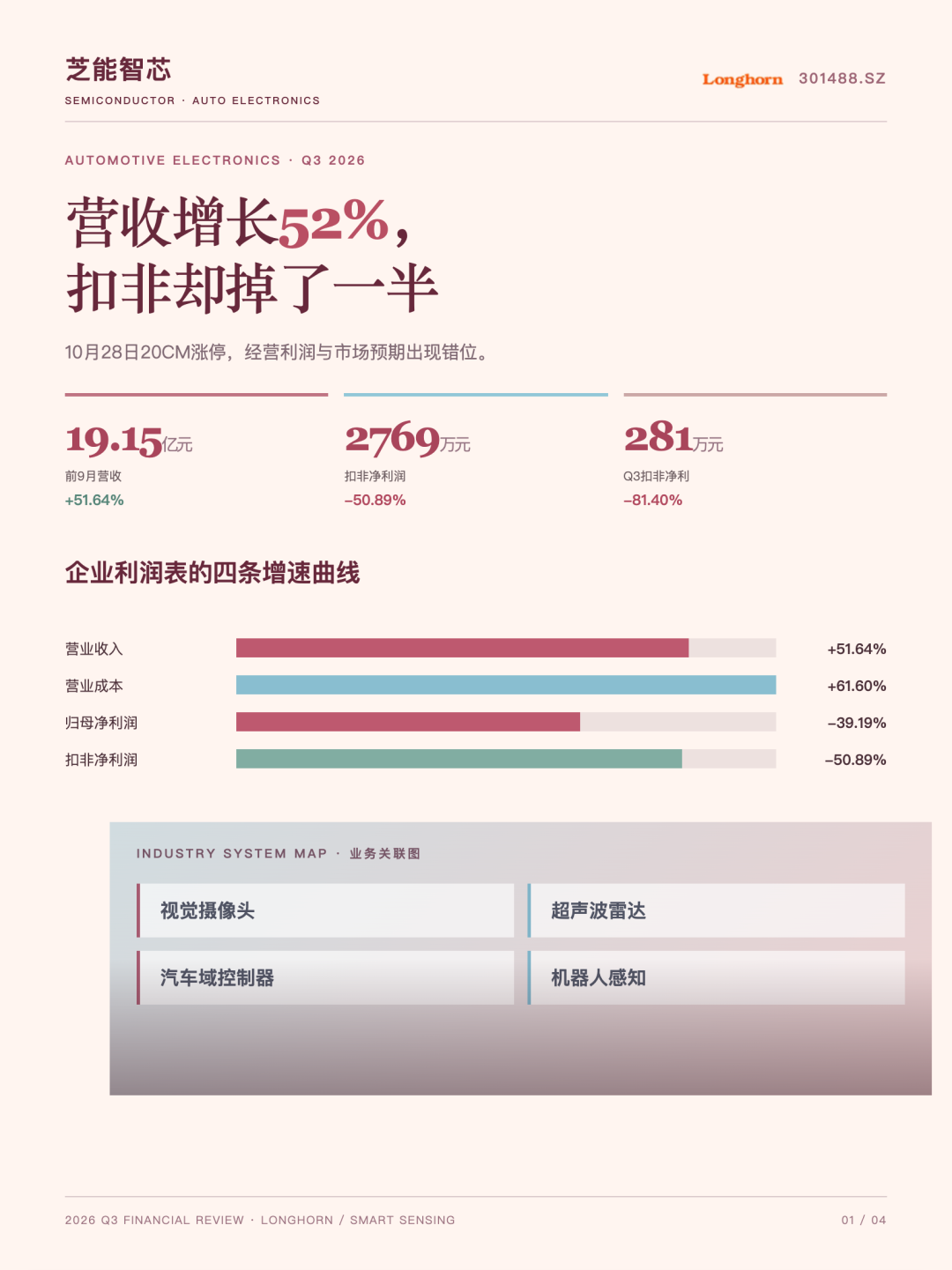
In the first three quarters of 2026, Haoon Automotive Electronics reported revenue of 1.915 billion yuan, a year-on-year increase of 51.64%. Net profit attributable to shareholders fell 39.19% year on year to 38.77 million yuan, while adjusted net profit dropped 50.89% to 27.69 million yuan.
In the third quarter alone, revenue surged 59.25%, yet adjusted profit came in at just 2.81 million yuan — a year-on-year plunge of 81.40%.
Part 1: Revenue Rose by 652 Million Yuan, While Gross Margin Fell 5.19 Percentage Points
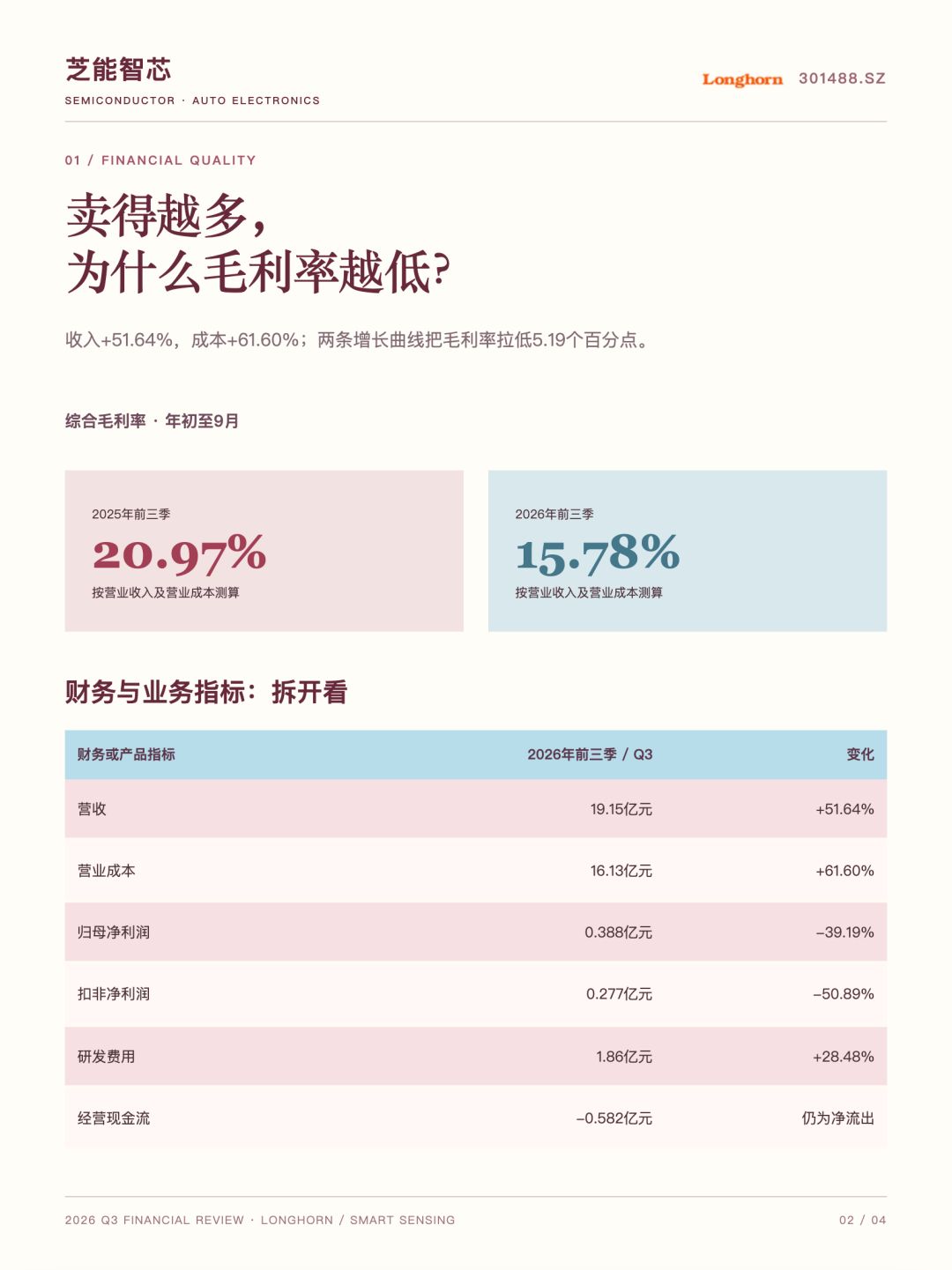
According to the third-quarter report, revenue climbed from 1.263 billion yuan in the same period last year to 1.915 billion yuan — an increase of 652 million yuan. Operating costs rose from 998 million yuan to 1.613 billion yuan, up 61.60%, notably outpacing revenue growth.
Over the first three quarters, gross margin declined from approximately 20.97% to 15.78%, a drop of 5.19 percentage points. A swing of more than five percentage points is enough to alter the full-year profit picture.
Revenue growth was indeed rapid, but the efficiency of converting newly added revenue into gross profit weakened.
On one side, perception hardware captures the increasingly widespread intelligent driving functions; on the other, it faces relentless pricing pressure from automakers and cost competition at the solution level.
Cameras, ultrasonic radar, and controllers all require image sensors, processing chips, lenses, structural components, PCBs, and extensive software calibration. Shifts in material costs and investment in new model development squeeze profits simultaneously.
Profit came under pressure in the third quarter. Rising raw material costs and a pullback in the price cycle should help gross margin recover.
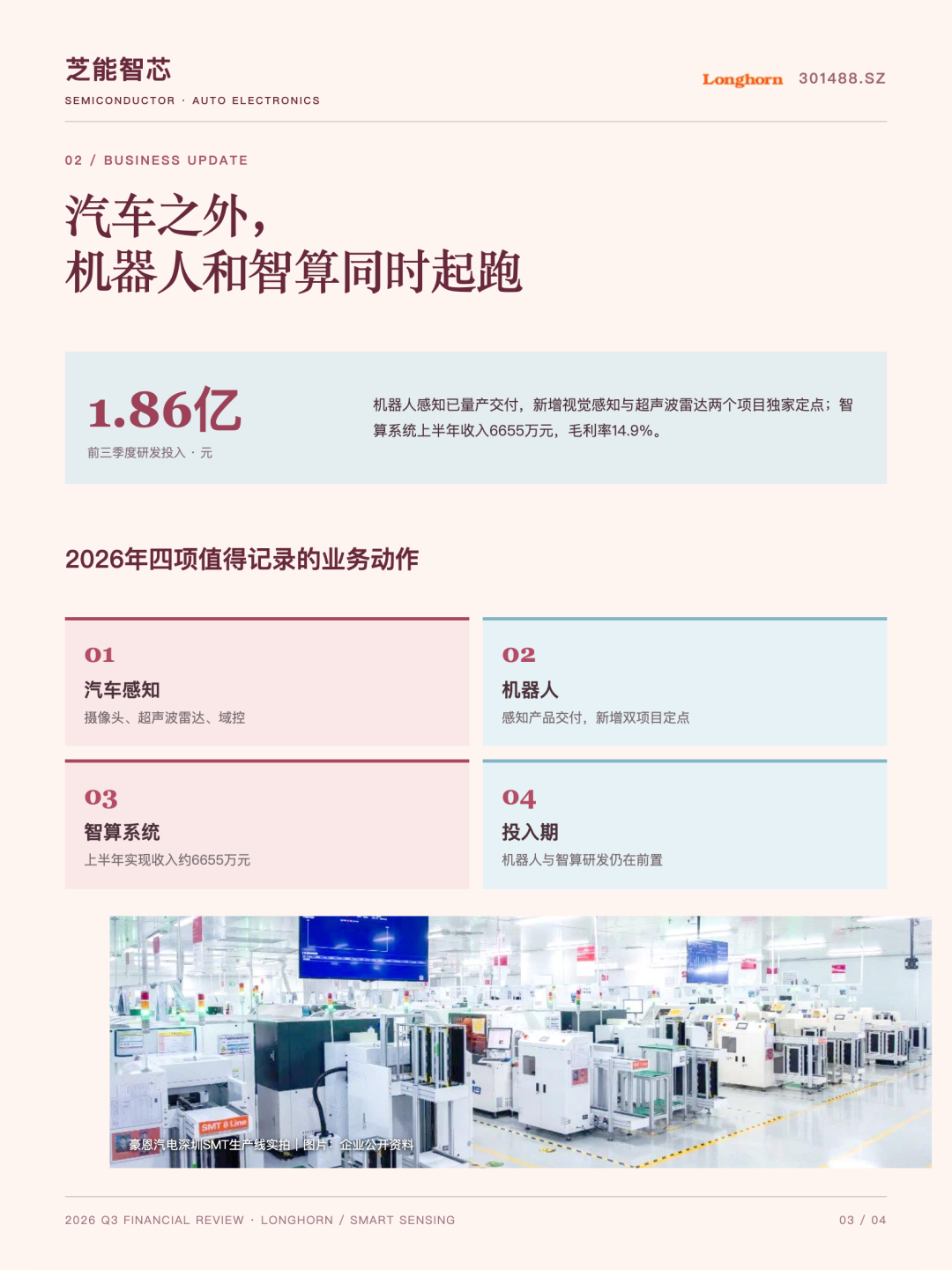
In the third quarter, revenue reached 729 million yuan; net profit attributable to shareholders was 7.87 million yuan, down 53.42% year on year; and adjusted profit totaled 2.81 million yuan. The adjusted net margin stood at roughly 0.38% — already close to the break-even line.
In the first three quarters, R&D expenses amounted to 186 million yuan, up 28.48% year on year, equivalent to 9.73% of operating revenue.
Haoon is migrating its visual perception, ultrasonic perception, and domain control capabilities into robotics, and has also launched an intelligent computing system business. R&D investment in the robot segment has yet to generate corresponding returns, and the intelligent computing business requires building a new delivery and customer system from the ground up.
While automotive orders contribute revenue, the two new business lines are burning cash first.
In the first three quarters, credit impairment losses were approximately 10.61 million yuan, and asset impairment losses were about 21.94 million yuan — both up significantly from the same period last year, involving bad debt provisions and inventory write-down provisions.
Material stocking and new product transitions both tie up cash, and rapid product iteration also exposes some inventory to the risk of price declines.
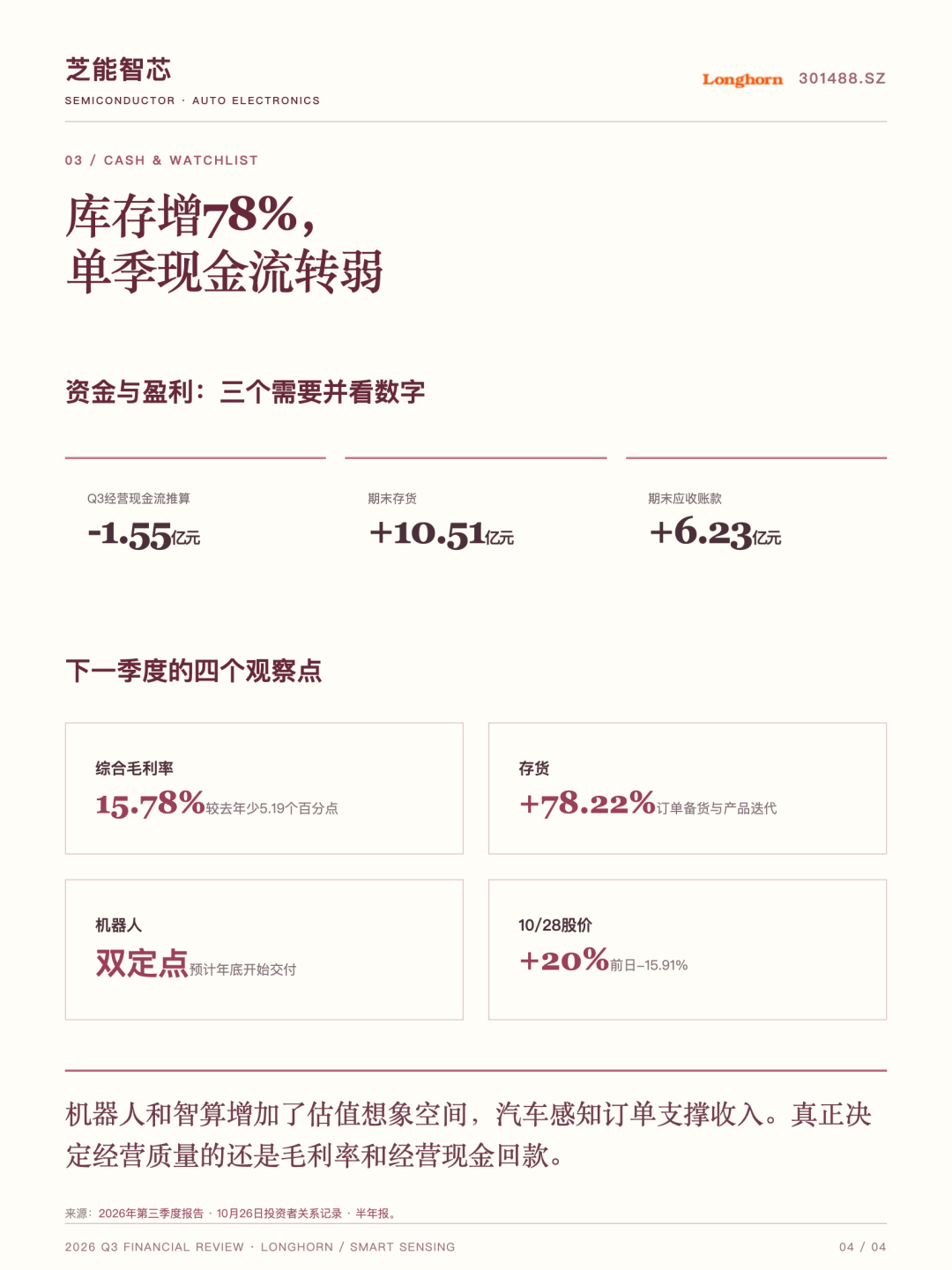
In the first three quarters, net operating cash flow was -58.15 million yuan. In the first half of the year, it was still positive at 96.798 million yuan. In the third quarter alone, net operating cash outflow was approximately 155 million yuan.
At the end of the period, inventory stood at 1.051 billion yuan, up 78.22% from 590 million yuan at the beginning of the year; accounts receivable were 623 million yuan, up 41.98% from the beginning of the year; book cash was 1.306 billion yuan, up 70.18% year on year, mainly from funds raised through private placement.
The inventory increase reflects stocking driven by a growing order book. The 1.3 billion yuan in cash came from financing, while operating activities themselves are still consuming cash.
Part 2: Robots and Intelligent Computing Have Expanded Business Boundaries, But Not Yet Profits
Robot perception products have begun mass production and delivery, and robot decision-making products have completed development.
Haoon has established partnerships with entities such as AgiBot, the Zhejiang Humanoid Robot Innovation Center, Shanghai Huazhijian, and Ant Lingbo. This year, it newly secured exclusive designations for two projects in visual perception and ultrasonic radar, with delivery expected to begin by the end of the year. The company is also developing robot data collection equipment.
Robots likewise require cameras, ultrasonic sensors, depth perception, and a certain level of edge computing capability. Automotive-grade hardware design, supply chains, and large-scale quality management can all be reused.
Robot demand is still undergoing rapid trial and error, and the degree of customization and project volatility are higher than for mature vehicle models. The unit price and gross margin per set of supporting equipment exceed those for automotive supporting equipment.
In the first half of the year, intelligent computing system revenue was approximately 66.55 million yuan, operating costs were about 56.64 million yuan, and gross margin was around 14.9% — thinner than traditional intelligent driving perception hardware.
Procurement of computing equipment, delivery cycles, customer use, and maintenance all require building a new process from scratch.
For a company still within 2 billion yuan in scale, with several business lines being rolled out simultaneously, funds all have to be advanced upfront.
Summary
Robot perception has already been delivered, new projects have obtained exclusive designations, and the intelligent computing business has begun to generate revenue. Automotive electronics companies, ultimately, still have to do something else.
-
![]()
Anthropic Gives AI Models an 'ID Card' That Even They Can't Forge
-
![]()
OFILM Reinvests in Zhongke Daojing to Drive TGV Technology into Semiconductor Packaging
-
![]()
At Least Eight Orders in a Single Year: Why Does This Optical Company Keep Receiving Repeat Orders?
-
![]()
Pupil Dilation Isn't About "Magnifying the Image"—It's About "Replicating the Exit Pupil": The Underlying Logic of Optical Waveguide Eyebox
-
![]()
When World Models Are No Longer a Selling Point, Is the Intelligent Driving Industry Entering the Era of Technology Delivery?
-
![]()
Beyond Smart Glasses, Meta Charts a New Course!
-
![]()
Over 4,000 Exhibitors and Six Attraction Strategies Across 31 Provinces: The CIIE Investment Opportunity List
-
[Insight] 2026 Global and China LDI Inner-Layer Photosensitive Circuit Ink Market Status and Major Enterprise Analysis