Pupil Dilation Isn't About "Magnifying the Image"—It's About "Replicating the Exit Pupil": The Underlying Logic of Optical Waveguide Eyebox
 11/10 2026
 419

Abstract: Optical waveguide pupil dilation does not magnify the image. Instead, it relies on gratings to repeatedly replicate the exit pupil within the waveguide, generating a larger Eyebox so that a complete image remains visible as the eye moves.
One-dimensional and two-dimensional pupil dilation each come with their own trade-offs. PVG polarization multiplexing enables bilateral pupil dilation from a single light engine, and the transition zone design directly determines image brightness uniformity. When it comes to AR optical waveguides, "pupil dilation" is a keyword that comes up again and again in the industry.
But many people misunderstand it: does pupil dilation mean magnifying the image? No. Image size is determined by the FOV (field of view); pupil dilation does not change image size.
What pupil dilation truly addresses is the exit pupil. The light engine emits a beam through only a small aperture; once the eye moves away from this position, the image dims or even disappears entirely.
The optical waveguide relies on grating structures to repeatedly replicate this aperture within the waveguide, creating a larger viewing area so that the eye can move slightly and still see the complete image.
Exit Pupil and Entrance Pupil—the "Beam Inlet and Outlet" of an Optical System
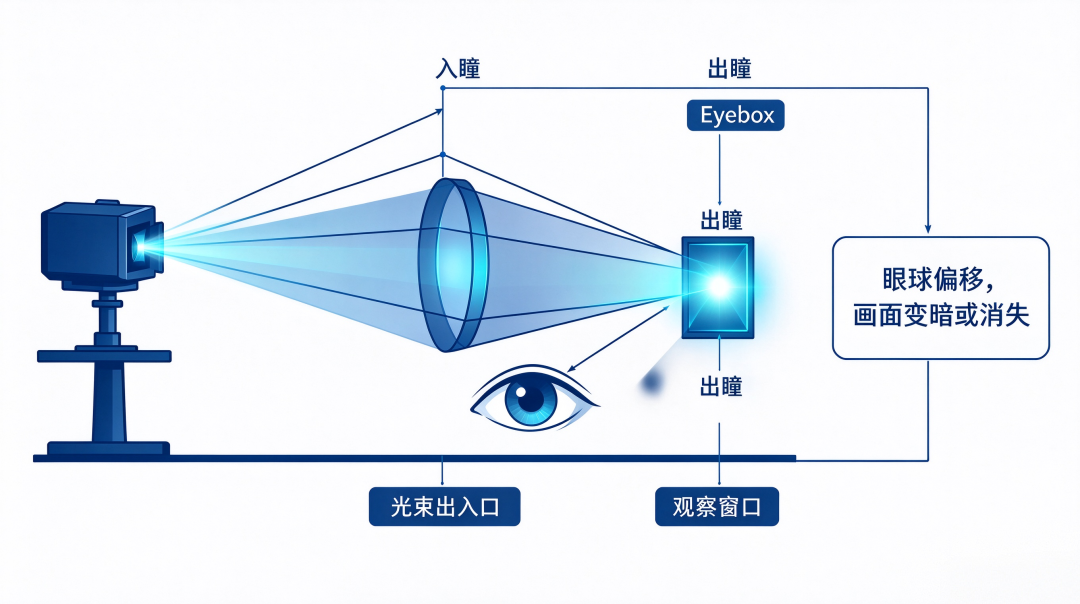
Before discussing pupil dilation, let's clarify two basic concepts. The entrance pupil is the image of the aperture stop in object space—essentially the entrance through which the beam enters the optical system.
The exit pupil is the image of the aperture stop in image space—the exit through which the beam leaves the system. In the context of AR optical waveguide glasses, the light engine has an exit pupil of fixed size, and both the position and aperture of the emitted beam are limited.
When the eye is precisely aligned with the exit pupil, the complete image is visible; once the position shifts, the image dims or even disappears. The core goal of pupil dilation is to replicate this single limited exit pupil across multiple positions.
This allows the eye to move within a larger range. This observation window available for eye movement is the Eyebox.
One-Dimensional Pupil Dilation—Unidirectional Exit Pupil Replication
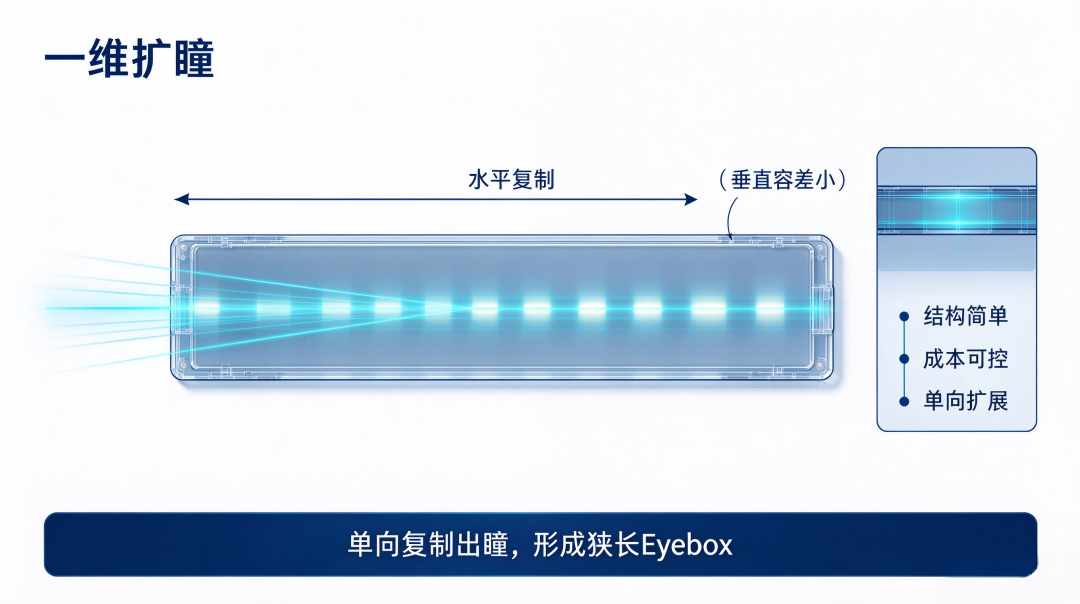
One-dimensional pupil dilation is the most basic pupil expansion scheme, completing exit pupil replication in only a single direction (mostly horizontal), ultimately forming a narrow, elongated Eyebox. A review paper from Soochow University compared various pupil dilation architectures.
The advantages of one-dimensional pupil dilation are intuitive: simple structure, low lithography processing difficulty, and easier control of mass production costs. The shortcomings are equally prominent: the expansion dimension is limited, the tolerance for vertical eye movement is very small, and a slight up-down deviation easily causes image loss.
A typical AR-HUD one-dimensional pupil dilation scheme can achieve an 80mm×15mm exit pupil, but the field of view is only 10°×5°. Such high-aspect-ratio schemes are common in automotive AR-HUDs rather than lightweight glasses.
Such schemes are suitable for scenarios with low vertical tolerance requirements. For consumer AR glasses, vertical eye movement tolerance is equally critical, making two-dimensional pupil dilation the mainstream industry approach.
Two-Dimensional Pupil Dilation—Simultaneous Exit Pupil Replication in Two Directions
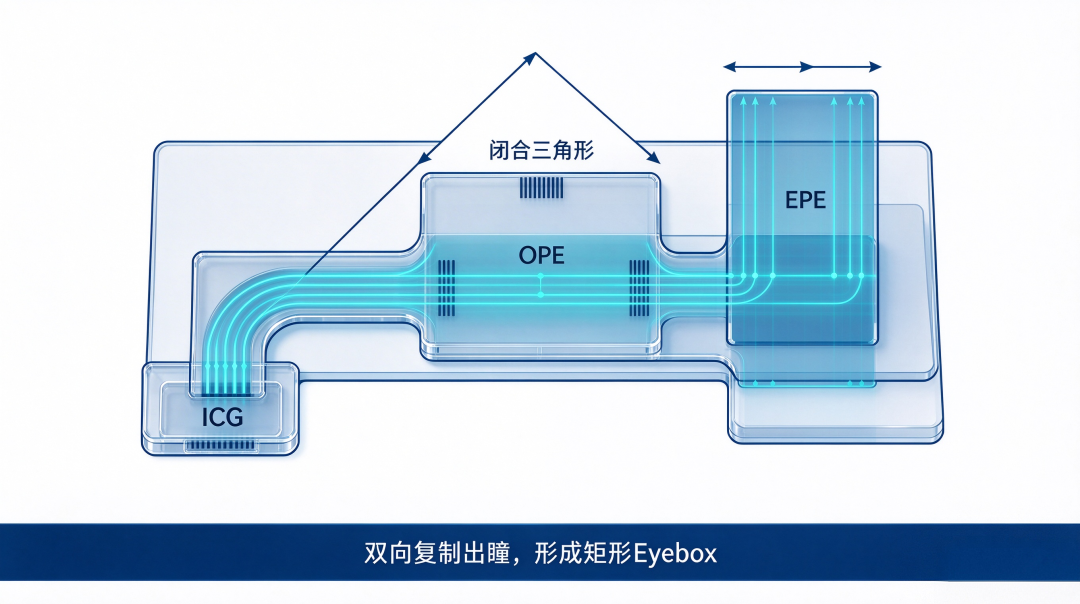
Two-dimensional pupil dilation replicates the exit pupil simultaneously in both horizontal and vertical dimensions, forming a rectangular Eyebox and providing greater room for eye movement.
Two-dimensional pupil dilation in optical waveguides relies on three types of core gratings: the in-coupling grating (ICG), responsible for coupling image light into the waveguide; the orthogonal pupil expander (OPE), which completes pupil expansion in one direction; and the exit pupil expander (EPE), which continues pupil expansion in the other direction and couples light out of the waveguide.
The vector directions of the three grating groups must form a closed triangle; otherwise, light will diverge within the waveguide or fail to reach the distal out-coupling region. This ensures that the light propagation angle remains stable.
The design complexity of two-dimensional pupil dilation far exceeds that of the one-dimensional case. The biggest engineering pain point is brightness uniformity in the out-coupling region: each time light passes through the out-coupling region, part of the energy is coupled out, and the remaining light intensity continuously attenuates, making it prone to being brighter near the in-coupling end and darker at the far end.
The industry now commonly uses transition out-coupling gratings, gradient-period gratings, and other means to smooth out the brightness differences.
PVG Polarization Multiplexing: Single Light Engine Achieves Bilateral Pupil Dilation
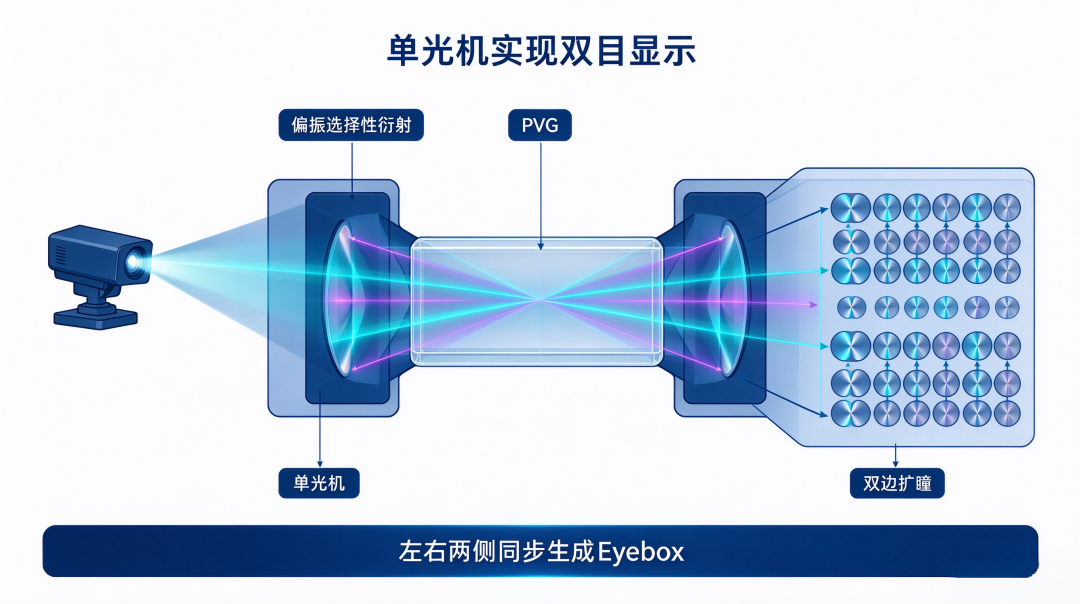
Traditional binocular AR requires two independent light engines to drive the left and right eyes separately, directly leading to increased overall device volume, higher power consumption, and greater assembly difficulty.
A team from Southeast University proposed a bilateral pupil dilation scheme based on PVG polarization volume holographic gratings, achieving binocular imaging with only one light engine.
The core characteristic of PVG is polarization-selective diffraction: efficient diffraction occurs only for circularly polarized light matching the handedness, while orthogonally polarized light is almost directly transmitted.
The research team placed PVGs of different handedness in the in-coupling region to split different circular polarization components of a single incident beam, and arranged symmetric out-coupling regions on both left and right sides of the waveguide, simultaneously achieving binocular display and two-dimensional pupil dilation.
Experimental results show that regular and stable three-dimensional diffraction dot arrays can be generated on both left and right sides of the waveguide, with exit pupil sizes of 20mm×15mm on both sides, fully presenting images with a 30° diagonal field of view, and consistent light intensity distribution for the left and right eyes.
Pupil Dilation Uniformity: The Engineering Value of Transition Zone Design
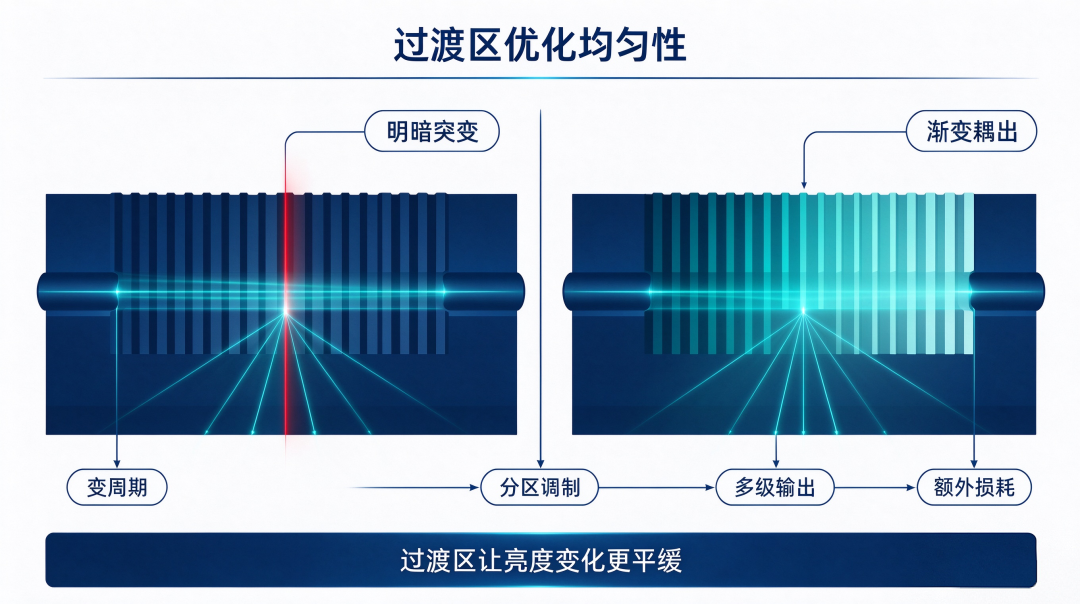
The brightness uniformity of the image after pupil dilation directly determines the viewing quality of AR glasses.
If the grating structure in the out-coupling region switches abruptly (from one-dimensional grating to two-dimensional grating), a clear bright-dark boundary will appear at the junction, and during eye movement, the image will exhibit abrupt brightness jumps.
A related patent proposes adding transition zones between different out-coupling regions, relying on multi-level transition out-coupling gratings to achieve a smooth gradient of light intensity from bright to dark, softening the abruptness.
The same review mentions that methods for optimizing pupil dilation uniformity include variable-period gratings, zone-modulated structures, and multi-level output designs.
These methods can effectively improve image uniformity, but at a cost: energy redistribution introduces additional optical loss, and overall optical efficiency decreases slightly.
Conclusion: Pupil dilation is not magnifying the image; its essence is replicating the exit pupil. One-dimensional pupil dilation addresses unidirectional eye tolerance, while two-dimensional pupil dilation enables bidirectional large-range observation;
PVG polarization multiplexing makes it feasible for a single light engine to drive both eyes; and transition zone design determines the image uniformity after pupil dilation is completed.
The size of the Eyebox determines whether users can easily capture the image; pupil dilation uniformity determines whether the viewed image quality is good. Both are entirely determined by the pupil dilation architecture design.
Discussion topic: In your AR optical waveguide design, how do you trade off between pupil dilation uniformity and optical efficiency? Feel free to share your experience in the comments.
[Risk Disclaimer] This article is for industry education purposes. The exit pupil dimensions, field of view, and experimental data cited are from public literature and are results under specific experimental conditions, not equivalent to mass production specifications; pupil dilation performance is affected by grating processes, coating systems, and light engine matching, and actual results are subject to device-level measurements.
—— AR Andy | Focused on optical waveguides and AR micro-display, providing in-depth analysis of the underlying logic of the optical industry
-
![]()
Anthropic Gives AI Models an 'ID Card' That Even They Can't Forge
-
![]()
OFILM Reinvests in Zhongke Daojing to Drive TGV Technology into Semiconductor Packaging
-
![]()
At Least Eight Orders in a Single Year: Why Does This Optical Company Keep Receiving Repeat Orders?
-
![]()
Pupil Dilation Isn't About "Magnifying the Image"—It's About "Replicating the Exit Pupil": The Underlying Logic of Optical Waveguide Eyebox
-
![]()
When World Models Are No Longer a Selling Point, Is the Intelligent Driving Industry Entering the Era of Technology Delivery?
-
![]()
Beyond Smart Glasses, Meta Charts a New Course!
-
![]()
Over 4,000 Exhibitors and Six Attraction Strategies Across 31 Provinces: The CIIE Investment Opportunity List
-
[Insight] 2026 Global and China LDI Inner-Layer Photosensitive Circuit Ink Market Status and Major Enterprise Analysis