"Silver October" Falls Flat, Exports Hold the Line: 928,000 Chinese Vehicles Sold Overseas in October
 11/10 2026
 463
In October, domestic passenger car retail sales fell 27.1%, while exports surged to 928,000 units, accounting for 35% of manufacturer wholesale. Factory output held steady, but the industry profit margin dropped to 3.3%.
Produced by Zhineng Technology
In October, China's auto market moved in two directions: domestic and overseas.
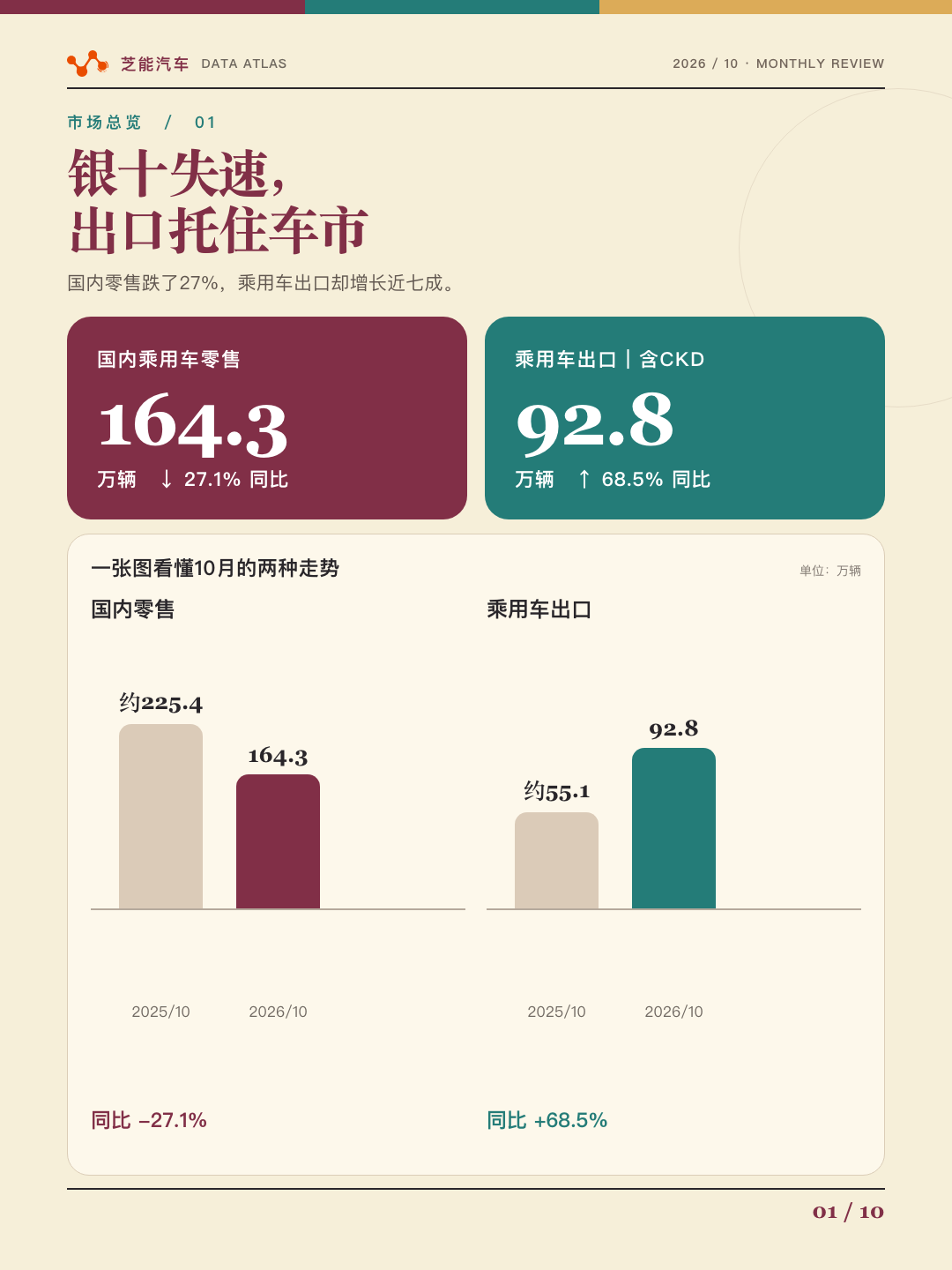
◎ Domestic passenger car retail sales were 1.643 million units, down 27.1% year-on-year and up only 1.5% month-on-month;
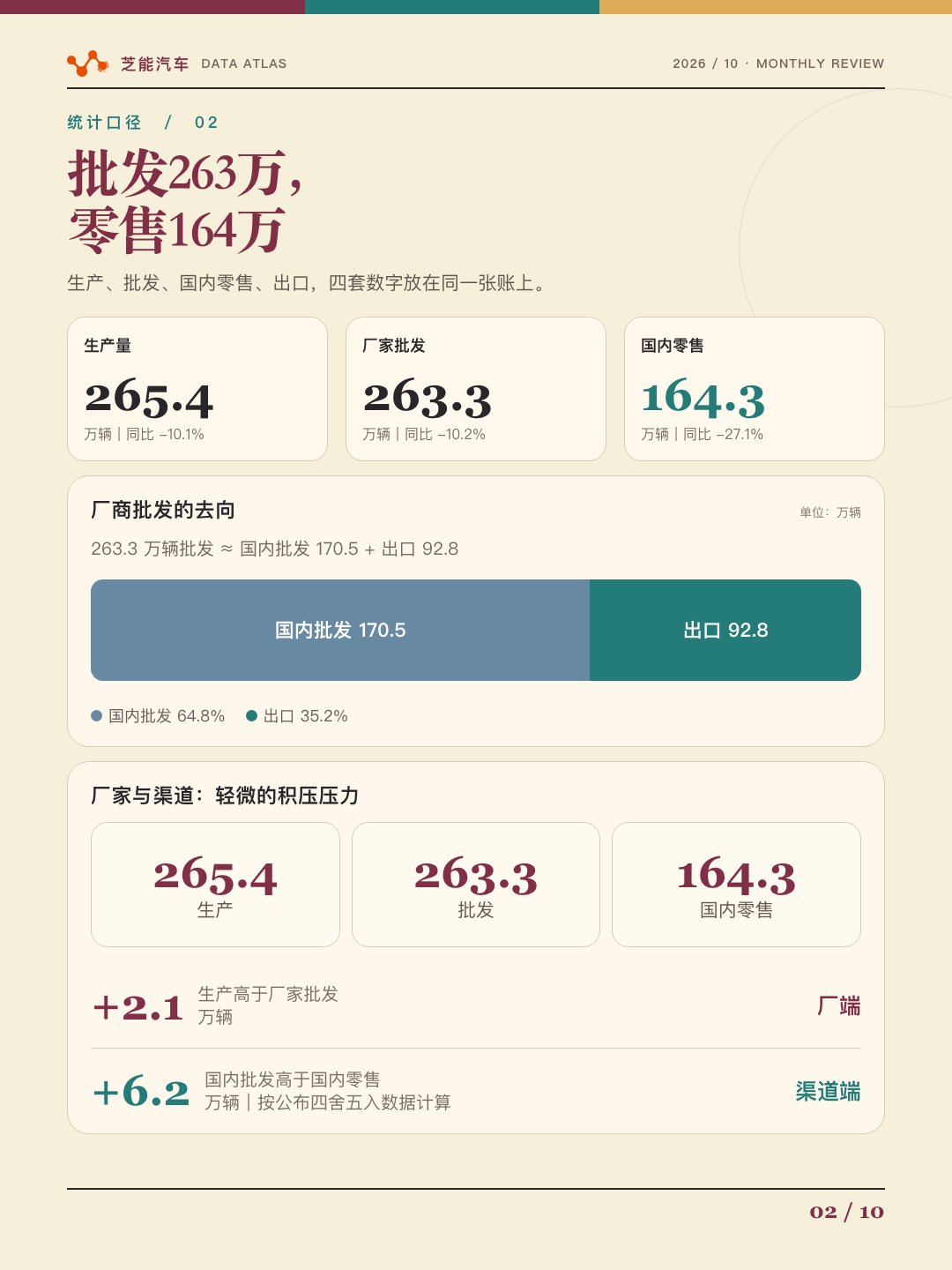
◎ Manufacturer wholesale was 2.633 million units, down 10.2% year-on-year;
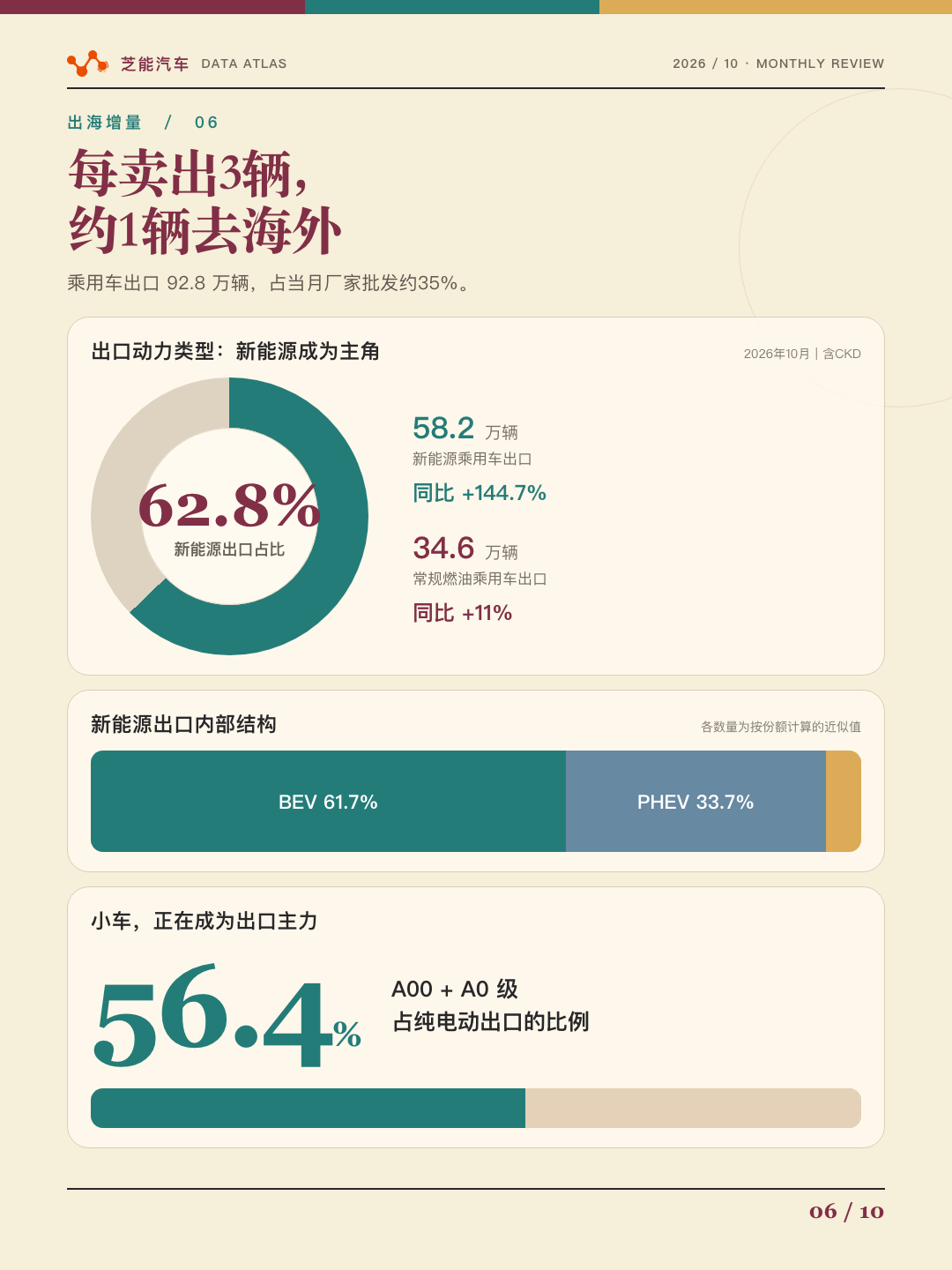
◎ Passenger car exports were 928,000 units, up 68.5% year-on-year, accounting for 35% of manufacturer wholesale, compared with 19% in the same period last year.
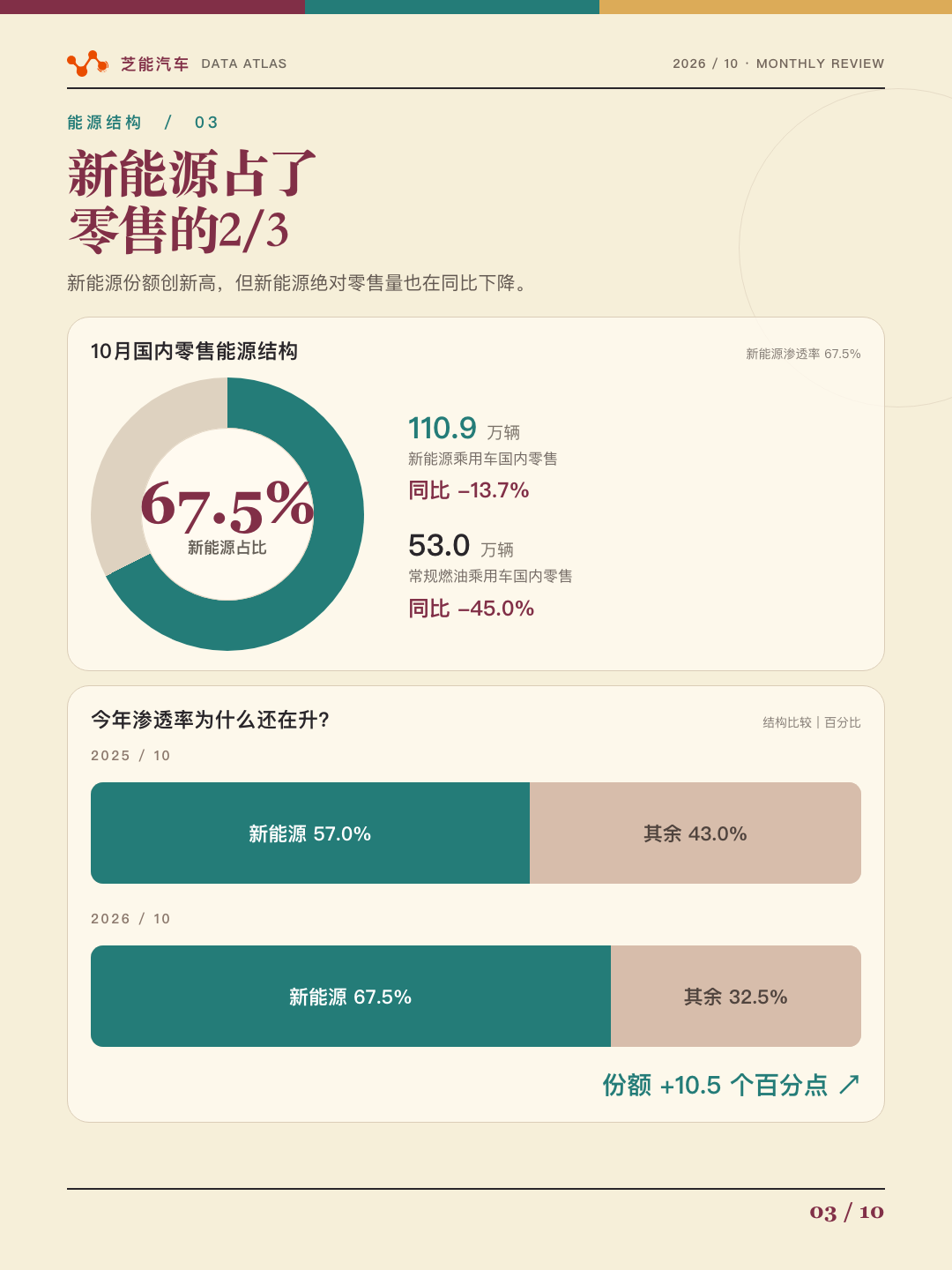
Cumulative retail sales for the first 10 months were 14.978 million units, down 22.3% year-on-year. New energy's share of domestic retail rose to 67.5%, with 1.109 million units in retail sales, still down 13.7% year-on-year.
01 Silver October Lacks Luster, New Energy Accounting for Two-Thirds Also Selling Less
October has traditionally been a peak season for auto consumption. This October, sales were only 1.5% higher than in September, and the expected peak-season growth did not materialize.
Fuel vehicles saw the largest decline. In October, conventional fuel passenger car retail sales were approximately 530,000 units, down 45% year-on-year, with pure fuel vehicles down 51%. Ordinary hybrid models grew 28% year-on-year, one of the few categories in traditional powertrains still expanding.
The first-time buyer market is also weakening, with A00-segment and A-segment economy models under more concentrated pressure.
Some local subsidies favor trade-ins, making it easier for families that already own cars to participate. Young people buying cars for the first time are more price-sensitive.
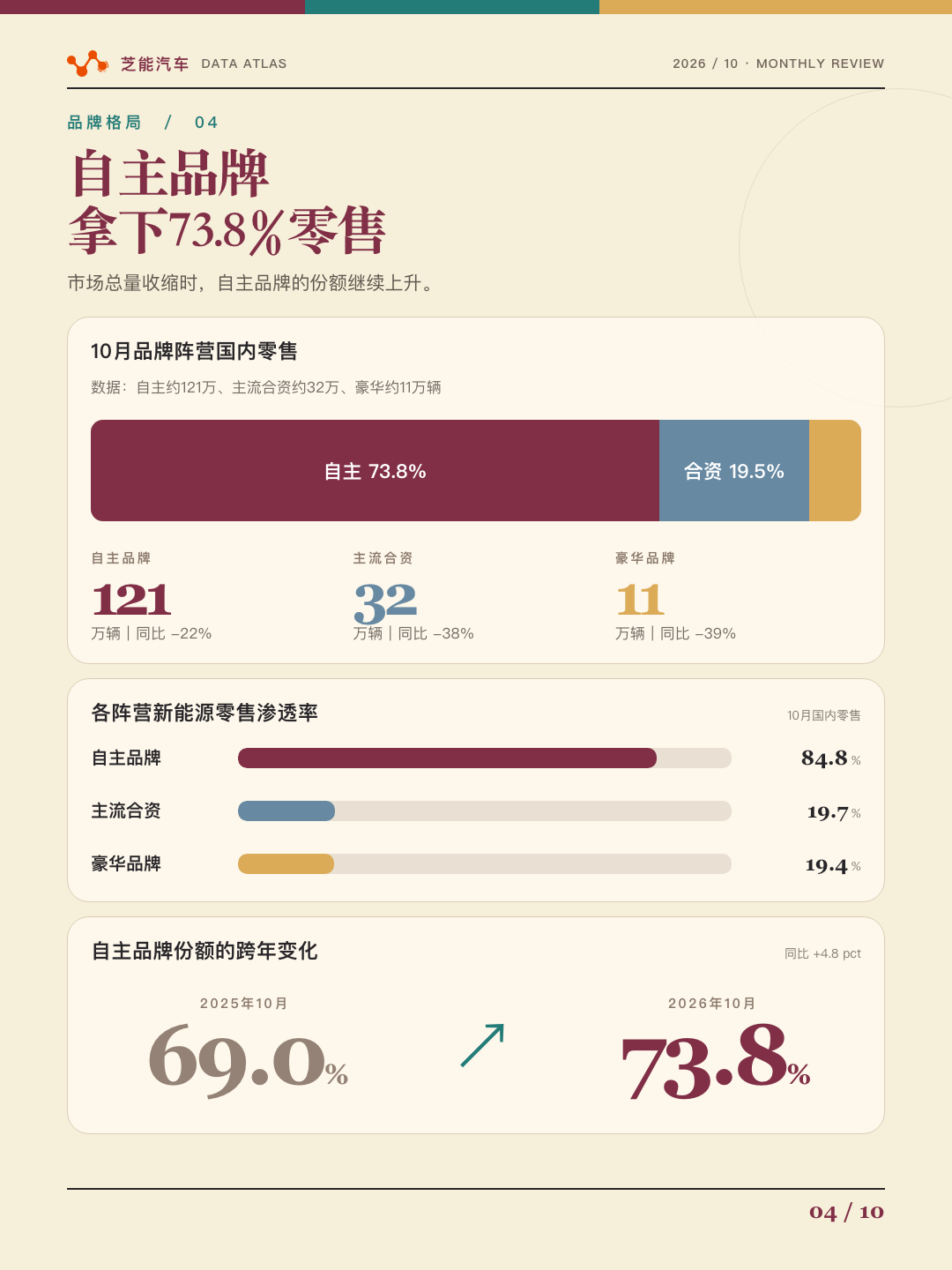
In October, independent brand retail sales were approximately 1.21 million units, down 22% year-on-year, with market share rising to 73.8%, up 4.8 percentage points from the same period last year.
Mainstream joint venture brands had retail sales of approximately 320,000 units, down 38% year-on-year; luxury brands approximately 110,000 units, down 39% year-on-year. Independent brands declined less, so their share continued to expand.
On the new energy side, October domestic retail sales were 1.109 million units, down 13.7% year-on-year and up 2.3% month-on-month, with a penetration rate of 67.5%, up 10.5 percentage points from the same period last year. For every three passenger cars sold, approximately two are new energy vehicles.
The penetration rate is rising because fuel vehicles are declining faster, while new energy retail sales are also shrinking.
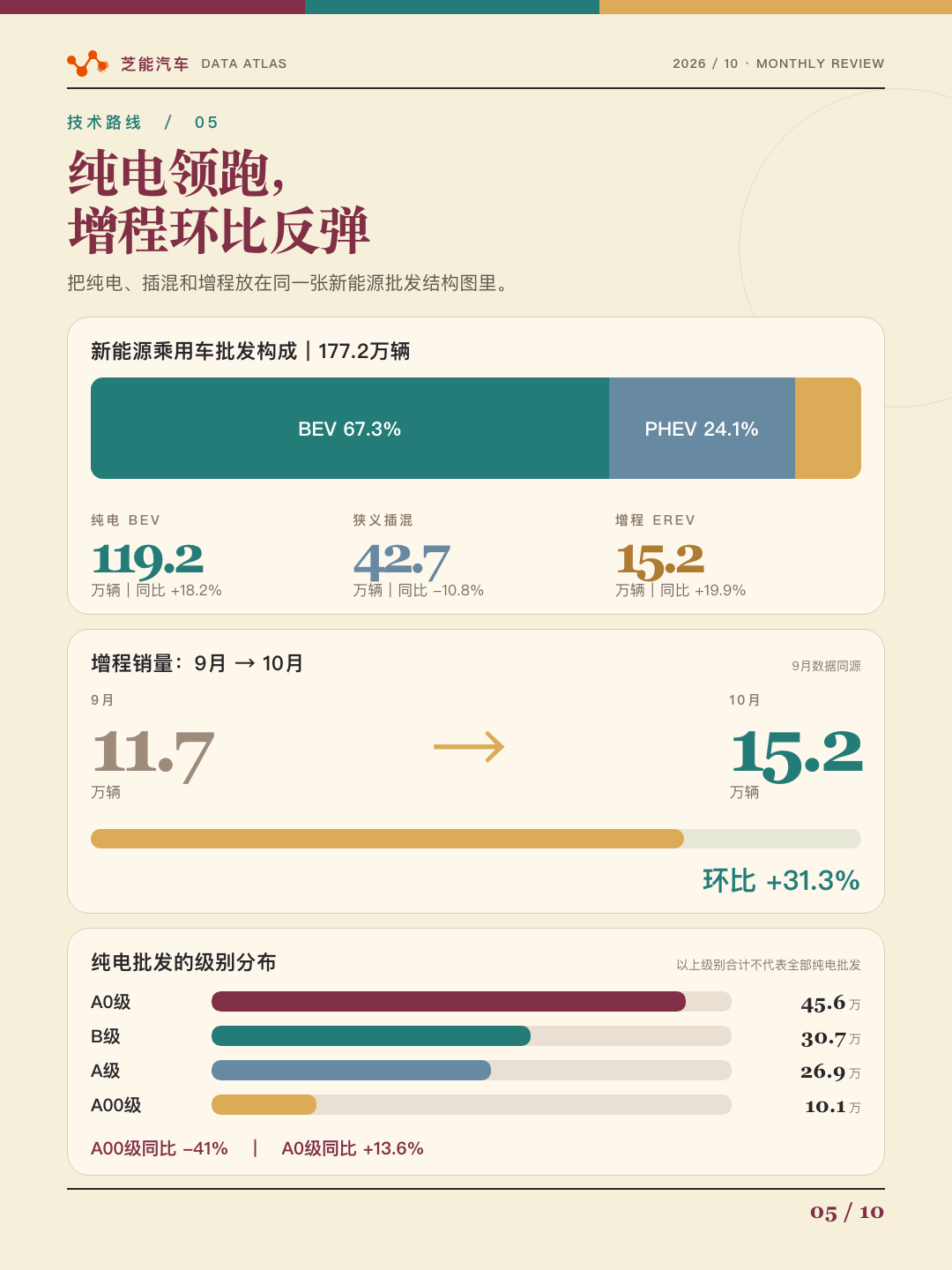
◎ October new energy passenger car wholesale was 1.772 million units, with battery electric at 1.192 million units, up 18.2% year-on-year;
◎ Narrow-sense plug-in hybrids at 427,000 units, down 10.8% year-on-year;
◎ Extended-range at 152,000 units, up 19.9% year-on-year and up 31.3% month-on-month.
Battery electric remains the largest segment, extended-range rebounded month-on-month, and plug-in hybrid is the only category among the three with a year-on-year decline.
In October, A0-segment battery electric vehicle wholesale was 456,000 units, up 13.6% year-on-year; A00-segment was only 101,000 units, down 41% year-on-year. Despite both targeting affordability, consumer expectations for body space, range, fast charging, and comfort features have changed.
New energy penetration in independent brands' domestic retail reached 84.8%, while mainstream joint venture brands were at approximately 19.7%.
02 Exports Kept Factories Running, But Profits Did Not Follow
Domestic retail fell 27.1%, while manufacturer wholesale only fell 10.2%.
October wholesale was 2.633 million units, production was 2.654 million units, domestic wholesale was 1.705 million units, and exports were 928,000 units (including complete vehicles and CKD), up 68.5% year-on-year, accounting for 35% of manufacturer wholesale, compared with only 19% in the same period last year.
For every 100 passenger cars wholesaled by manufacturers, approximately 35 are shipped overseas.
Export growth mainly came from new energy.
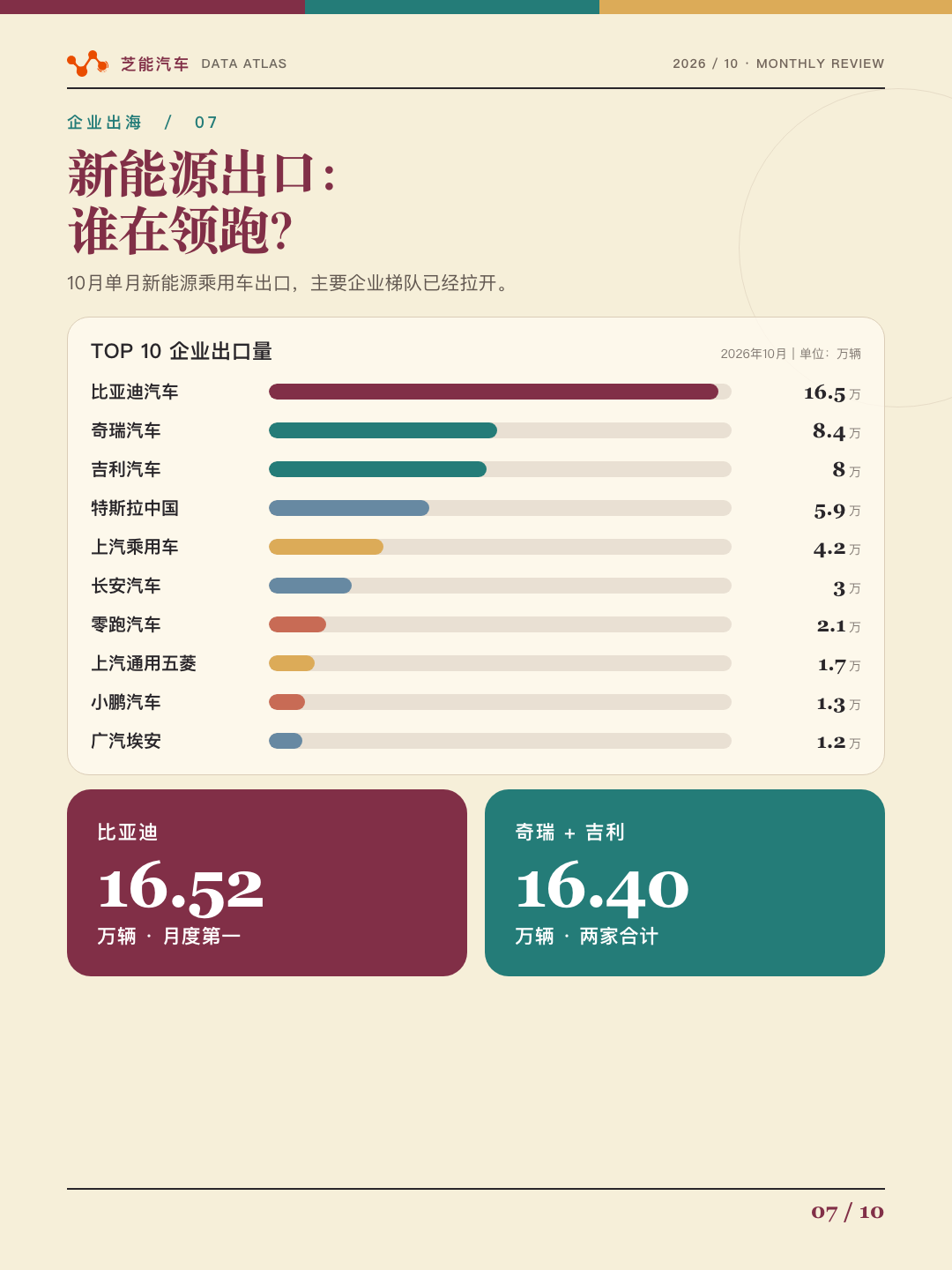
◎ October new energy passenger car exports were 582,000 units, up 144.7% year-on-year, accounting for 62.8% of total passenger car exports;
◎ Conventional fuel passenger car exports were 346,000 units, up 11% year-on-year.
Among new energy exports, battery electric accounted for 61.7%, plug-in hybrid 33.7%, and extended-range 4.6%. A00 and A0 segments accounted for 56.4% of battery electric exports, with small cars becoming the main export force.
In October, BYD's new energy passenger car exports were approximately 165,200 units, Chery approximately 83,800 units, Geely approximately 80,100 units, Tesla China approximately 59,000 units, and SAIC Passenger Vehicle, Changan, Leapmotor, and Wuling each had their own export scale.
Great Wall, SAIC-GM-Wuling, and SAIC Passenger Vehicle are still using CKD to build overseas assembly networks.
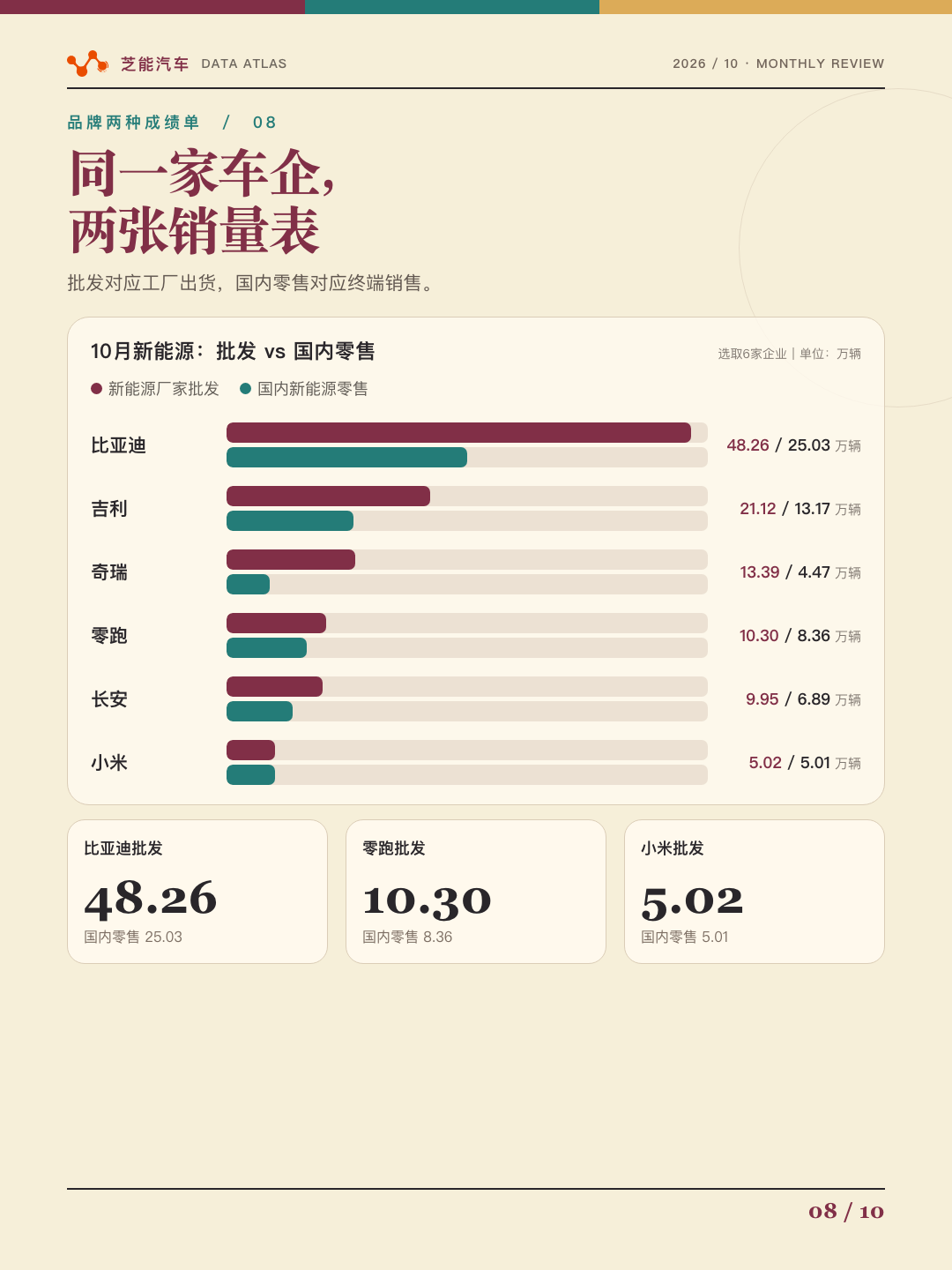
Looking at wholesale and domestic retail separately, the same automaker has two different report cards.
In October, BYD's new energy wholesale was 482,600 units versus 250,300 units domestic retail; Geely 211,200 versus 131,700; Chery 133,900 versus 44,700; Leapmotor 103,000 versus 83,600.
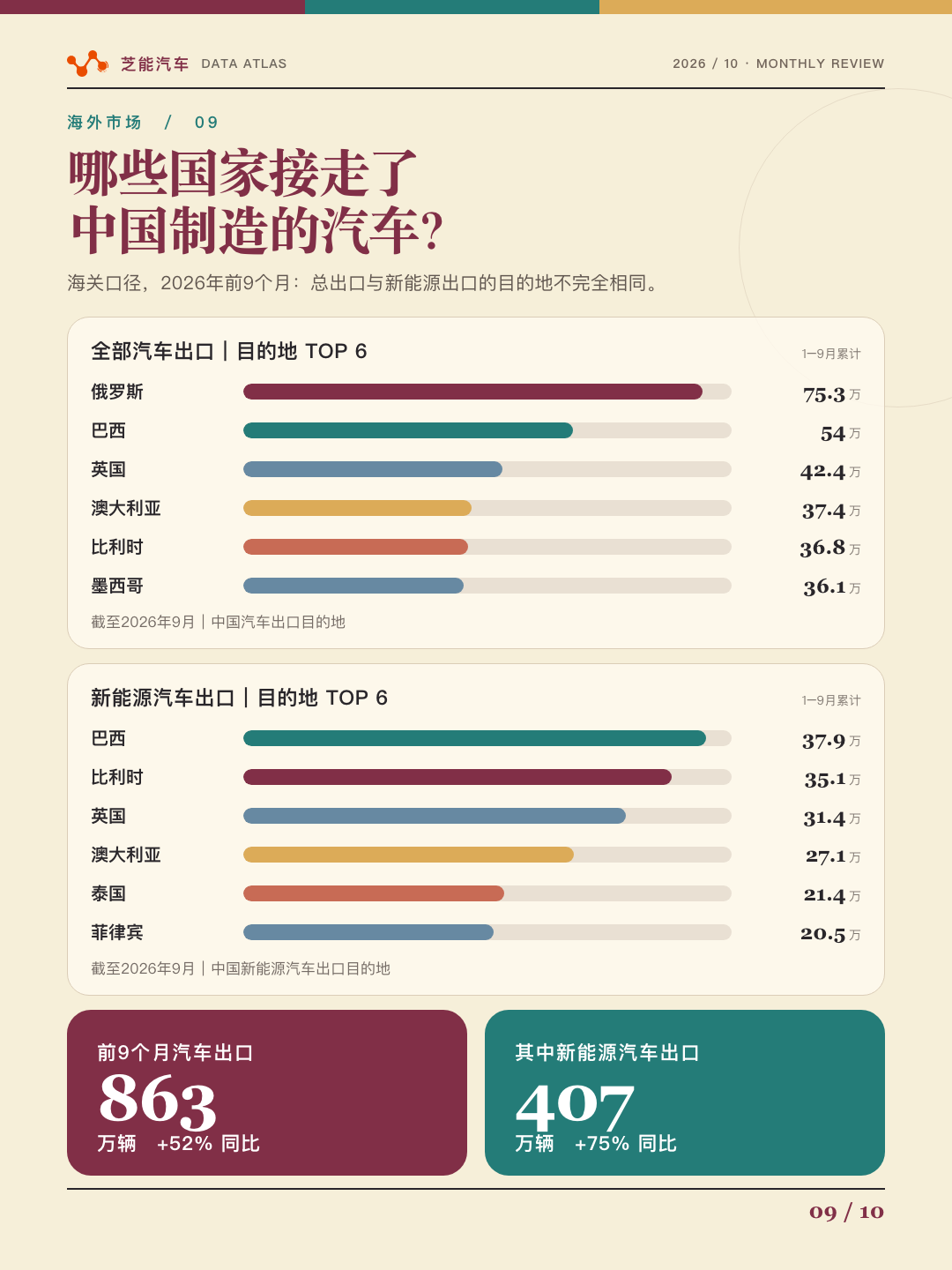
In terms of export destinations, from January to September cumulative exports ranked top three: Russia 753,000 units, Brazil 540,000 units, and the UK 424,000 units. The top two new energy export destinations were Brazil at 379,000 units and Belgium at 351,000 units.
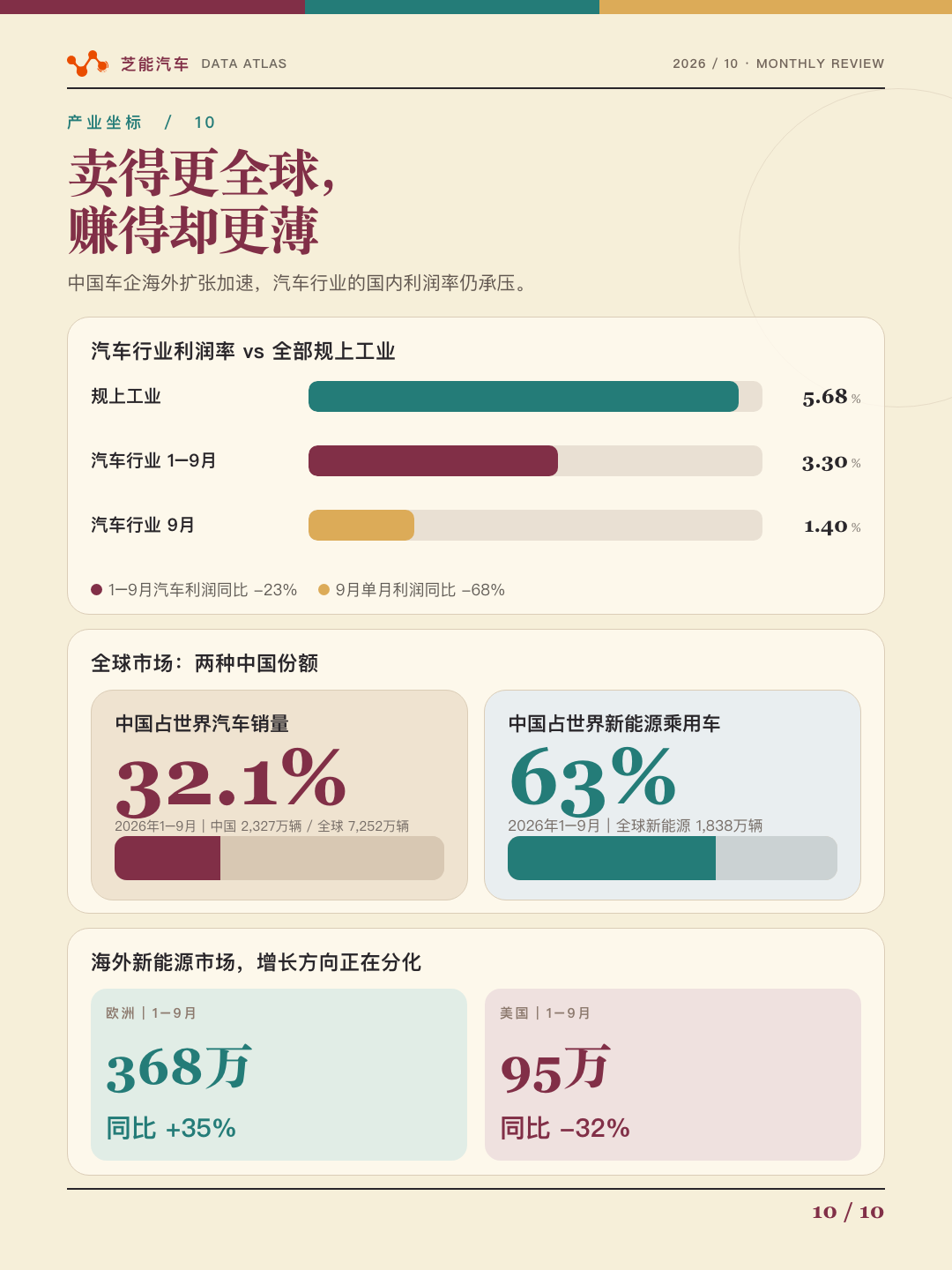
In the first nine months of this year, China's automotive industry revenue was 8,043.5 billion yuan, up 2.6% year-on-year; costs were 7,162.7 billion yuan, up 3.8% year-on-year; profit was 267.5 billion yuan, down 23% year-on-year, with the sales profit margin dropping to 3.3%.
For September alone, industry profit was 14.2 billion yuan, down 68% year-on-year, with a sales profit margin of only 1.4%. Revenue is still growing, but costs are rising faster. Wholesale scale held steady, but profitability did not rise in tandem.
Summary
Domestic dealers are also under pressure. When retail is weak, inventory ties up capital, while store rent, personnel, and after-sales costs remain unchanged. As manufacturers push volume at year-end, inventory still needs to be absorbed by the channel.
Exports kept factory scale afloat, but could not sustain the 3.3% sales profit margin.
-
![]()
Anthropic Gives AI Models an 'ID Card' That Even They Can't Forge
-
![]()
OFILM Reinvests in Zhongke Daojing to Drive TGV Technology into Semiconductor Packaging
-
![]()
At Least Eight Orders in a Single Year: Why Does This Optical Company Keep Receiving Repeat Orders?
-
![]()
Pupil Dilation Isn't About "Magnifying the Image"—It's About "Replicating the Exit Pupil": The Underlying Logic of Optical Waveguide Eyebox
-
![]()
When World Models Are No Longer a Selling Point, Is the Intelligent Driving Industry Entering the Era of Technology Delivery?
-
![]()
Beyond Smart Glasses, Meta Charts a New Course!
-
![]()
Over 4,000 Exhibitors and Six Attraction Strategies Across 31 Provinces: The CIIE Investment Opportunity List
-
[Insight] 2026 Global and China LDI Inner-Layer Photosensitive Circuit Ink Market Status and Major Enterprise Analysis