The 'Business Strategy' Behind AI-Generated Pornographic Content and Video Generation Models
 04/15 2026
 516
516

Alibaba Enters the Fray, Intensifying Competition in Video Generation Models
Recent headlines have been dominated by the AI video sector, with events such as the shutdown of Sora, Alibaba's 'HappyHorse' making a breakthrough, and Lib TV AI video being exposed for 'pornographic content'.
Following Open AI's announcement of Sora's shutdown, Alibaba's newly launched 'HappyHorse' video model has unexpectedly surged to the top of the leaderboard on the evaluation platform Artificial Analysis, outperforming leading models like Seedance 2.0 and Kling 3.0, drawing significant industry attention.
With Alibaba disrupting the AI video generation sector, competition among major players has once again intensified. Some video practitioners have noted that their pace of learning new products cannot keep up with the speed of product iteration.
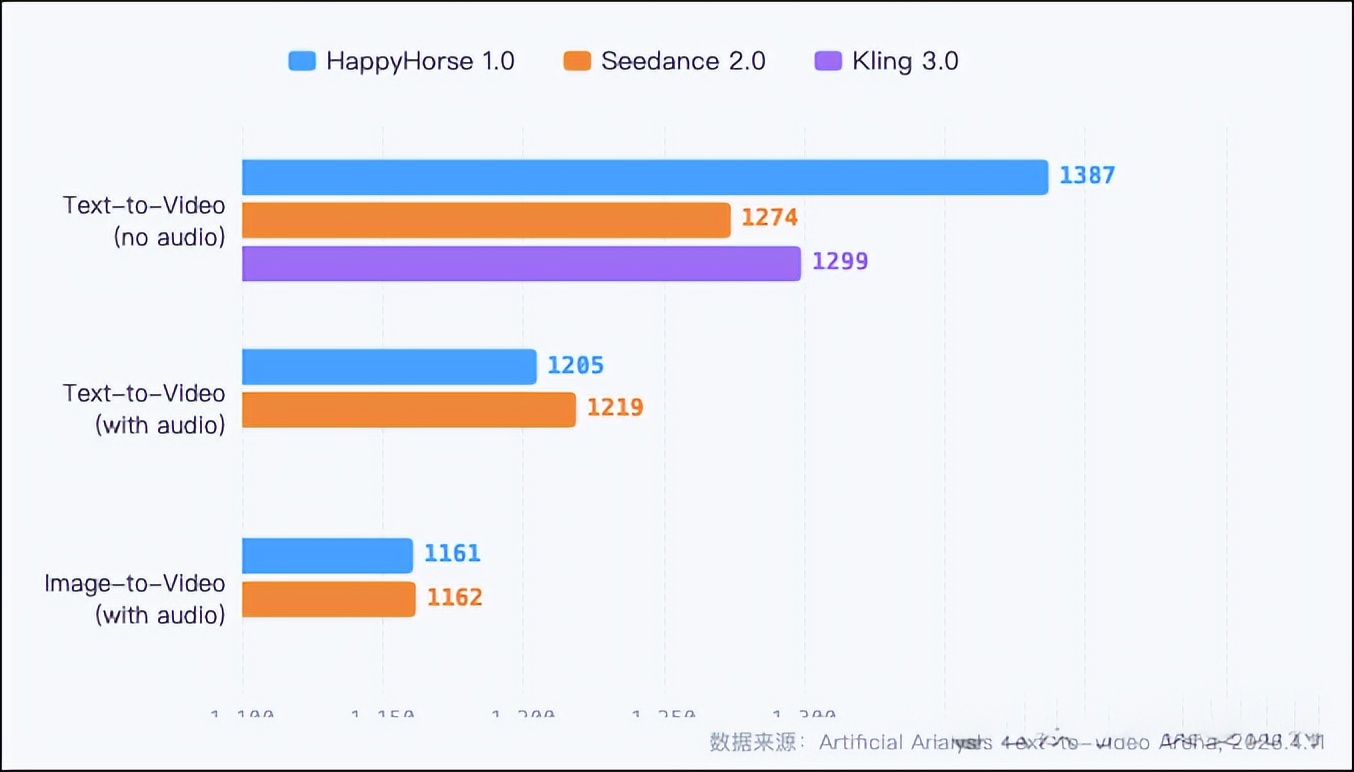
Image Source: Artificial Analysis
'Qujie Business' has observed that amid fierce competition in upstream model technology, a new generation of AI-era 'CapCuts' is rapidly emerging. Leveraging models from major players, these platforms are quickly monetizing and becoming hot investment targets in the current video wave. However, they also bring increased compliance and infringement concerns.
01. Alibaba Disrupts the AI Video Sector
Before Alibaba's 'dark horse' emerged, Seedance 2.0 and Kling were popular products in the video creation industry, especially in anime and drama creation.
In this context, HappyHorse quickly garnered attention from a large number of film and television practitioners after achieving a high score on the evaluation leaderboard. According to Alibaba's official information, HappyHorse is a model developed by the innovation division of Alibaba's ATH business group. Currently, the model is in beta testing and will open its API on April 30. Many users have found through blind testing that 'HappyHorse' significantly outperforms general models in terms of character consistency and environmental details, placing it in the top tier.
However, many users and practitioners believe that HappyHorse is not yet capable of 'overthrowing' Seedance 2.0. On one hand, Artificial Analysis's scoring system favors models that excel in 'portrait generation,' making it easier for them to achieve high scores. Additionally, the blind testing mechanism carries the risk of score manipulation, as models can be optimized for specific evaluation metrics to improve rankings. Whether they can maintain stable complex details in real-world production environments is another matter. Some users have pointed out issues in HappyHorse videos released by Artificial Analysis, such as object distortion during rapid movement and inconsistent video quality.

Image Source: Weibo Screenshot
The emergence of new tools always brings prosperity to the creative ecosystem. Whether 'HappyHorse' can surpass its competitors or not, it is beneficial for video practitioners.
'Qujie Business' has noticed that despite Alibaba's repeated emphasis that 'HappyHorse' has not yet opened for public testing, a large number of film and television practitioners are still lining up for beta access. There has even been an emergence of video generation websites that have already integrated HappyHorse, claiming to be 'channel partners' with official collaboration channels. Searching for HappyHorse on search engines also reveals fake official websites that have been preemptively registered. Some users only realize after recharging for the experience that these are not the genuine 'HappyHorse.'
This eagerness to embrace new tools is related to the current technological dominance of Seedance 2.0. Relying on Seedance 2.0, Jiemeng has continuously raised its prices over the past month. Some short drama practitioners have found that the computational cost per second of video has increased by 6 to 8 times after Jiemeng's price hike. Other practitioners lament, 'Profits are being severely compressed, and it's becoming untenable. We're just hoping that competition among major players will drive prices down.'
02. Model 'Middlemen' Profit Quietly
The escalation of competition among upstream models has indirectly sparked a entrepreneurial boom in downstream AI video platforms.
'Qujie Business' has observed that in just over a year, dozens of video generation tool platforms have emerged domestically, with many securing tens or even hundreds of millions of yuan in funding.
These platforms are characterized by integrating models from multiple vendors, allowing simultaneous access to models like Kling and Seedance 2.0, thus avoiding the hassle of switching between web pages and multiple recharges. Examples include Lib TV (an AI video creation platform launched by Lib TV AI), Paiwo AI, Flova, and Tap Now, all of which are aggregation platforms following this approach.
To compete with Jiemeng and Kling for users, these platforms often offer more specialized features. For instance, Lib TV's 'storyboard analysis' after video generation has been praised by many creators. This feature provides a storyboard script on the canvas simultaneously, making it easier to fine-tune each frame. In 'infinite canvas' mode, text, video, and music modifications can be made simultaneously, and a convenient workflow can be saved for reuse.


Image Source: Lib TV, Flova Screenshots
In terms of pricing, these platforms charge based on usage quotas, similar to Jiemeng and Kling, with annual membership prices for professional creators ranging from around 1,500 to 3,000 yuan. Many short drama and e-commerce advertising teams have already adopted these aggregation platforms as their primary creative tools.
An industry insider in digital media stated that the current flourishing of AI video tools is essentially because many AIGC needs cannot be met by a single tool. 'For example, I am accustomed to using Tap Now for storyboarding before generating images and videos with Gemini and Doubao. Then, I upload them to Tap Now to utilize its unique multi-angle conversion and image modification features.'
Standing on the shoulders of giants to 'sell shovels' is indeed a more relaxed business than training large models from scratch. According to data disclosed by various parties, Lib TV has surpassed 100 million global user visits. Aishi Technology, the company behind Paiwo AI, has an annual recurring revenue (ARR) exceeding $40 million in 2025, with product subscriptions covering costs.
However, the 'value' of these applications has always been controversial due to their lack of self-developed models.
'Qujie Business' has noticed that currently, the selling point of these platforms is still 'large models.' Recently, Lib TV launched a wave of advertisements on Bilibili and WeChat Official Accounts, emphasizing its access to a no-queue, full-version Seedance 2.0. The person in charge of AI tools at a certain listed company stated that once HappyHorse is launched, they will also integrate it into their tools at the first opportunity.
A venture capitalist focusing on hard technology bluntly stated that the moat for AI aggregation platforms is shallow. Once major players open their APIs, lower prices, or launch native applications with better experiences, these platforms can be easily replaced. More critically, given the current 'intensity' and speed of model iteration, the differentiated advantages of these aggregation platforms are quite fragile. Features polished over half a year may be rendered obsolete by a single model update.
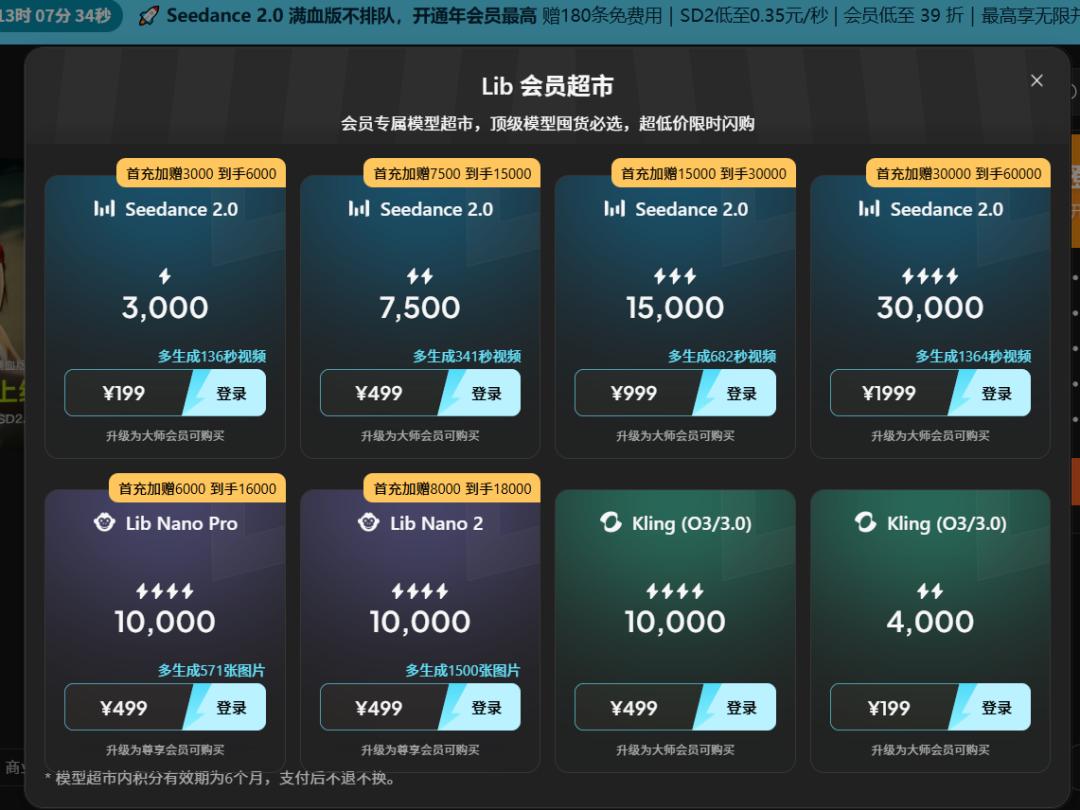
Image Source: Lib TV Screenshot
Although the uncertainty of 'profit prospects' is high, top investment institutions are still keen to bet on these platforms. 'Qujie Business' has observed that many AI video tools have not lacked funding since their inception. Qidian Xingyu, the company behind Lib TV AI, completed a $130 million Series B funding round in the second half of last year, co-led by Sequoia China, CMC Capital, and a strategic investor. In March this year, Aishi Technology, the company behind 'Paiwo AI,' completed a Series C funding round exceeding $300 million, led by CDH Investments, setting a new record for single-round funding in China's video generation sector.
Behind the lively financing scene is also related to the founders' backgrounds. The founders of Lib TV AI, Chen Mian, the founder of Aishi Technology, Wang Changhu, the founder of oiioii (an AI animation tool), Nao Nao, and the founder of ArtArch, Huang Yan, have all previously worked at ByteDance, serving as product or R&D leaders for video software-related roles.
The halo (aura/prestige) of having a background at a major company makes these founders more likely to receive capital favor than grassroots entrepreneurs. When a sector has not yet fully established a viable business model, it is hard to say whether capital truly favors the commercial potential of AI video tools or is more inclined toward these entrepreneurs with major company backgrounds who are familiar with industry rules.
03. AI Content Faces a 'Compliance' Test
Before discussing commercialization, AI video platforms face more severe compliance and content governance issues.
Firstly, there are the perennial issues of copyright and personal likeness rights infringement. Both model training and content generation by creators through platforms involve gray areas of intellectual property and likeness rights infringement. Recently, top actors such as Gong Jun, Yi Yangqianxi, and Yang Zi have publicly issued statements to protect their rights, opposing the use of their likenesses and voices to train and generate virtual images for profit through AI videos.
More tricky ( tricky /challenging) is that some AI video platforms have even become breeding grounds for producing inappropriate content such as soft pornography.
Recently, Lib TV AI was criticized by CCTV for 'generating pornographic content.' On Lib TV AI and other AI video platforms, users can generate suggestive videos featuring semi-nude, scantily clad individuals with ambiguous dance moves by modifying prompts, without triggering any platform restrictions. Some individuals even openly sell tutorials and 'prompts' for 'AI-generated suggestive videos,' claiming that they can create satisfying explicit videos with just a single image and a few sentences.

Image Source: CCTV Finance Screenshot
This reflects the lack of content governance on AI video platforms. While it may be difficult for platforms to predict the output from seemingly normal prompts, they can identify content during the export and download phase. However, suggestive videos often mean higher user retention and paid conversion rates, leading some platforms to turn a blind eye to gray content in their early stages of development.
On April 10, five departments jointly announced the 'Interim Measures for the Administration of AI Personified Interactive Services,' which will take effect on July 15, 2026. The measures clarify requirements for safety assessments and algorithm filing, while also making provisions for minors and the elderly using personified interactive services, aiming to promote healthy development and standardized application in the industry.
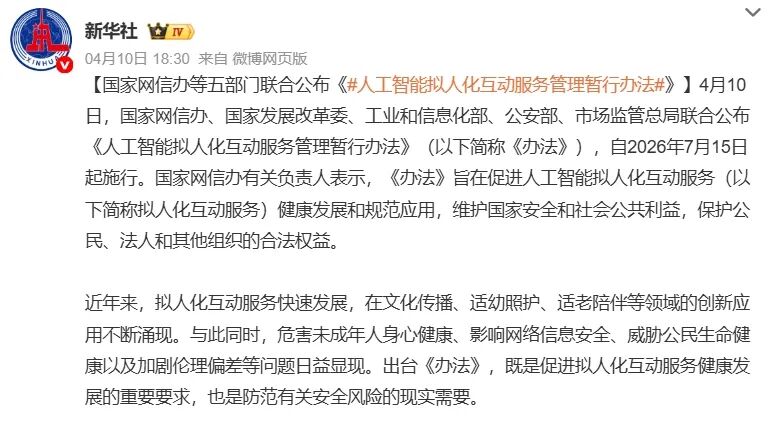
Image Source: Weibo Screenshot
After being criticized by CCTV, Lib TV AI issued a statement saying it had completed technical repairs and comprehensively blocked risky pathways at the first opportunity. Balancing commercial expansion with compliance is a question that all AI video tools, and indeed all AIGC platforms, must answer.
From 'HappyHorse's breakthrough to Lib TV AI's rectification, the AI video industry stands at a critical juncture. The arms race for upstream models continues to accelerate, while downstream platforms are just beginning their commercialization exploration, and compliance governance still needs strengthening. How model vendors can resolve copyright issues and how tool platforms can move away from model dependency to create truly irreplaceable core value are questions that must be answered in the AI era.
-
![]()
The Allure of 'Acquisition Spree': Li Shufu's Left Turn, Xu Jiayin's Right
-
![]()
Strategic Transformation Yields Results: Phoenix Optics Reports 10.9% YoY Rise in Core Net Profit for H1 2026
-
![]()
Three Key Growth Trajectories Synergize! Crystal-Optech Reports 3.478 Billion Yuan in Revenue for H1 2026
-
![]()
Semi-Annual Report Sparks XPENG Motors Buzz
-
![]()
1.6 Billion Big Order Secured! SeeYA Technology's Revenue Soars by 287.87% in the First Half of the Year
-
![]()
Baidu's Profits Plunge by 68%: Unraveling the Mystery Behind the Numbers
-
![]()
Baidu’s Profits Tumble by 68%! Where Has All the Money Gone?
-
![]()
Hynix’s Taobao Store Shuts Down Abruptly: What Should Customers Do About Warranty Services for Memory Modules?